Institute of Plant Breeding, Genetics, and Genomics, University of Georgia, Griffin Campus, Griffin, GA, USA.
Department of Crop and Soil Sciences, University of Georgia, Griffin Campus, Griffin, GA, USA.
Mol Plant Pathol. 2020 Mar;21(3):291-302. doi: 10.1111/mpp.12909. Epub 2020 Jan 21.
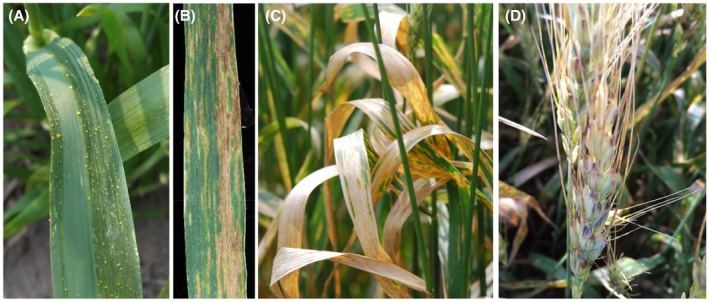
Xanthomonas translucens is a group of gram-negative bacteria that can cause important diseases in cereal crops and forage grasses. Different pathovars have been defined according to their host ranges, and molecular and biochemical characteristics. Pathovars have been placed into two major groups: translucens and graminis. The translucens group contains the pathovars causing bacterial leaf streak (BLS) on cereal crops such as wheat, barley, triticale, rye, and oat. In recent years, BLS has re-emerged as a major problem for many wheat- and barley-producing areas worldwide. The biology of the pathogens and the host-pathogen interactions in cereal BLS diseases were poorly understood. However, recent genome sequence data have provided an insight into the bacterial phylogeny and identification and pathogenicity/virulence. Furthermore, identification of sources of resistance to BLS and mapping of the resistance genes have been initiated.
Kingdom Bacteria; Phylum Proteobacteria; Class Gammaproteobacteria; Order Xanthomonadales; Family Xanthomonadaceae; Genus Xanthomonas; Species X. translucens; translucens group pathovars: undulosa, translucens, cerealis, hordei, and secalis; graminis group pathovars: arrhenatheri, graminis, poae, phlei; newly established pathovar: pistaciae.
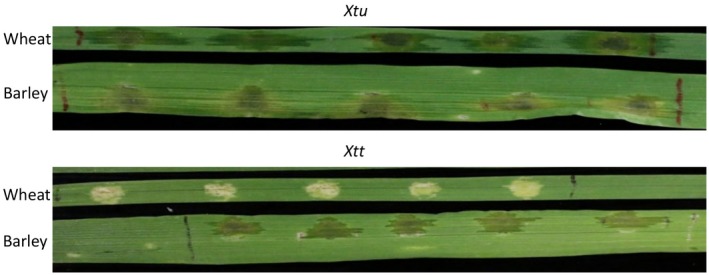
X. translucens mainly infects plant species in the Poaceae with the translucens group on cereal crop species and the graminis group on forage grass species. However, some strains have been isolated from, and are able to infect, ornamental asparagus and pistachio trees. Most pathovars have a narrow host range, while a few can infect a broad range of hosts.
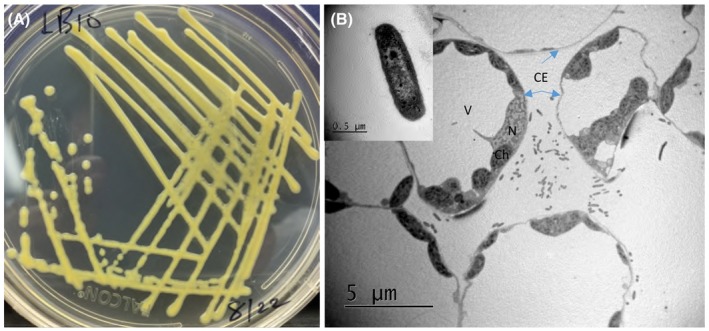
The complete genome sequence is available for two X. translucens pv. undulosa strains and one pv. translucens strain. A draft genome sequence is also available for at least one strain from each pathovar. The X. translucens pv. undulosa strain Xt4699 was the first to have its complete genome sequenced, which consists of 4,561,137 bp with total GC content approximately at 68% and 3,528 predicted genes.
Like most xanthomonads, X. translucens utilizes a type III secretion system (T3SS) to deliver a suite of T3SS effectors (T3Es) inside plant cells. Transcription activator-like effectors, a special group of T3Es, have been identified in most of the X. translucens genomes, some of which have been implicated in virulence. Genetic factors determining host range virulence have also been identified.
黄单胞菌属是一组革兰氏阴性细菌,可导致谷类作物和饲料草的重要疾病。根据其宿主范围、分子和生化特征,已定义了不同的致病变种。致病变种已分为两组: translucentens 和 graminis。translucens 组包含引起谷类作物(如小麦、大麦、黑麦小麦、黑麦和燕麦)细菌性叶斑病(BLS)的致病变种。近年来,BLS 在世界范围内许多小麦和大麦产区再次成为一个主要问题。对病原体的生物学和谷类 BLS 疾病中的宿主-病原体相互作用知之甚少。然而,最近的基因组序列数据为细菌系统发育以及鉴定和致病性/毒力提供了深入了解。此外,已经启动了对 BLS 的抗性来源的鉴定和抗性基因的定位。
细菌王国;门变形菌门;纲γ-变形菌纲;目黄单胞菌目;科黄单胞菌科;属黄单胞菌属;种 X. translucentens;translucens 组致病变种:undulosa、translucens、cerealis、hordei 和 secalis;graminis 组致病变种:arrhenatheri、graminis、poae、phlei;新建立的致病变种:pistaciae。
X. translucentens 主要感染禾本科植物物种,translucens 组感染谷类作物物种,graminis 组感染饲料草物种。然而,一些菌株已从观赏芦笋和开心果树中分离出来,并能够感染这些树。大多数致病变种的宿主范围较窄,而少数致病变种的宿主范围较宽。
两个 X. translucentens pv. undulosa 菌株和一个 pv. translucens 菌株的完整基因组序列已经可用。至少有一个菌株的基因组草图序列也可用。X. translucentens pv. undulosa 菌株 Xt4699 是第一个完成其全基因组测序的菌株,其基因组由 4,561,137 bp 组成,总 GC 含量约为 68%,预测基因 3,528 个。
与大多数黄单胞菌一样,X. translucentens 使用 III 型分泌系统(T3SS)将一套 T3SS 效应物(T3Es)输送到植物细胞内。转录激活子样效应物是 T3Es 的一个特殊群体,已在大多数 X. translucentens 基因组中被鉴定,其中一些与毒力有关。也已确定了决定宿主范围毒力的遗传因素。