Li Yuanfeng, Yang Guang, Ren Yijin, Shi Linqi, Ma Rujiang, van der Mei Henny C, Busscher Henk J
State Key Laboratory of Medicinal Chemical Biology, Key Laboratory of Functional Polymer Materials, Ministry of Education, Institute of Polymer Chemistry, College of Chemistry, Nankai University, Tianjin, China.
Department of Biomedical Engineering, University of Groningen and University Medical Center Groningen, Groningen, Netherlands.
Front Chem. 2020 Jan 8;7:861. doi: 10.3389/fchem.2019.00861. eCollection 2019.
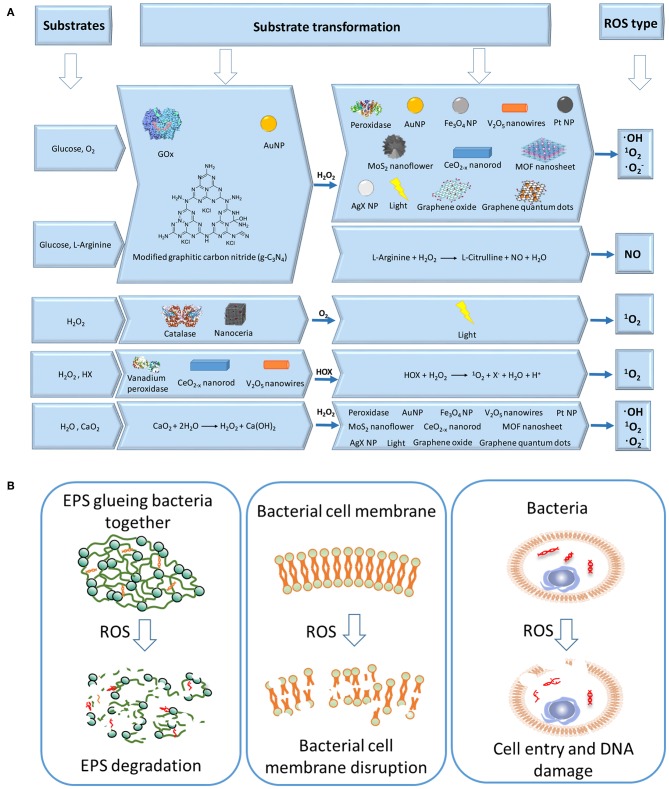
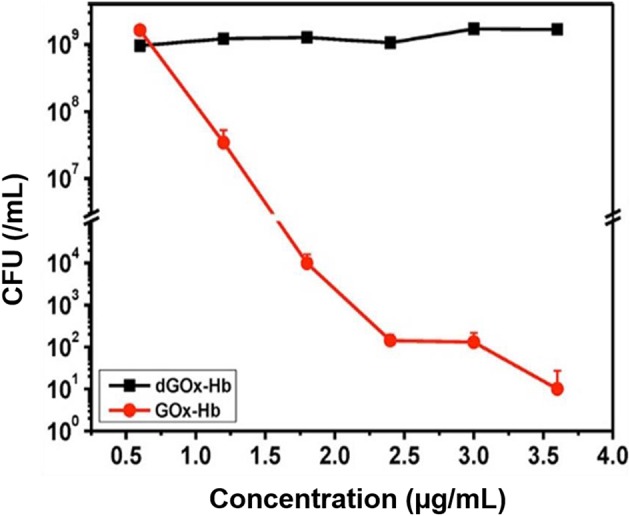
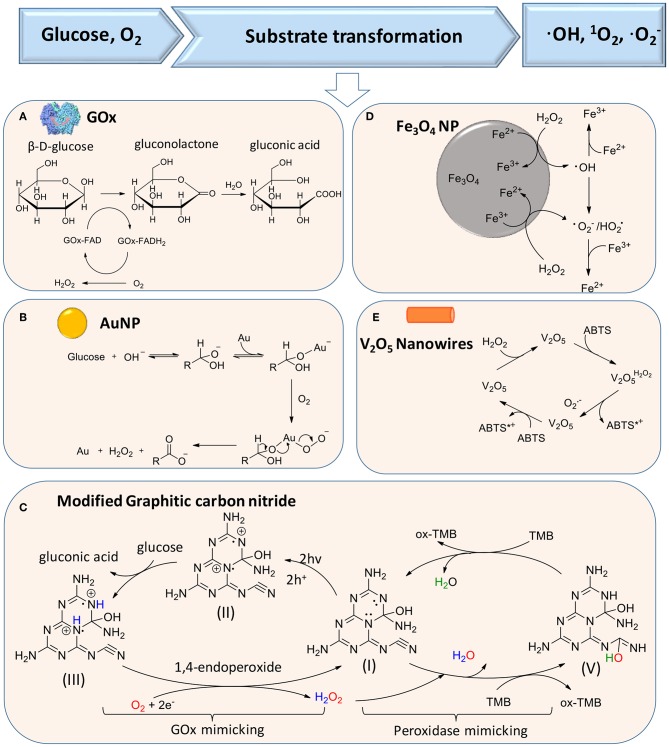
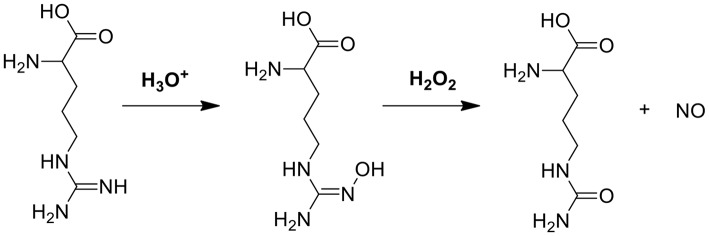
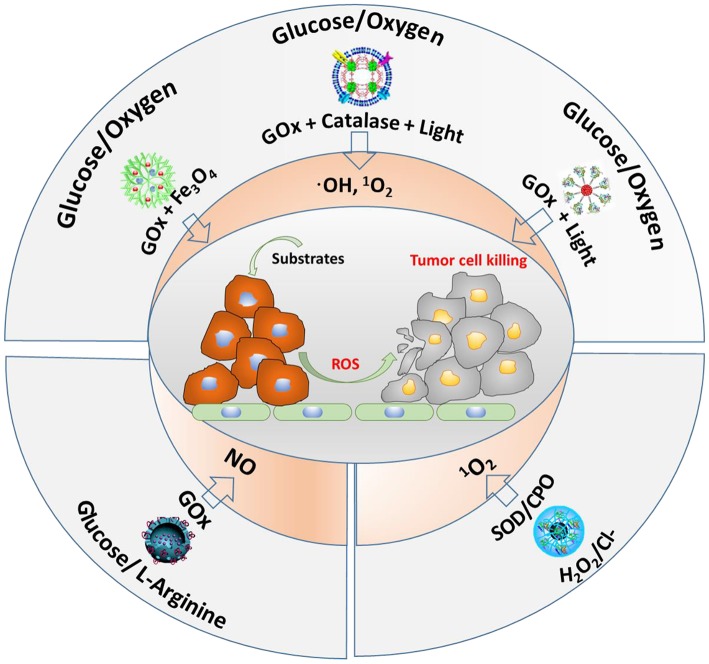
Cascade reactions integrate two or more reactions, of which each subsequent reaction can only start when the previous reaction step is completed. Employing natural substrates in the human body such as glucose and oxygen, cascade reactions can generate reactive oxygen species (ROS) to kill tumor cells, but cascade reactions may also have potential as a direly needed, novel bacterial infection-control strategy. ROS can disintegrate the EPS matrix of infectious biofilm, disrupt bacterial cell membranes, and damage intra-cellular DNA. Application of cascade reactions producing ROS as a new infection-control strategy is still in its infancy. The main advantages for infection-control cascade reactions include the fact that they are non-antibiotic based and induction of ROS resistance is unlikely. However, the amount of ROS generated is generally low and antimicrobial efficacies reported are still far <3-4 log units necessary for clinical efficacy. Increasing the amounts of ROS generated by adding more substrate bears the risk of collateral damage to tissue surrounding an infection site. Collateral tissue damage upon increasing substrate concentrations may be prevented by locally increasing substrate concentrations, for instance, using smart nanocarriers. Smart, pH-responsive nanocarriers can self-target and accumulate in infectious biofilms from the blood circulation to confine ROS production inside the biofilm to yield long-term presence of ROS, despite the short lifetime (nanoseconds) of individual ROS molecules. Increasing bacterial killing efficacies using cascade reaction components containing nanocarriers constitutes a first, major challenge in the development of infection-control cascade reactions. Nevertheless, their use in combination with clinical antibiotic treatment may already yield synergistic effects, but this remains to be established for cascade reactions. Furthermore, specific patient groups possessing elevated levels of endogenous substrate (for instance, diabetic or cancer patients) may benefit from the use of cascade reaction components containing nanocarriers.
级联反应整合了两个或更多反应,其中每个后续反应只有在前一个反应步骤完成时才能开始。利用人体中的天然底物,如葡萄糖和氧气,级联反应可以产生活性氧(ROS)来杀死肿瘤细胞,但级联反应也可能具有作为一种急需的新型细菌感染控制策略的潜力。ROS可以分解感染性生物膜的胞外聚合物基质,破坏细菌细胞膜,并损伤细胞内DNA。将产生活性氧的级联反应作为一种新的感染控制策略的应用仍处于起步阶段。感染控制级联反应的主要优点包括它们不是基于抗生素的,而且不太可能诱导产生ROS抗性。然而,产生的ROS量通常较低,所报道的抗菌效果仍远低于临床疗效所需的3-4个对数单位。通过添加更多底物来增加ROS的产量存在对感染部位周围组织造成附带损伤的风险。通过局部增加底物浓度,例如使用智能纳米载体,可以防止增加底物浓度时的附带组织损伤。智能的、pH响应性纳米载体可以从血液循环中自靶向并积聚在感染性生物膜中,将ROS的产生限制在生物膜内,以产生ROS的长期存在,尽管单个ROS分子的寿命很短(纳秒)。使用含有纳米载体的级联反应成分来提高细菌杀灭效果是感染控制级联反应开发中的首要重大挑战。然而,将它们与临床抗生素治疗联合使用可能已经产生协同效应,但这对于级联反应来说仍有待确定。此外,内源性底物水平升高的特定患者群体(例如糖尿病患者或癌症患者)可能会受益于使用含有纳米载体的级联反应成分。