Research Unit Occupational & Organizational Psychology and Professional Learning, KU Leuven, 3000 Leuven, Belgium.
Fakultas Psikologi, Universitas Sumatera Utara, Medan 20155, Indonesia.
Int J Environ Res Public Health. 2020 Jan 26;17(3):776. doi: 10.3390/ijerph17030776.
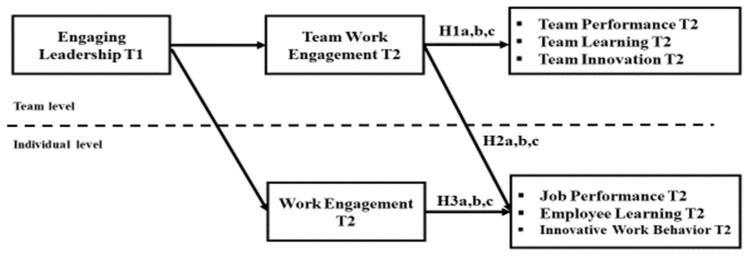
The current study investigates how supervisors' engaging leadership, as perceived by their employees, increases employees' job outcomes at the individual and team level, as mediated by (team) work engagement. Job outcome indicators at the team level are team performance, team learning, and team innovation; and at the individual level, job performance, employee learning, and innovative work behavior. The novel concept of engaging leadership is presented as the specific type of leadership to foster (team) work engagement. A multi-level longitudinal study is conducted among 224 blue collar employees nested in 54 teams in an Indonesian state-owned holding company in the agricultural industry using a one-year time lag. The findings show, as expected, that at the team level, engaging leadership at time 1 predicted team learning and team innovation (but not team performance) at time 2, via team work engagement at time 2. Additionally, an expected cross-level effect was observed from engaging leadership at the team level at time 1 predicting individual job performance (but not employee learning and innovative work behavior) at time 2, via team work engagement at time 2. Finally, an expected second cross-level effect was observed for engaging leadership at the team level at time 1, which predicted individual job performance, employee learning, and innovative work behavior at time 2, via work engagement at time 2.
本研究旨在探讨员工感知到的主管的激励型领导如何通过(团队)工作投入来增加员工在个人和团队层面的工作成果,其中工作成果指标包括团队绩效、团队学习和团队创新,以及个人层面的工作绩效、员工学习和创新工作行为。激励型领导是一种新颖的领导概念,旨在促进(团队)工作投入。本研究采用为期一年的时间滞后,在一家印度尼西亚国有农业企业集团中,对 54 个团队中的 224 名蓝领员工进行了一项多层面纵向研究。研究结果表明,在团队层面上,激励型领导在第 1 时间点预测了第 2 时间点的团队学习和团队创新(但不是团队绩效),这是通过第 2 时间点的团队工作投入实现的。此外,还观察到了一个预期的跨层次效应,即激励型领导在第 1 时间点的团队层面预测了第 2 时间点的个人工作绩效(但不是员工学习和创新工作行为),这是通过第 2 时间点的团队工作投入实现的。最后,还观察到了激励型领导在第 1 时间点的团队层面的第二个预期的跨层次效应,该效应通过第 2 时间点的工作投入预测了个人工作绩效、员工学习和创新工作行为。