Hsu Bryan B, Way Jeffrey C, Silver Pamela A
Department of Systems Biology, Harvard Medical School, Boston, Massachusetts, USA
Wyss Institute for Biologically Inspired Engineering, Boston, Massachusetts, USA.
mSystems. 2020 Jan 28;5(1):e00013-20. doi: 10.1128/mSystems.00013-20.
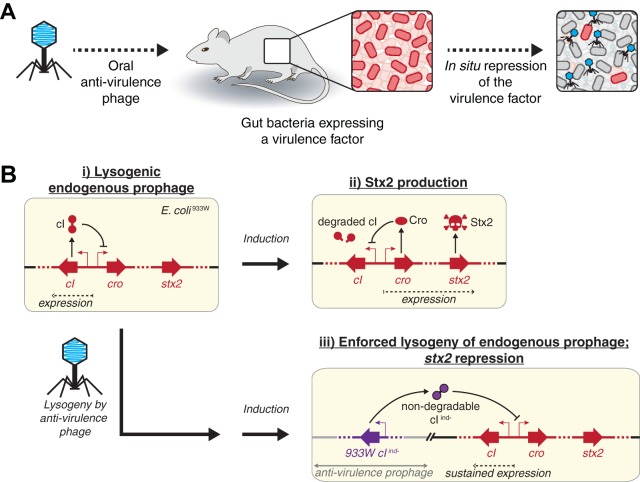
Elimination or alteration of select members of the gut microbiota is key to therapeutic efficacy. However, the complexity of these microbial inhabitants makes it challenging to precisely target bacteria. Here, we deliver exogenous genes to specific bacteria by genomic integration of temperate phage for long-lasting modification. As a real-world therapeutic test, we engineered λ phage to transcriptionally repress Shiga toxin by using genetic hybrids between λ and other lambdoid phages to overcome resistance encoded by the virulence-expressing prophage. We show that a single dose of engineered phage propagates throughout the bacterial community and reduces Shiga toxin production in an enteric mouse model of infection without markedly affecting bacterial concentrations. Our work reveals a new framework for transferring functions to bacteria within their native environment. With the increasing frequency of antibiotic resistance, it is critical to explore new therapeutic strategies for treating bacterial infections. Here, we use a temperate phage, i.e., one that integrates itself into the bacterial genome, to neutralize the expression of a virulence factor by modifying bacterial function at the genetic level. We show that Shiga toxin production can be significantly reduced and in the mammalian gut. Alternative to traditional applications of phage therapy that rely on killing bacteria, our genetics-based antivirulence approach introduces a new framework for treating bacterial infections.
消除或改变肠道微生物群的特定成员是治疗效果的关键。然而,这些微生物居民的复杂性使得精确靶向细菌具有挑战性。在这里,我们通过温和噬菌体的基因组整合将外源基因传递给特定细菌,以实现持久的修饰。作为一个实际的治疗测试,我们通过使用λ噬菌体与其他类λ噬菌体之间的基因杂交,对λ噬菌体进行工程改造,以转录抑制志贺毒素,从而克服表达毒力的前噬菌体编码的抗性。我们表明,单剂量的工程噬菌体在整个细菌群落中传播,并在肠道感染小鼠模型中降低志贺毒素的产生,而不会显著影响细菌浓度。我们的工作揭示了一个在细菌天然环境中向细菌转移功能的新框架。随着抗生素耐药性频率的增加,探索治疗细菌感染的新治疗策略至关重要。在这里,我们使用一种温和噬菌体,即一种将自身整合到细菌基因组中的噬菌体,通过在基因水平上修饰细菌功能来中和毒力因子的表达。我们表明,在哺乳动物肠道中,志贺毒素的产生可以显著减少。与传统的依赖杀死细菌的噬菌体治疗应用不同,我们基于遗传学的抗毒力方法为治疗细菌感染引入了一个新框架。