Robert Koch Institute, Centre for Biological Threats and Special Pathogens, Berlin, Germany.
Robert Koch Institute, Methodology and Research Infrastructure, Berlin, Germany.
Sci Rep. 2020 Jan 28;10(1):1370. doi: 10.1038/s41598-020-58466-w.
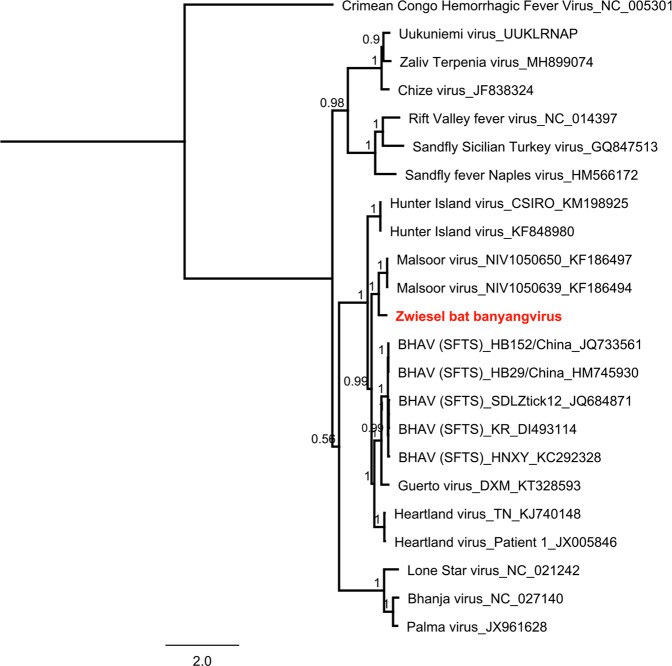
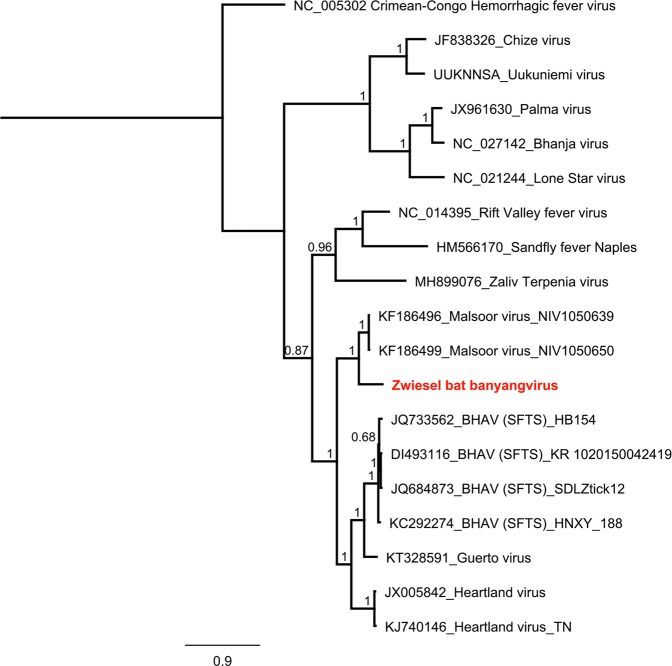
Bats are reservoir hosts for several emerging and re-emerging viral pathogens causing morbidity and mortality in wildlife, animal stocks and humans. Various viruses within the family Phenuiviridae have been detected in bats, including the highly pathogenic Rift Valley fever virus and Malsoor virus, a novel Banyangvirus with close genetic relation to Huaiyangshan banyangvirus (BHAV)(former known as Severe fever with thrombocytopenia syndrome virus, SFTSV) and Heartland virus (HRTV), both of which have caused severe disease with fatal casualties in humans. In this study we present the whole genome of a novel Banyangvirus, named Zwiesel bat banyangvirus, revealed through deep sequencing of the Eptesicus nilssonii bat virome. The detection of the novel bat banyangvirus, which is in close phylogenetic relationship with the pathogenic HRTV and BHAV, underlines the possible impact of emerging phenuiviruses on public health.
蝙蝠是几种新兴和再现的病毒病原体的宿主,这些病原体可导致野生动物、动物种群和人类发病和死亡。在蝙蝠中已检测到包括高致病性裂谷热病毒和马索病毒在内的多种属于 Phenuiviridae 科的病毒,马索病毒是一种新型的 Banyangvirus,与淮阳山 Banyangvirus(原称严重发热伴血小板减少综合征病毒,SFTSV)和 Heartland 病毒(HRTV)具有密切的遗传关系,这两种病毒均可导致人类严重疾病和致命伤亡。在本研究中,我们通过对 Eptesicus nilssonii 蝙蝠病毒组进行深度测序,展示了一种新型 Banyangvirus(Zwiesel 蝙蝠 Banyangvirus)的全基因组。这种新型蝙蝠 Banyangvirus 的检测与致病性 HRTV 和 BHAV 密切相关,这突显了新兴 Phenuiviruses 对公共卫生可能产生的影响。