Division of Oncology, Section of Stem Cell Biology, Department of Internal Medicine, Washington University School of Medicine, St. Louis, MO 63110.
Division of Dermatology, Department of Internal Medicine, Washington University School of Medicine, St. Louis, MO 63110.
Proc Natl Acad Sci U S A. 2020 Feb 11;117(6):3123-3134. doi: 10.1073/pnas.1918611117. Epub 2020 Jan 29.
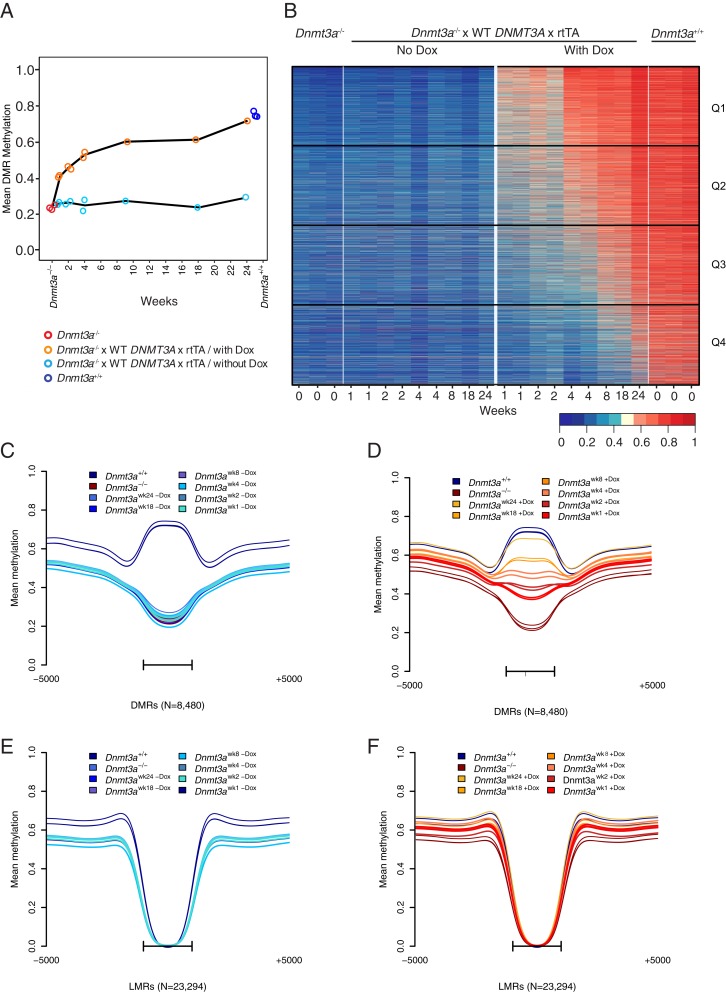
Mutations in the DNA methyltransferase 3A () gene are the most common cause of age-related clonal hematopoiesis (ARCH) in older individuals, and are among the most common initiating events for acute myeloid leukemia (AML). The most frequent mutation in AML patients (R882H) encodes a dominant-negative protein that reduces methyltransferase activity by ∼80% in cells with heterozygous mutations, causing a focal, canonical DNA hypomethylation phenotype; this phenotype is partially recapitulated in murine bone marrow cells. To determine whether the hypomethylation phenotype of hematopoietic cells is reversible, we developed an inducible transgene to restore expression of in transplanted bone marrow cells from mice. Partial remethylation was detected within 1 wk, but near-complete remethylation required 6 mo. Remethylation was accurate, dynamic, and highly ordered, suggesting that differentially methylated regions have unique properties that may be relevant for their functions. Importantly, 22 wk of addback partially corrected dysregulated gene expression, and mitigated the expansion of myeloid cells. These data show that restoring expression can alter the epigenetic "state" created by loss of Dnmt3a activity; this genetic proof-of-concept experiment suggests that this approach could be relevant for patients with ARCH or AML caused by loss-of-function mutations.
DNA 甲基转移酶 3A()基因的突变是导致老年人年龄相关克隆性造血(ARCH)的最常见原因,也是急性髓系白血病(AML)最常见的起始事件之一。AML 患者最常见的突变(R882H)编码一种显性负蛋白,在杂合突变的细胞中降低甲基转移酶活性约 80%,导致局部、典型的 DNA 低甲基化表型;这种表型在小鼠骨髓细胞中部分重现。为了确定造血细胞的低甲基化表型是否可逆,我们开发了一种诱导型转基因,以恢复 在来自 小鼠的移植骨髓细胞中的表达。在 1 周内检测到部分再甲基化,但需要 6 个月才能达到近乎完全再甲基化。再甲基化是准确的、动态的和高度有序的,这表明差异甲基化区域具有独特的性质,这些性质可能与其功能有关。重要的是,22 周的 添加部分纠正了失调的基因表达,并减轻了髓系细胞的扩增。这些数据表明,恢复 的表达可以改变由 Dnmt3a 活性丧失引起的表观遗传“状态”;这种遗传概念验证实验表明,这种方法可能与由功能丧失 突变引起的 ARCH 或 AML 患者相关。