Gialluisi Alessandro, Reccia Mafalda Giovanna, Tirozzi Alfonsina, Nutile Teresa, Lombardi Alessia, De Sanctis Claudia, Varanese Sara, Pietracupa Sara, Modugno Nicola, Simeone Antonio, Ciullo Marina, Esposito Teresa
IRCCS Neuromed, Pozzilli, Italy.
Institute of Genetics and Biophysics, National Research Council, Naples, Italy.
Front Neurol. 2020 Jan 10;10:1362. doi: 10.3389/fneur.2019.01362. eCollection 2019.
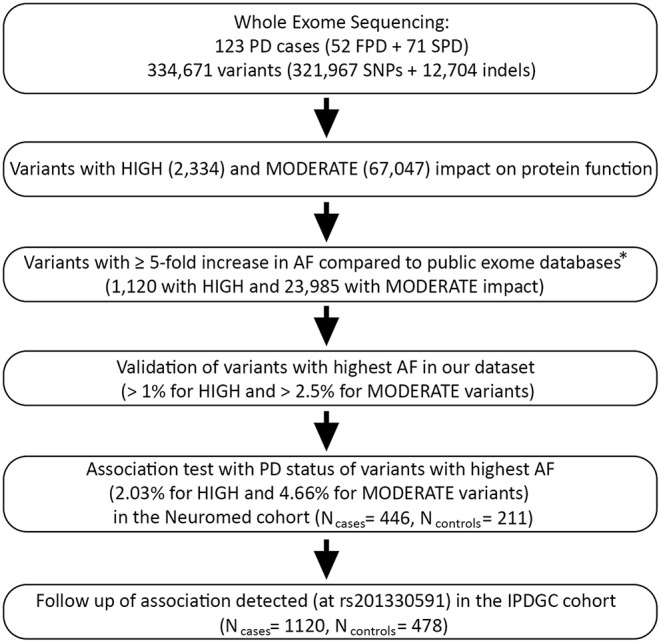
Parkinson Disease (PD) is a complex neurodegenerative disorder characterized by large genetic heterogeneity and missing heritability. Since the genetic background of PD can partly vary among ethnicities and neurological scales have been scarcely investigated in a PD setting, we performed an exploratory Whole Exome Sequencing (WES) analysis of 123 PD patients from mainland Italy, investigating scales assessing motor (UPDRS), cognitive (MoCA), and other non-motor symptoms (NMS). We performed variant prioritization, followed by targeted association testing of prioritized variants in 446 PD cases and 211 controls. Then we ran Exome-Wide Association Scans (EWAS) within sequenced PD cases ( = 113), testing both motor and non-motor PD endophenotypes, as well as their associations with Polygenic Risk Scores (PRS) influencing brain subcortical volumes. We identified a variant associated with PD, rs201330591 in (5q13; alternative T allele: OR [CI] = 8.16[1.08; 61.52], FDR = 0.048), which was not replicated in an independent cohort of European ancestry (1,148 PD cases, 503 controls). In the EWAS, polygenic analyses revealed statistically significant multivariable associations of amygdala- [β(SE) = -0.039(0.013); FDR = 0.039] and caudate-PRS [0.043(0.013); 0.028] with motor symptoms. All subcortical PRSs in a multivariable model notably increased the variance explained in motor (adjusted-R = 38.6%), cognitive (32.2%) and other non-motor symptoms (28.9%), compared to baseline models (~20%). Although, the small sample size warrants further replications, these findings suggest shared genetic architecture between PD symptoms and subcortical structures, and provide interesting clues on PD genetic and neuroimaging features.
帕金森病(PD)是一种复杂的神经退行性疾病,具有高度的遗传异质性且存在遗传力缺失现象。由于PD的遗传背景在不同种族间可能存在部分差异,并且在PD患者中对神经学量表的研究很少,我们对来自意大利大陆的123例PD患者进行了探索性全外显子组测序(WES)分析,研究了评估运动功能(统一帕金森病评定量表,UPDRS)、认知功能(蒙特利尔认知评估量表,MoCA)和其他非运动症状(NMS)的量表。我们进行了变异优先级排序,随后在446例PD病例和211例对照中对优先级变异进行了靶向关联测试。然后我们在测序的PD病例(n = 113)中进行全外显子组关联扫描(EWAS),测试运动和非运动PD内表型,以及它们与影响脑皮质下体积的多基因风险评分(PRS)的关联。我们鉴定出一个与PD相关的变异,位于5号染色体长臂1区3带(5q13)的rs201330591(替代T等位基因:比值比[置信区间] = 8.16[1.08;61.52],错误发现率 = 0.048),该变异在一个独立的欧洲血统队列(1148例PD病例,503例对照)中未得到重复验证。在EWAS中,多基因分析显示杏仁核-PRS[β(标准误) = -0.039(0.013);错误发现率 = 0.039]和尾状核-PRS[0.043(0.013);0.028]与运动症状存在统计学显著的多变量关联。与基线模型(约20%)相比,多变量模型中的所有皮质下PRS显著增加了运动症状(调整决定系数R = 38.6%)、认知症状(32.2%)和其他非运动症状(28.9%)所解释的方差。尽管样本量较小需要进一步重复验证,但这些发现提示了PD症状与皮质下结构之间共享的遗传结构,并为PD的遗传和神经影像学特征提供了有趣的线索。