Department of Endocrinology and Metabolism, Affiliated Longyan First Hospital of Fujian Medical University, Longyan, 364000 Fujian Province, China.
Department of Tumor Radiotherapy, Affiliated Longyan First Hospital of Fujian Medical University, Longyan, 364000 Fujian Province, China.
J Diabetes Res. 2020 Jan 3;2020:4739271. doi: 10.1155/2020/4739271. eCollection 2020.
To investigate the association of the serum adiponectin level with the intima media thickness of the dorsalis pedis artery (D-IMT) and macroangiopathy in type 2 diabetes (T2DM).
We recruited 173 patients with T2DM, of whom 83 had macroangiopathy (MA group) and 90 did not have macroangiopathy (NM group), and 40 normal control subjects (NC group). We measured D-IMT using color B-mode Doppler ultrasonography. Serum adiponectin, blood glucose, lipids, and other clinical characteristics were analyzed. Participants were divided into three subgroups according to serum adiponectin level (high, moderate, and low).
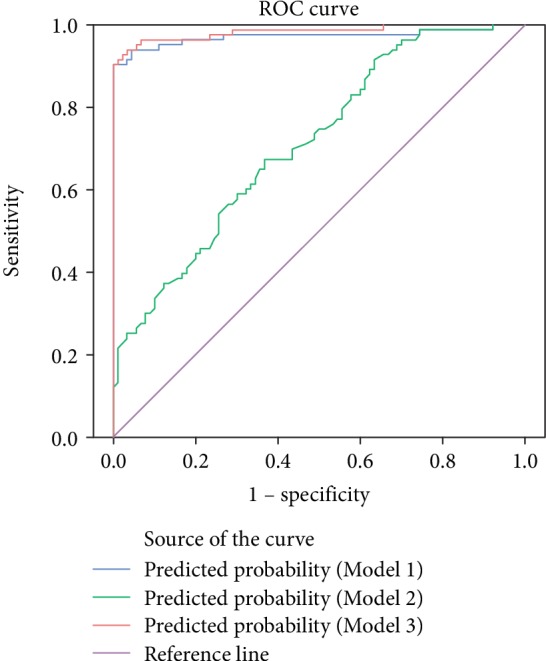
Compared with the NM and NC groups, serum adiponectin levels were significantly decreased in the MA group after adjusting for sex and body mass index. Compared with the NM and NC groups, D-IMT was significantly increased in the MA group. Compared with the moderate- and high-adiponectin subgroups, D-IMT was significantly increased in the low-adiponectin subgroup. The prevalence of diabetic macroangiopathy increased gradually with decreasing adiponectin levels. After controlling for age, sex, smoking, and alcohol drinking, partial correlation analysis showed that adiponectin was negatively correlated with D-IMT. Elevated serum adiponectin was independently associated with a decreased risk for diabetic macroangiopathy by logistic regression analysis. Multiple linear regression analysis revealed that adiponectin was an independent factor of D-IMT. In receiver operating characteristic analyses, the area under the curve for traditional risk factors plus adiponectin for prediction of macroangiopathy was 0.984, while that of traditional risk factors alone was 0.972.
Adiponectin is lower in patients with T2DM with macroangiopathy. We suggest that D-IMT could represent a noninvasive indicator of diabetic macroangiopathy. Decrease of adiponectin as an independent risk factor for both macroangiopathy and D-IMT among Chinese patients with T2DM suggests that adiponectin might have clinical utility in the prediction of diabetic macroangiopathy. This clinical trial is registered in the "Chinese Clinical Trial Registry." The registration number is ChiCTR-ROC-17011731.
探讨血清脂联素水平与 2 型糖尿病(T2DM)患者足背动脉内膜中层厚度(D-IMT)及大血管病变的关系。
选取 173 例 T2DM 患者,其中 83 例合并大血管病变(MA 组),90 例无大血管病变(NM 组),另选 40 例健康对照者(NC 组)。采用彩色多普勒超声检测 D-IMT。分析血清脂联素、血糖、血脂等临床特征。根据血清脂联素水平将患者分为高、中、低 3 组亚组。
校正性别和体重指数后,与 NM 组和 NC 组比较,MA 组血清脂联素水平明显降低。与 NM 组和 NC 组比较,MA 组 D-IMT 明显增加。与中、高脂联素亚组比较,低脂联素亚组 D-IMT 明显增加。随着脂联素水平降低,糖尿病大血管病变的患病率逐渐增加。校正年龄、性别、吸烟和饮酒后,偏相关分析显示脂联素与 D-IMT 呈负相关。Logistic 回归分析显示,升高的血清脂联素与糖尿病大血管病变风险降低独立相关。多元线性回归分析显示,脂联素是 D-IMT 的独立影响因素。受试者工作特征曲线分析显示,传统危险因素加脂联素预测大血管病变的曲线下面积为 0.984,而传统危险因素单独预测的曲线下面积为 0.972。
T2DM 合并大血管病变患者血清脂联素水平较低。我们推测 D-IMT 可能是糖尿病大血管病变的一种无创指标。脂联素作为中国 T2DM 患者大血管病变及 D-IMT 的独立危险因素,提示脂联素在预测糖尿病大血管病变方面可能具有临床应用价值。本临床试验在中国临床试验注册中心注册,注册号为 ChiCTR-ROC-17011731。