Maclean Michelle, Gelderman Monique P, Kulkarni Sandhya, Tomb Rachael M, Stewart Caitlin F, Anderson John G, MacGregor Scott J, Atreya Chintamani D
The Robertson Trust Laboratory for Electronic Sterilisation Technologies, Department of Electronic & Electrical Engineering, University of Strathclyde, Glasgow, United Kingdom.
Department of Biomedical Engineering, University of Strathclyde, Glasgow, United Kingdom.
Front Med (Lausanne). 2020 Jan 15;6:331. doi: 10.3389/fmed.2019.00331. eCollection 2019.
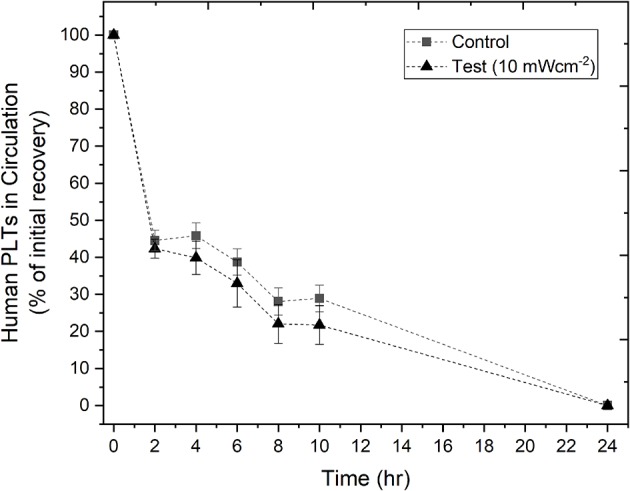
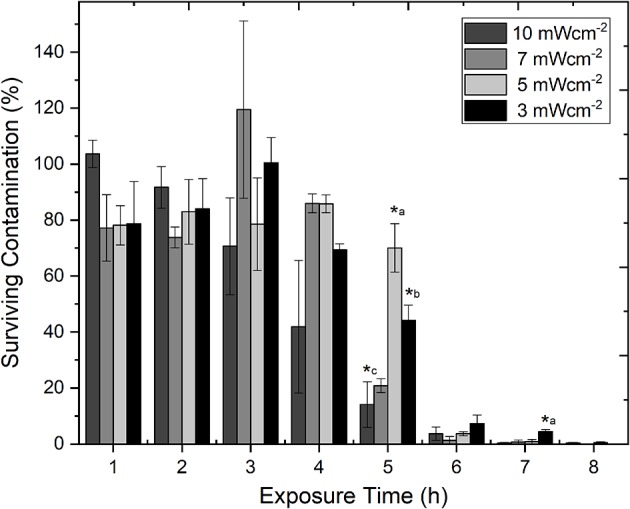
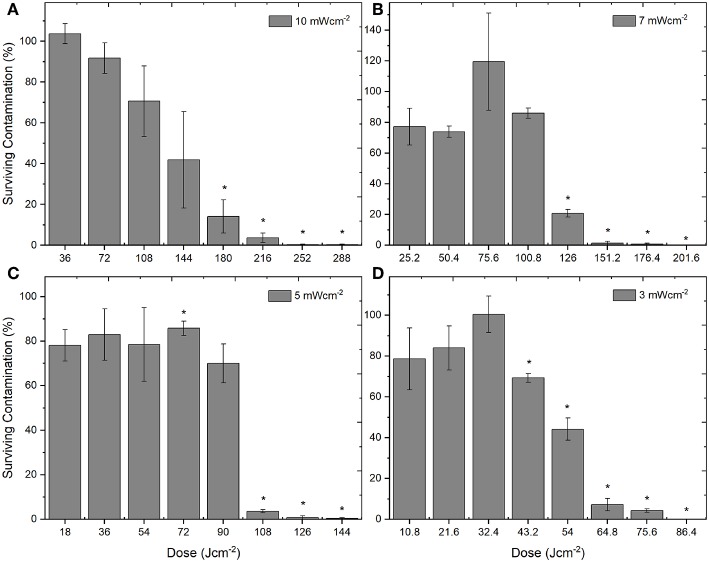
Bacterial contamination of stored platelets is a cause of transfusion-transmitted infection. Violet-blue 405 nm light has recently demonstrated efficacy in reducing the bacterial burden in blood plasma, and its operational benefits such as non-ionizing nature, penetrability, and non-requirement for photosensitizing agents, provide a unique opportunity to develop this treatment for treatment of stored platelets as a tool for bacterial reduction. Sealed bags of platelet concentrates, seeded with low-level contamination, were 405 nm light-treated (3-10 mWcm) up to 8 h. Antimicrobial efficacy and dose efficiency was evaluated by quantification of the post-treatment surviving bacterial contamination levels. Platelets treated with 10 mWcm for 8 h were further evaluated for survival and recovery in severe combined immunodeficient (SCID) mice. Significant inactivation of bacteria in platelet concentrates was achieved using all irradiance levels, with 99.6-100% inactivation achieved by 8 h ( < 0.05). Analysis of applied dose demonstrated that lower irradiance levels generally resulted in significant decontamination at lower doses: 180 Jcm/10 mWcm ( = 0.008) compared to 43.2 Jcm/3 mWcm ( = 0.002). Additionally, the recovery of light-treated platelets, compared to non-treated platelets, in the murine model showed no significant differences ( = >0.05). This report paves the way for further comprehensive studies to test 405 nm light treatment as a bactericidal technology for stored platelets.
储存血小板的细菌污染是输血传播感染的一个原因。最近,405纳米的蓝紫光已证明在降低血浆细菌负荷方面具有功效,其诸如非电离性质、穿透性以及无需光敏剂等操作优势,为开发这种针对储存血小板的治疗方法以作为减少细菌的工具提供了独特机会。将接种低水平污染的密封血小板浓缩液袋用405纳米光(3 - 10毫瓦/平方厘米)处理长达8小时。通过对处理后存活细菌污染水平的定量来评估抗菌功效和剂量效率。对用10毫瓦/平方厘米处理8小时的血小板在严重联合免疫缺陷(SCID)小鼠中的存活和恢复情况进行了进一步评估。使用所有辐照水平均实现了血小板浓缩液中细菌的显著灭活,8小时时灭活率达到99.6 - 100%(P < 0.05)。对应用剂量的分析表明,较低辐照水平通常在较低剂量下就能实现显著去污:180焦/平方厘米/10毫瓦/平方厘米(P = 0.008),而43.2焦/平方厘米/3毫瓦/平方厘米(P = 0.002)。此外,在小鼠模型中,与未处理的血小板相比,光处理血小板的恢复情况没有显著差异(P > 0.05)。本报告为进一步全面研究测试405纳米光处理作为储存血小板杀菌技术铺平了道路。