Widyarman Armelia Sari, Lay Sammy H, Wendhita Izharie Putri, Tjakra Eugene E, Murdono Felix Indrawan, Binartha Ciptadhi Tri Oka
Department of Microbiology, Faculty of Dentistry, Trisakti University, Jakarta, Indonesia.
Undergraduate Student, Faculty of Dentistry, Trisakti University, Jakarta, Indonesia.
Contemp Clin Dent. 2019 Jan-Mar;10(1):123-128. doi: 10.4103/ccd.ccd_758_18.
and are caries and periodontal disease-related bacteria. The mangosteen fruit ( L.) peel contains flavonoids, tannins, saponins, and xanthones that have antibacterial properties.
The aim of this study is to analyze mangosteen peel extracts' ability to inhibit and has biofilms growth .
Mangosteen peel extract effects on the ATCC-3198 and ATCC-3327 in biofilms growth were evaluated by a crystal violet biofilm assay. Each bacterium was inoculated into a brain-heart infusion broth for 24 h at 37°C anaerobic conditions. A volume of 200 μL (10 colony-forming unit/mL) of bacterial suspension were distributed in microplate wells and incubated for 24 h. Mangosteen peel extracts with different concentrations were added into biofilm wells. Biofilm without treatment was used as negative control. Biofilm mass was calculated by 0.5% crystal violet staining, and optical density was measured at 600 nm using microplate reader. All obtained data were statistically analyzed using one-way analysis of variance test with < 0.05 set as the level of significance.
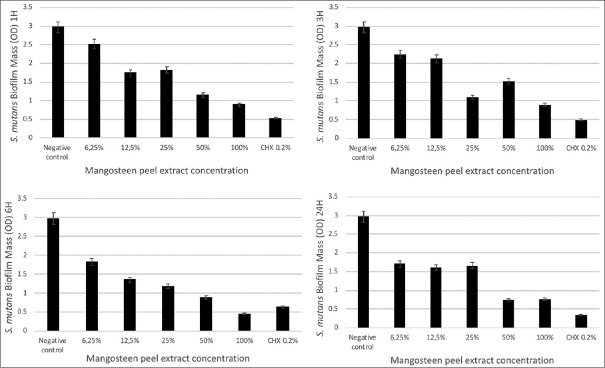
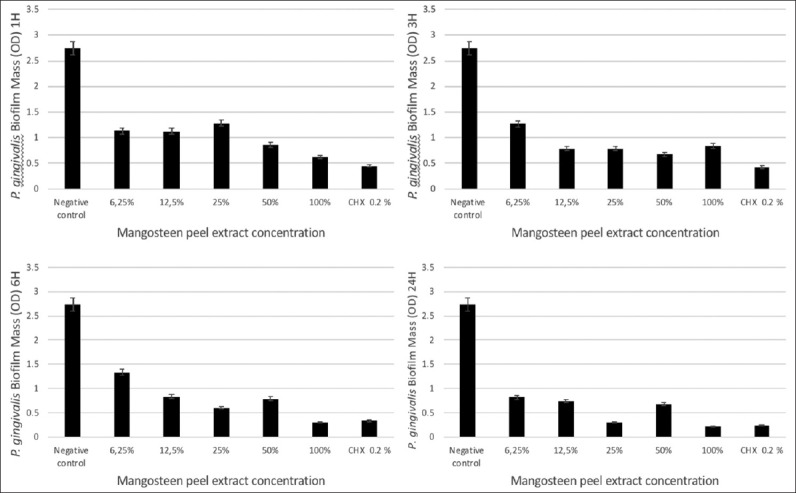
The results showed that mangosteen peel extract could inhibit the growth of and in biofilms significantly compared to the negative control ( < 0.05). The most effective concentration and incubation time for inhibiting biofilm growth was 100% in 6 h for and 100% in 24 h for .
Mangosteen peel extract is effective at inhibiting and biofilms, and this antibiofilm agent can be an alternative therapy in preventing caries and periodontal disease. Future studies are needed to explore this effect.
[具体细菌名称1]和[具体细菌名称2]是与龋齿和牙周疾病相关的细菌。山竹果(莽吉柿)果皮含有具有抗菌特性的黄酮类化合物、单宁、皂苷和氧杂蒽酮。
本研究旨在分析山竹果皮提取物抑制[具体细菌名称1]和[具体细菌名称2]生物膜生长的能力。
通过结晶紫生物膜测定法评估山竹果皮提取物对生物膜生长中[具体细菌名称1] ATCC - 3198和[具体细菌名称2] ATCC - 3327的影响。每种细菌在37℃厌氧条件下接种于脑心浸液肉汤中培养24小时。将200μL(10个菌落形成单位/ mL)细菌悬液接种到微孔板孔中并孵育24小时。向生物膜孔中加入不同浓度的山竹果皮提取物。未处理的生物膜用作阴性对照。通过0.5%结晶紫染色计算生物膜量,并使用微孔板读数器在600nm处测量光密度。所有获得的数据采用单因素方差分析进行统计学分析,以P < 0.05作为显著性水平。
结果表明,与阴性对照相比,山竹果皮提取物能显著抑制生物膜中[具体细菌名称1]和[具体细菌名称2]的生长(P < 0.05)。抑制生物膜生长的最有效浓度和孵育时间,对于[具体细菌名称1]是6小时的100%提取物,对于[具体细菌名称2]是24小时的100%提取物。
山竹果皮提取物对抑制[具体细菌名称1]和[具体细菌名称2]生物膜有效,这种抗生物膜剂可作为预防龋齿和牙周疾病的替代疗法。未来需要进一步研究来探索这种效果。