Clayton David J, James Lewis J, Sale Craig, Templeman Iain, Betts James A, Varley Ian
National Centre for Sport and Exercise Medicine, School of Sport, Exercise and Health Sciences, Loughborough University, Loughborough, Leicestershire, LE11 3TU, UK.
School of Science and Technology, Nottingham Trent University, Nottingham, NG11 8NS, UK.
Eur J Nutr. 2020 Dec;59(8):3527-3535. doi: 10.1007/s00394-020-02186-4. Epub 2020 Feb 3.
Intermittent energy restriction commonly refers to ad libitum energy intake punctuated with 24 h periods of severe energy restriction. This can improve markers of metabolic health but the effects on bone metabolism are unknown. This study assessed how 24 h severe energy restriction and subsequent refeeding affected markers of bone turnover.
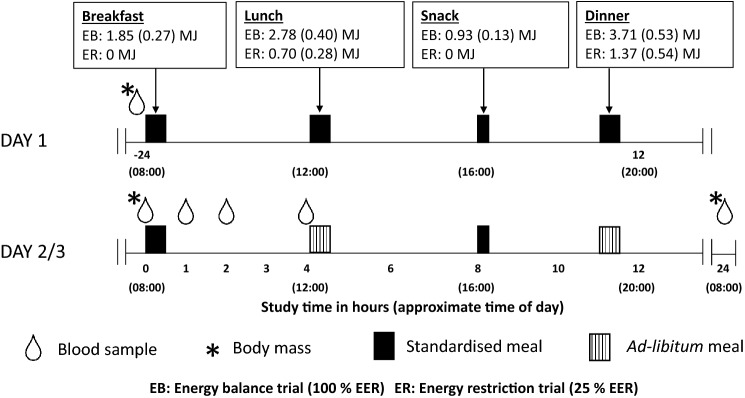
In a randomised order, 16 lean men and women completed 2, 48 h trials over 3 days. On day 1, participants consumed a 24 h diet providing 100% [EB: 9.27 (1.43) MJ] or 25% [ER: 2.33 (0.34) MJ] of estimated energy requirements. On day 2, participants consumed a standardised breakfast (08:00), followed by an ad libitum lunch (12:00) and dinner (19:30). Participants then fasted overnight, returning on day 3. Plasma concentrations of C-terminal telopeptide of type I collagen (CTX), procollagen type 1 N-terminal propeptide (P1NP) and parathyroid hormone (PTH) were assessed as indices of bone metabolism after an overnight fast on days 1-3, and for 4 h after breakfast on day 2.
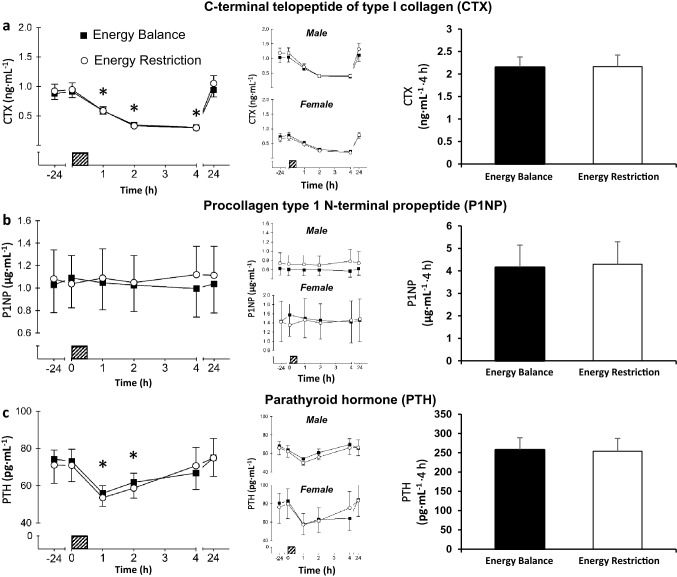
There were no differences between trials in fasting concentrations of CTX, P1NP or PTH on days 1-3 (P > 0.512). During both trials, consuming breakfast reduced CTX between 1 and 4 h (P < 0.001) and PTH between 1 and 2 h (P < 0.05), but did not affect P1NP (P = 0.773) Postprandial responses for CTX (P = 0.157), P1NP (P = 0.148) and PTH (P = 0.575) were not different between trials. Ad libitum energy intake on day 2 was greater on ER [12.62 (2.46) MJ] than EB [11.91 (2.49) MJ].
Twenty-four hour severe energy restriction does not affect markers of bone metabolism.
间歇性能量限制通常是指随意能量摄入与24小时的严重能量限制交替进行。这可以改善代谢健康指标,但对骨代谢的影响尚不清楚。本研究评估了24小时严重能量限制及随后的再喂养对骨转换标志物的影响。
16名体重正常的男性和女性按随机顺序在3天内完成了2次48小时试验。在第1天,参与者食用24小时的饮食,提供估计能量需求的100%[能量充足组(EB):9.27(1.43)兆焦耳]或25%[能量限制组(ER):2.33(0.34)兆焦耳]。在第2天,参与者食用标准化早餐(08:00),随后随意享用午餐(12:00)和晚餐(19:30)。然后参与者禁食过夜,第3天返回。在第1 - 3天禁食过夜后以及第2天早餐后4小时,评估血浆I型胶原C末端肽(CTX)、I型前胶原N末端前肽(P1NP)和甲状旁腺激素(PTH)的浓度,作为骨代谢指标。
在第1 - 3天,各试验间CTX、P1NP或PTH的空腹浓度无差异(P>0.512)。在两个试验中,食用早餐均使1 - 4小时的CTX降低(P<0.001),1 - 2小时的PTH降低(P<0.05),但对P1NP无影响(P = 0.773)。各试验间CTX(P = 0.157)、P1NP(P = 0.148)和PTH(P = 0.575)的餐后反应无差异。第2天能量限制组的随意能量摄入量[12.62(2.46)兆焦耳]高于能量充足组[11.91(2.49)兆焦耳]。
24小时严重能量限制不影响骨代谢标志物。