School of Physical Therapy, CES University, Medellin, Colombia.
Department of Social Medicine, UNC School of Medicine, University of North Carolina at Chapel Hill, Chapel Hill, USA.
BMC Public Health. 2020 Feb 4;20(1):181. doi: 10.1186/s12889-020-8285-9.
Disability is an evolving concept that results from the complex interaction between a person with an impairment and the context in which he/she lives. There is limited understanding on the types, access and use of community assets valuable for people with disabilities, and the role of contextual factors in Colombia. Our goal with this work was to identify the factors at the levels of the socio-ecological framework, and their interaction, that influence the use of community assets among people with physical disabilities and community stakeholders in Envigado, Colombia.
Using participatory mapping, a community based participatory approach, we carried out an assessment of community assets identified by people with disabilities and rehabilitation professionals. In-depth interviews (n = 32) informed the design of two participatory mapping activities, one among people with disabilities (n = 5) and a second with rehabilitation professionals (n = 4). Results were presented in a community forum to receive feedback on the findings.
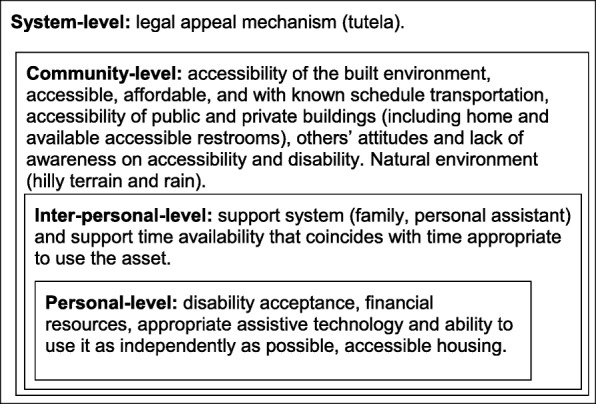
Main findings indicate a chain of contextual factors that limit access and use of assets stemming from the personal (e.g. financial resources, inaccessible housing), interpersonal level (e.g. lack of a personal assistance or aid), and community levels (e.g. lack of accessible public transportation and inaccessible buildings). In most cases these barriers are heightened by system level barriers (e.g. lack of effective enforcement of the legal framework).
Identifying these contextual factors, and their interactions, calls for stronger enforcement of the existing legal framework through articulated work between different stakeholders, so that people with disabilities can enjoy community assets.
残疾是一个不断发展的概念,它是由身体损伤者与他/她所处的环境之间的复杂相互作用所导致的。对于残疾人群体有价值的社区资产的类型、获取和使用,以及哥伦比亚的情境因素在其中所起的作用,人们的理解有限。我们开展这项工作的目的是确定社会生态框架各级的因素及其相互作用,这些因素影响着哥伦比亚恩维加多的身体残疾者和社区利益相关者对社区资产的使用。
我们采用基于社区的参与式方法,即参与式绘图法,对残疾人和康复专业人员所确定的社区资产进行评估。深入访谈(n=32)为两项参与式绘图活动的设计提供了信息,一项是针对残疾人(n=5),另一项是针对康复专业人员(n=4)。结果在社区论坛上展示,以获取对调查结果的反馈。
主要发现表明,存在一系列限制资产获取和使用的情境因素,这些因素源于个人层面(例如经济资源、住房无法进入)、人际层面(例如缺乏个人援助或辅助)和社区层面(例如缺乏无障碍公共交通和无障碍建筑)。在大多数情况下,这些障碍因制度层面的障碍而加剧(例如缺乏对法律框架的有效执行)。
确定这些情境因素及其相互作用,需要通过不同利益相关者之间的明确工作,加强现有法律框架的执行力度,以便残疾人士能够享用社区资产。