Department of Plant Science and Landscape Architecture, University of Maryland, College Park, MD, United States.
Division of Microbiology, Office of Regulatory Science, Center for Food Safety & Applied Nutrition, Food and Drug Administration, College Park, MD, United States.
Sci Rep. 2020 Feb 4;10(1):1765. doi: 10.1038/s41598-020-58671-7.
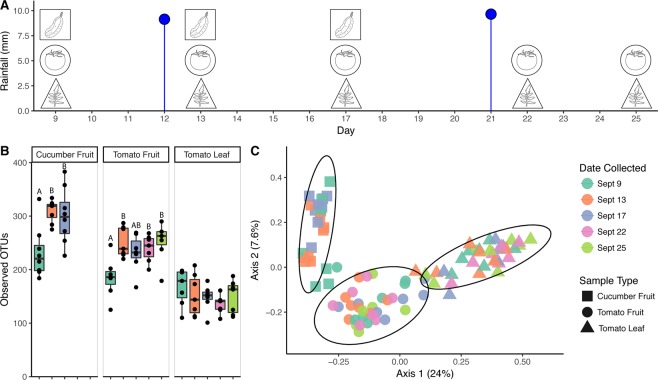
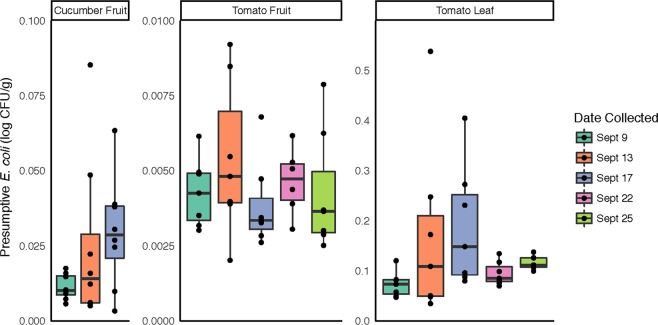
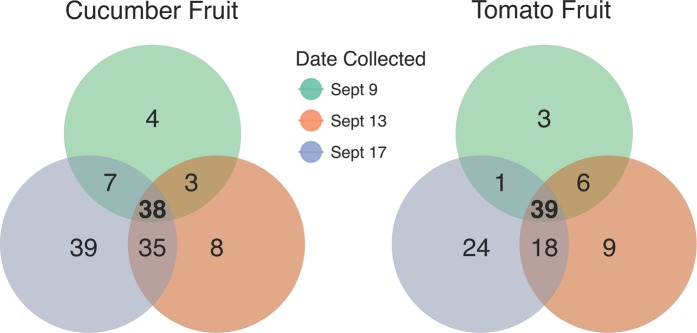
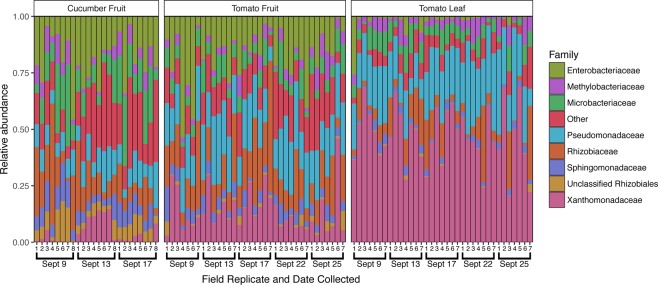
Understanding weather-related drivers of crop plant-microbiome relationships is important for food security and food safety in the face of a changing climate. Cucumber and tomato are commercially important commodities that are susceptible to plant disease and have been implicated in foodborne disease outbreaks. To investigate the influence of precipitation on plant-associated microbiomes, epiphytically associated bacterial communities of cucumber and tomato samples were profiled by 16 S rRNA gene sequencing (V1-V3) in the days surrounding two rain events over a 17-day period. Following rain, α (within-sample) diversity measured on cucumber and tomato fruit surfaces, but not tomato leaf surfaces, increased significantly and remained elevated for several days. Bacterial β (between-sample) diversity on cucumber and tomato fruit responded to precipitation. In the cucumber fruit surface (carpoplane), notable shifts in the families Xanthomonadaceae, Oxalobacteriaceae, Sphingobacteriaceae and Comamonadaceae were detected following precipitation. In the tomato carpoplane, shifts were detected in the families Enterobacteriaceae and Xanthomonadaceae following the first rain event, and in the Pseudomonadaceae and Oxalobacteriaceae following the second rain event. Few taxonomic shifts were detected in the tomato leaf surface (phylloplane). Exploring rain-induced shifts in plant microbiomes is highly relevant to crop protection, food safety and agroecology, and can aid in devising ways to enhance crop resilience to stresses and climate fluctuations.
了解与天气相关的作物-微生物组关系对于在气候变化面前保障粮食安全和食品安全非常重要。黄瓜和番茄是商业上重要的商品,容易受到植物疾病的影响,并且与食源性疾病爆发有关。为了研究降水对植物相关微生物组的影响,在 17 天的时间里,在两次降水事件前后几天,通过 16S rRNA 基因测序(V1-V3)对黄瓜和番茄样本的附生细菌群落进行了分析。雨后,黄瓜和番茄果实表面的 α(样本内)多样性显著增加,并持续升高数天,但番茄叶片表面的 α 多样性没有增加。黄瓜和番茄果实上的细菌 β(样本间)多样性对降水有反应。在黄瓜果实表面(果皮)中,降水后检测到黄单胞菌科、草酸杆菌科、鞘氨醇单胞菌科和根瘤菌科的显著变化。在番茄果皮中,第一次降水后检测到肠杆菌科和黄单胞菌科的变化,第二次降水后检测到假单胞菌科和草酸杆菌科的变化。在番茄叶片表面(叶表)中检测到的分类变化很少。探索降雨引起的植物微生物组变化与作物保护、食品安全和农业生态高度相关,并有助于设计增强作物对压力和气候波动的适应能力的方法。