Olteanu Gheorghe-Emilian, Mihai Ioana-Maria, Bojin Florina, Gavriliuc Oana, Paunescu Virgil
Department of Microscopic Morphology, "Victor Babes" University of Medicine and Pharmacy Timisoara, Timisoara, Romania; Clinical Emergency County Hospital "Pius Brinzeu" Timisoara, Center for Gene and Cellular Therapies in the Treatment of Cancer Timisoara - OncoGen, Timisoara, Romania.
Department of Microscopic Morphology, "Victor Babes" University of Medicine and Pharmacy Timisoara, Timisoara, Romania.
Bosn J Basic Med Sci. 2020 Aug 3;20(3):303-309. doi: 10.17305/bjbms.2019.4565.
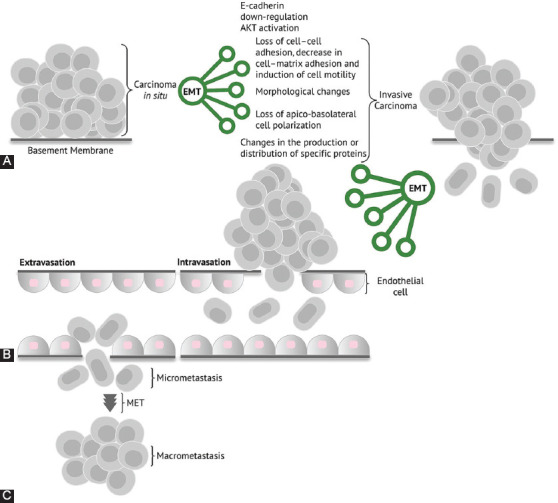
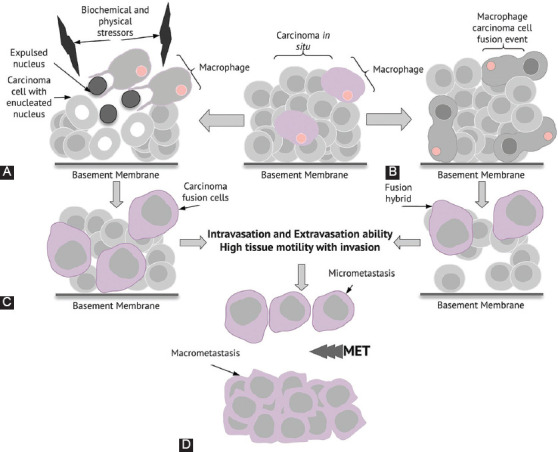
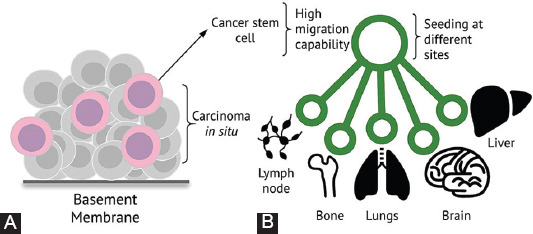
The ability of cancer to adapt renders it one of the most challenging pathologies of all time. It is the most dreaded pathological entity because of its capacity to metastasize to distant sites in the body, and 90% of all cancer-related deaths recorded to date are attributed to metastasis. Currently, three main theories have been proposed to explain the metastatic pathway of cancer: the epithelial-mesenchymal transition (EMT) and mesenchymal-epithelial transition (MET) hypothesis (1), the cancer stem cell hypothesis (2), and the macrophage-cancer cell fusion hybrid hypothesis (3). We propose a new hypothesis, i.e., under the effect of particular biochemical and/or physical stressors, cancer cells can undergo nuclear expulsion with subsequent macrophage engulfment and fusion, with the formation of cancer fusion cells (CFCs). The existence of CFCs, if confirmed, would represent a novel metastatic pathway and a shift in the extant dogma of cancer; consequently, new treatment targets would be available for this adaptive pathology.
癌症的适应能力使其成为有史以来最具挑战性的病理之一。它是最可怕的病理实体,因为它有能力转移到身体的远处部位,迄今为止记录的所有与癌症相关的死亡中,90% 都归因于转移。目前,已经提出了三种主要理论来解释癌症的转移途径:上皮-间质转化(EMT)和间质-上皮转化(MET)假说(1)、癌症干细胞假说(2)以及巨噬细胞-癌细胞融合杂种假说(3)。我们提出了一个新的假说,即在特定生化和/或物理应激源的作用下,癌细胞可以经历核排出,随后被巨噬细胞吞噬和融合,形成癌症融合细胞(CFCs)。如果CFCs的存在得到证实,将代表一种新的转移途径以及现有癌症理论的转变;因此,对于这种适应性病理将有新的治疗靶点。