Labots Mariette, Pham Thang V, Honeywell Richard J, Knol Jaco C, Beekhof Robin, de Goeij-de Haas Richard, Dekker Henk, Neerincx Maarten, Piersma Sander R, van der Mijn Johannes C, van der Peet Donald L, Meijerink Martijn R, Peters Godefridus J, van Grieken Nicole C T, Jiménez Connie R, Verheul Henk M W
Department of Medical Oncology, Cancer Center Amsterdam, Amsterdam UMC, Vrije Universiteit Amsterdam, De Boelelaan 1117, 1081 HV Amsterdam, The Netherlands.
Department of Surgery, Cancer Center Amsterdam, Amsterdam UMC, Vrije Universiteit Amsterdam, De Boelelaan 1117, 1081 HV Amsterdam, The Netherlands.
Cancers (Basel). 2020 Feb 1;12(2):330. doi: 10.3390/cancers12020330.
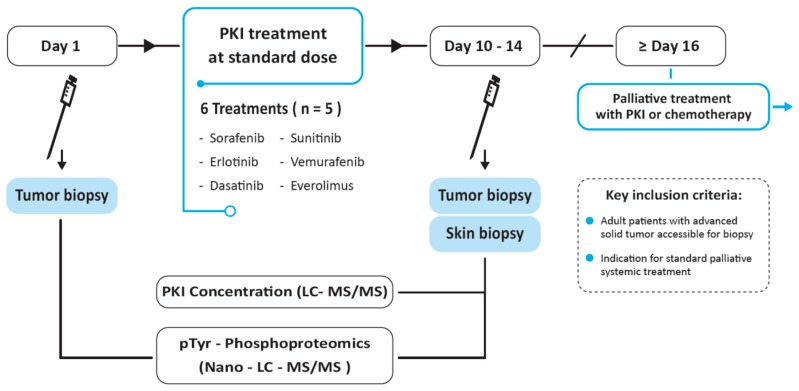
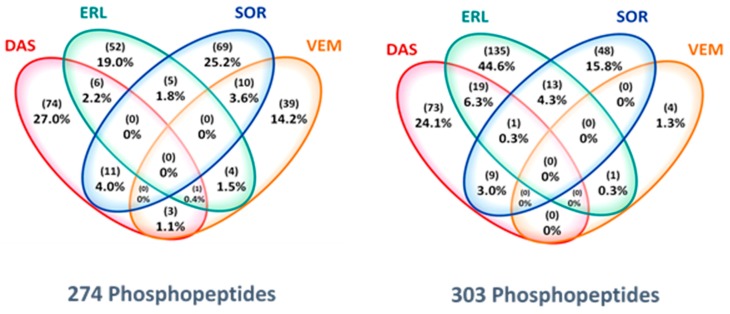
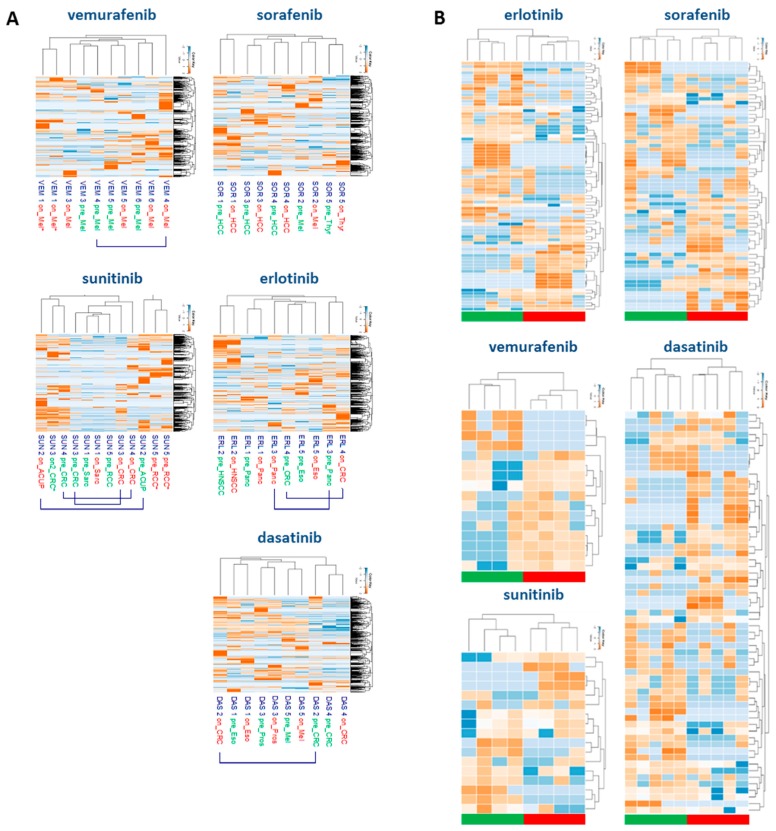
Identification of predictive biomarkers for targeted therapies requires information on drug exposure at the target site as well as its effect on the signaling context of a tumor. To obtain more insight in the clinical mechanism of action of protein kinase inhibitors (PKIs), we studied tumor drug concentrations of protein kinase inhibitors (PKIs) and their effect on the tyrosine-(pTyr)-phosphoproteome in patients with advanced cancer. Tumor biopsies were obtained from 31 patients with advanced cancer before and after 2 weeks of treatment with sorafenib (SOR), erlotinib (ERL), dasatinib (DAS), vemurafenib (VEM), sunitinib (SUN) or everolimus (EVE). Tumor concentrations were determined by LC-MS/MS. pTyr-phosphoproteomics was performed by pTyr-immunoprecipitation followed by LC-MS/MS. Median tumor concentrations were 2-10 µM for SOR, ERL, DAS, SUN, EVE and >1 mM for VEM. These were 2-178 × higher than median plasma concentrations. Unsupervised hierarchical clustering of pTyr-phosphopeptide intensities revealed patient-specific clustering of pre- and on-treatment profiles. Drug-specific alterations of peptide phosphorylation was demonstrated by marginal overlap of robustly up- and downregulated phosphopeptides. These findings demonstrate that tumor drug concentrations are higher than anticipated and result in drug specific alterations of the phosphoproteome. Further development of phosphoproteomics-based personalized medicine is warranted.
识别靶向治疗的预测生物标志物需要有关靶位点药物暴露及其对肿瘤信号转导背景影响的信息。为了更深入了解蛋白激酶抑制剂(PKIs)的临床作用机制,我们研究了晚期癌症患者中蛋白激酶抑制剂(PKIs)的肿瘤药物浓度及其对酪氨酸 - (pTyr) - 磷酸化蛋白质组的影响。在使用索拉非尼(SOR)、厄洛替尼(ERL)、达沙替尼(DAS)、维莫非尼(VEM)、舒尼替尼(SUN)或依维莫司(EVE)治疗2周前后,从31例晚期癌症患者中获取肿瘤活检样本。通过液相色谱 - 串联质谱(LC - MS/MS)测定肿瘤浓度。通过pTyr免疫沉淀,随后进行LC - MS/MS进行pTyr - 磷酸化蛋白质组学分析。SOR、ERL、DAS、SUN、EVE的肿瘤浓度中位数为2 - 10 μM,VEM的肿瘤浓度中位数>1 mM。这些浓度比血浆浓度中位数高2 - 178倍。pTyr - 磷酸肽强度的无监督层次聚类揭示了治疗前和治疗时图谱的患者特异性聚类。通过强烈上调和下调的磷酸肽的边缘重叠证明了肽磷酸化的药物特异性改变。这些发现表明肿瘤药物浓度高于预期,并导致磷酸化蛋白质组的药物特异性改变。基于磷酸化蛋白质组学的个性化医疗有必要进一步发展。