Jorge Natasha A N, Cruz Jéssica G V, Pretti Marco Antônio M, Bonamino Martín H, Possik Patricia A, Boroni Mariana
Bioinformatics and Computational Biology Lab, Division of Experimental and Translational Research, Brazilian National Cancer Institute, Rio de Janeiro, RJ, 20231-050, Brazil.
Program of Immunology and Tumor Biology, Division of Experimental and Translational Research, Brazilian National Cancer Institute, Rio de Janeiro, RJ, 20231-050, Brazil.
J Transl Med. 2020 Feb 5;18(1):56. doi: 10.1186/s12967-020-02235-w.
Interaction between malignant cells and immune cells that reside within the tumor microenvironment (TME) modulate different aspects of tumor development and progression. Recent works showed the importance of miRNA-containing extracellular vesicles in this crosstalk.
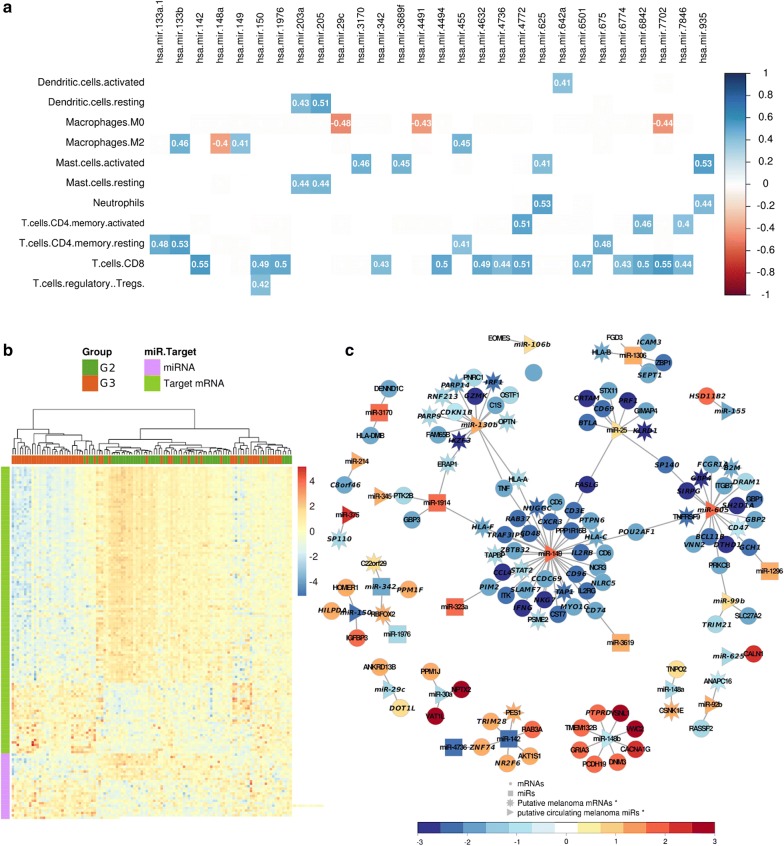
Interested in understanding the interplay between melanoma and immune-related TME cells, we characterized the TCGA's metastatic melanoma samples according to their tumor microenvironment profiles, HLA-I neoepitopes, transcriptome profile and classified them into three groups. Moreover, we combined our results with melanoma single-cell gene expression and public miRNA data to better characterize the regulatory network of circulating miRNAs and their targets related to immune evasion and microenvironment response.
The group associated with a worse prognosis showed phenotypic characteristics that favor immune evasion, including a strong signature of suppressor cells and less stable neoantigen:HLA-I complexes. Conversely, the group with better prognosis was marked by enrichment in lymphocyte and MHC signatures. By analyzing publicly available melanoma single-cell RNA and microvesicle microRNAs sequencing data we identified circulating microRNAs potentially involved in the crosstalk between tumor and TME cells. Candidate miRNA/target gene pairs with previously reported roles in tumor progression and immune escape mechanisms were further investigated and demonstrated to impact patient's overall survival not only in melanoma but across different tumor types.
Our results underscore the impact of tumor-microenvironment interactions on disease outcomes and reveal potential non-invasive biomarkers of prognosis and treatment response.
恶性细胞与肿瘤微环境(TME)中存在的免疫细胞之间的相互作用调节肿瘤发展和进展的不同方面。最近的研究表明含miRNA的细胞外囊泡在这种串扰中的重要性。
为了了解黑色素瘤与免疫相关TME细胞之间的相互作用,我们根据肿瘤微环境谱、HLA-I新表位、转录组谱对TCGA的转移性黑色素瘤样本进行了特征分析,并将它们分为三组。此外,我们将我们的结果与黑色素瘤单细胞基因表达和公开的miRNA数据相结合,以更好地表征循环miRNA及其与免疫逃逸和微环境反应相关的靶标的调控网络。
与较差预后相关的组表现出有利于免疫逃逸的表型特征,包括抑制细胞的强烈特征和不太稳定的新抗原:HLA-I复合物。相反,预后较好的组以淋巴细胞和MHC特征的富集为标志。通过分析公开可用的黑色素瘤单细胞RNA和微泡miRNA测序数据,我们确定了可能参与肿瘤与TME细胞之间串扰的循环miRNA。对先前报道在肿瘤进展和免疫逃逸机制中起作用的候选miRNA/靶基因对进行了进一步研究,并证明不仅在黑色素瘤中,而且在不同肿瘤类型中都影响患者的总生存期。
我们的结果强调了肿瘤-微环境相互作用对疾病结局的影响,并揭示了预后和治疗反应的潜在非侵入性生物标志物。