McConnell Brain Imaging Centre, Montreal Neurological Institute, McGill University, Montreal, QC, Canada.
Interdisciplinary Neuroscience Research Program, Students' Scientific Research Center, Tehran University of Medical Sciences, Tehran, Iran.
Nat Commun. 2020 Feb 5;11(1):709. doi: 10.1038/s41467-020-14610-8.
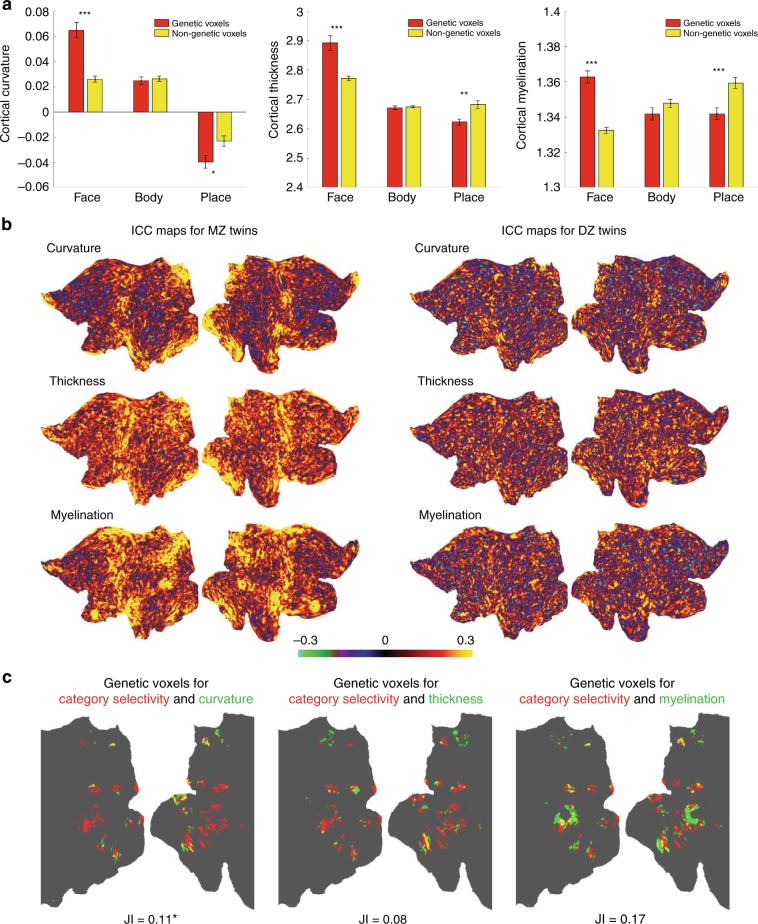
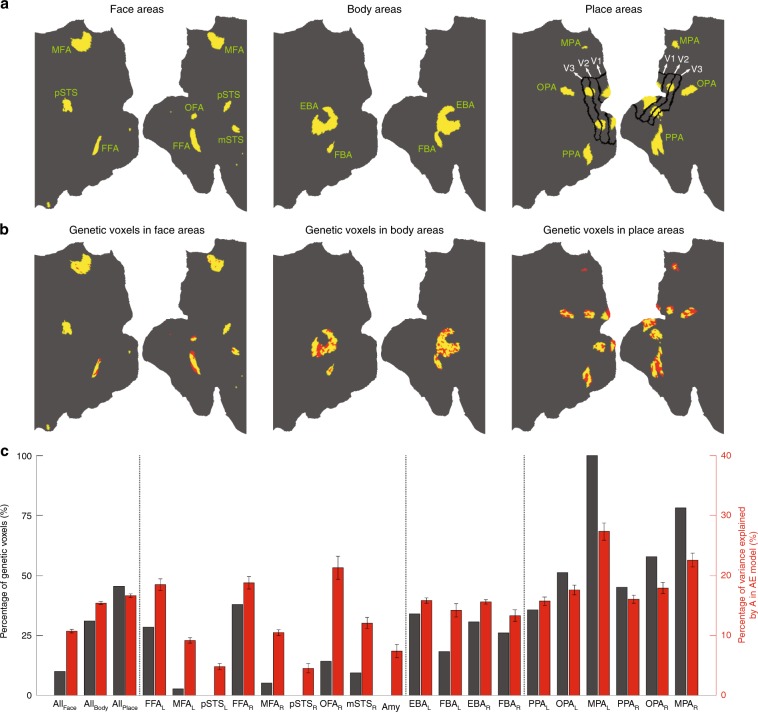
Human visual cortex contains discrete areas that respond selectively to specific object categories such as faces, bodies, and places. A long-standing question is whether these areas are shaped by genetic or environmental factors. To address this question, here we analyzed functional MRI data from an unprecedented number (n = 424) of monozygotic (MZ) and dizygotic (DZ) twins. Category-selective maps were more identical in MZ than DZ twins. Within each category-selective area, distinct subregions showed significant genetic influence. Structural MRI analysis revealed that the 'genetic voxels' were predominantly located in regions with higher cortical curvature (gyral crowns in face areas and sulcal fundi in place areas). Moreover, we found that cortex was thicker and more myelinated in genetic voxels of face areas, while it was thinner and less myelinated in genetic voxels of place areas. This double dissociation suggests a differential development of face and place areas in cerebral cortex.
人类视觉皮层包含离散的区域,这些区域对特定的物体类别(如人脸、身体和地点)有选择性地反应。一个长期存在的问题是这些区域是由遗传还是环境因素形成的。为了解决这个问题,我们分析了来自史无前例数量(n=424)的同卵(MZ)和异卵(DZ)双胞胎的功能性磁共振成像(fMRI)数据。在 MZ 双胞胎中,类别选择性图谱比 DZ 双胞胎更相似。在每个类别选择性区域内,不同的亚区显示出显著的遗传影响。结构磁共振成像(MRI)分析显示,“遗传体素”主要位于皮质曲率较高的区域(面部区域的脑回顶部和位置区域的脑沟底部)。此外,我们发现面部区域的遗传体素中皮质更厚、髓鞘化程度更高,而位置区域的遗传体素中皮质更薄、髓鞘化程度更低。这种双重分离表明大脑皮层中人脸和地点区域的发育存在差异。