Postgraduate Program in Epidemiology, School of Medicine, Universidade Federal de Pelotas. Rua Marechal Deodoro, 1160, Centro, 96020-220, Pelotas, Brazil.
Postgraduate Program in Physical Education, School of Physical Education, Universidade Federal de Pelotas. Rua Luís de Camões, 625, Três Vendas, 96055-630, Pelotas, Brazil.
Sci Rep. 2020 Feb 5;10(1):1851. doi: 10.1038/s41598-020-59034-y.
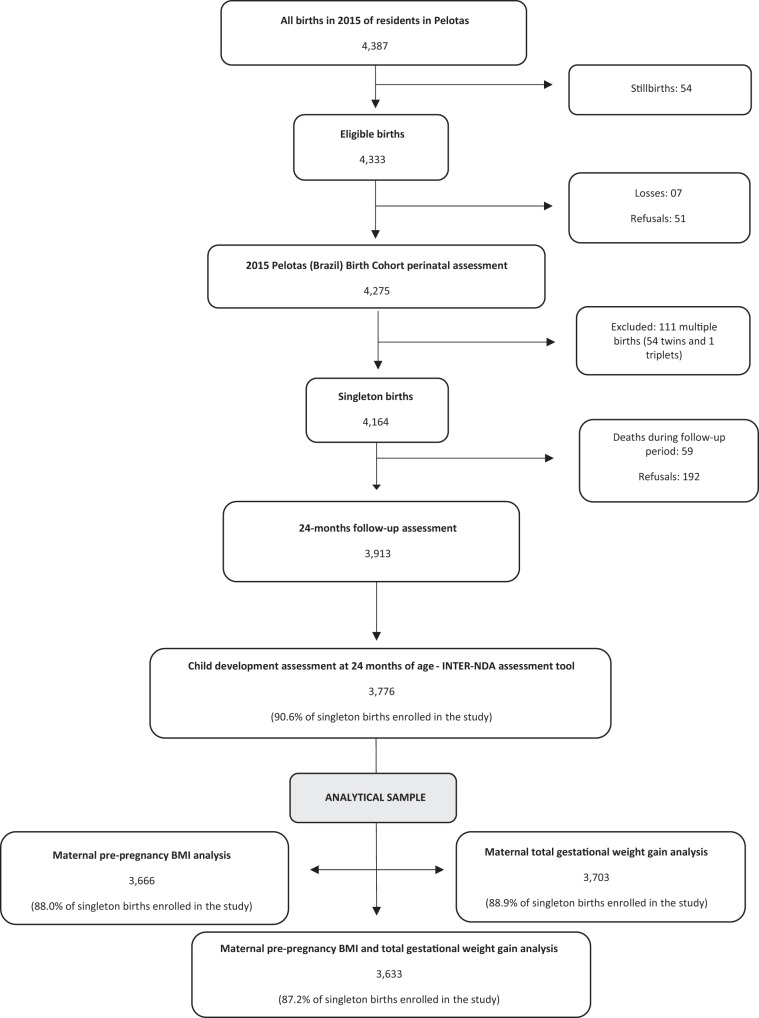
Inadequate pre-pregnancy BMI and gestational weight gain (GWG) have been associated with sub-optimal child development. We used data from the 2015 Pelotas (Brazil) Birth Cohort Study. Maternal anthropometry was extracted from antenatal/hospital records. BMI (kg/m) and GWG (kg) adequacy were classified according to WHO and IOM, respectively. Development was evaluated using the INTER-NDA assessment tool for 3,776 children aged 24 months. Suspected developmental delay (SDD) was defined as <10th percentile. Associations between maternal exposures and child development were tested using linear and logistic regressions. Mediation for the association between BMI and child development through GWG was tested using G-formula. Sex differences were observed for all child development domains, except motor. Maternal pre-pregnancy underweight increased the odds of SDD in language (OR: 2.75; 95%CI: 1.30-5.80), motor (OR: 2.28; 95%CI: 1.20-4.33), and global (OR: 2.14; 95% CI: 1.05-4.33) domains for girls; among boys, excessive GWG was associated with SDD in language (OR: 1.59; 95%CI: 1.13-2.24) and cognition (OR: 1.59; 95%CI: 1.15-2.22). Total GWG suppressed the association of pre-pregnancy BMI with percentiles of global development in the entire sample. Maternal underweight and excessive GWG were negatively associated with development of girls and boys, respectively. The association of pre-pregnancy BMI with global child development was not mediated by GWG, irrespective of child's sex.
孕前 BMI 不足和孕期体重增加不足(GWG)与儿童发育不良有关。我们使用了 2015 年佩洛塔斯(巴西)出生队列研究的数据。从产前/医院记录中提取了母体人体测量数据。根据世界卫生组织(WHO)和美国医学研究所(IOM)的标准,分别对 BMI(kg/m)和 GWG(kg)的充足性进行了分类。使用 INTER-NDA 评估工具对 24 个月大的 3776 名儿童进行了发育评估。将发育迟缓(SDD)定义为<第 10 百分位数。使用线性和逻辑回归检验了母体暴露与儿童发育之间的关系。使用 G 公式检验了 BMI 与儿童发育之间的关联的中介作用。除运动外,所有儿童发育领域都存在性别差异。女孩的语言(OR:2.75;95%CI:1.30-5.80)、运动(OR:2.28;95%CI:1.20-4.33)和整体(OR:2.14;95%CI:1.05-4.33)领域的母亲孕前体重不足会增加 SDD 的几率;对于男孩,过度 GWG 与语言(OR:1.59;95%CI:1.13-2.24)和认知(OR:1.59;95%CI:1.15-2.22)领域的 SDD 有关。总 GWG 抑制了孕前 BMI 与整个样本全球发育百分位数的关联。母亲体重不足和 GWG 过多分别与女孩和男孩的发育不良呈负相关。无论儿童的性别如何,孕前 BMI 与全球儿童发育的关联都不受 GWG 的影响。