Gahamanyi Noel, Mboera Leonard E G, Matee Mecky I, Mutangana Dieudonné, Komba Erick V G
SACIDS Foundation for One Health, College of Veterinary Medicine and Biomedical Sciences, Sokoine University of Agriculture, P.O. Box 3015, Chuo Kikuu, Morogoro, Tanzania.
School of Medicine, Muhimbili University of Health and Allied Sciences, P.O. Box 65001, Dar es Salaam, Tanzania.
Int J Microbiol. 2020 Jan 14;2020:2092478. doi: 10.1155/2020/2092478. eCollection 2020.
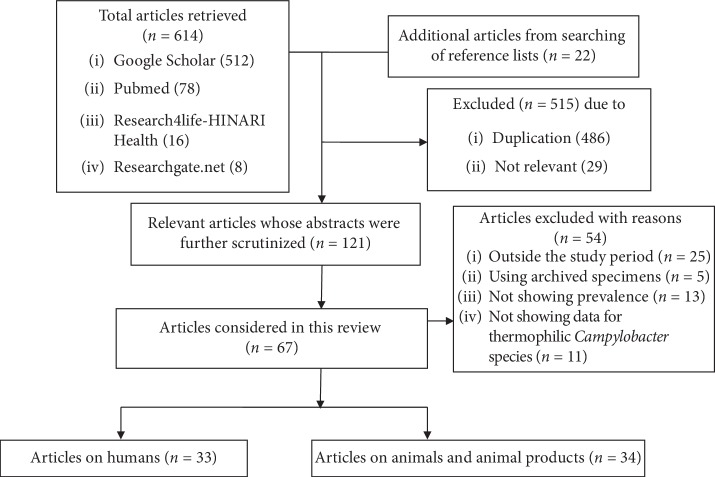
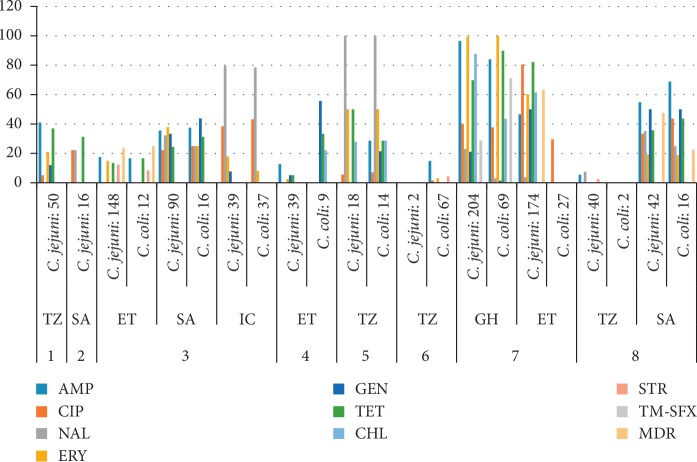
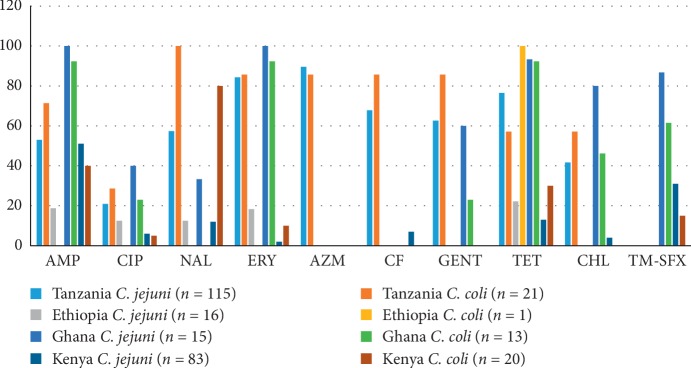
Thermophilic species are clinically important aetiologies of gastroenteritis in humans throughout the world. The colonization of different animal reservoirs by poses an important risk for humans through shedding of the pathogen in livestock waste and contamination of water sources, environment, and food. A review of published articles was conducted to obtain information on the prevalence and antimicrobial resistance (AMR) profiles of thermophilic species in humans and animals in sub-Saharan Africa (SSA). Electronic databases, namely, PubMed, Google Scholar, Research4life-HINARI Health, and Researchgate.net, were searched using the following search terms "thermophilic ," "," "," "diarrhea/diarrhoea," "antimicrobial resistance," "antibiotic resistance," "humans," "animals," "Sub-Saharan Africa," and "a specific country name." Initially, a total of 614 articles were identified, and the lists of references were screened in which 22 more articles were identified. After screening, 33 articles on humans and 34 on animals and animal products were included in this review. In humans, Nigeria reported the highest prevalence (62.7%), followed by Malawi (21%) and South Africa (20.3%). For infections in under-five children, Kenya reported 16.4%, followed by Rwanda (15.5%) and Ethiopia (14.5%). The country-level mean prevalence in all ages and under-five children was 18.6% and 9.4%, respectively. The prevalence ranged from 1.7%-62.7% in humans and 1.2%-80% in animals. The most reported species were and . The AMR to commonly used antimicrobials ranged from 0-100% in both humans and animals. Poultry consumption and drinking surface water were the main risk factors for campylobacteriosis. The present review provides evidence of thermophilic occurrence in humans and animals and high levels of AMR in SSA, emphasizing the need for strengthening both national and regional multisectoral antimicrobial resistance standard surveillance protocols to curb both the campylobacteriosis burden and increase of antimicrobial resistance in the region.
嗜热菌是全球人类肠胃炎的重要临床病因。嗜热菌在不同动物宿主中的定殖,通过家畜粪便中病原体的排放以及水源、环境和食物的污染,对人类构成了重大风险。我们对已发表的文章进行了综述,以获取有关撒哈拉以南非洲(SSA)人类和动物中嗜热菌的流行情况和抗菌药物耐药性(AMR)概况的信息。使用以下搜索词搜索了电子数据库,即PubMed、谷歌学术、Research4life - HINARI Health和Researchgate.net:“嗜热菌”、“[具体菌名]”、“人类”、“动物”、“腹泻”、“抗菌药物耐药性”、“抗生素耐药性”、“撒哈拉以南非洲”以及“特定国家名称”。最初,共识别出614篇文章,并对参考文献列表进行了筛选,又从中识别出22篇文章。筛选后,本综述纳入了33篇关于人类的文章和34篇关于动物及动物产品的文章。在人类中,尼日利亚报告的患病率最高(62.7%),其次是马拉维(21%)和南非(20.3%)。对于五岁以下儿童的[具体菌名]感染,肯尼亚报告为16.4%,其次是卢旺达(15.5%)和埃塞俄比亚(14.5%)。所有年龄段和五岁以下儿童的国家层面平均患病率分别为18.6%和9.4%。人类患病率范围为1.7% - 62.7%,动物患病率范围为1.2% - 80%。报告最多的菌种是[具体菌种1]和[具体菌种2]。人类和动物对常用抗菌药物的AMR范围为0 - 100%。食用家禽和饮用地表水是弯曲杆菌病的主要危险因素。本综述提供了嗜热菌在人类和动物中存在以及SSA地区高水平AMR的证据,强调需要加强国家和区域多部门抗菌药物耐药性标准监测方案,以控制弯曲杆菌病负担并遏制该地区抗菌药物耐药性的增加。