Department of Veterinary Sciences, University of Turin, largo Braccini 2, 10095, Grugliasco, TO, Italy.
Department of Veterinary Medicine and Animal Productions, University of Naples Federico II, Via Federico Delpino, 1, 80137, Naples, Italy.
BMC Vet Res. 2020 Feb 7;16(1):46. doi: 10.1186/s12917-020-2263-4.
Ticks and tick-borne diseases are increasingly recognized as a cause of disease in dogs worldwide. The epidemiology of ticks and tick-transmitted protozoa and bacteria has changed due to the spread of ticks to urban and peri-urban areas and the movement of infected animals, posing new risks for animals and humans. This countrywide study reports information on distribution and prevalence of pathogens in ticks collected from privately-owned dogs in Italy. We analyzed 2681 Ixodidae ticks, collected from 1454 pet dogs from Italy. Specific PCR protocols were used to detect i) Piroplasms of the genera Babesia and Theileria, ii) Gram-negative cocci of the family Anaplasmataceae and iii) Borrelia burgdorferi sensu lato. Sequencing of positive amplicons allowed for species identification.
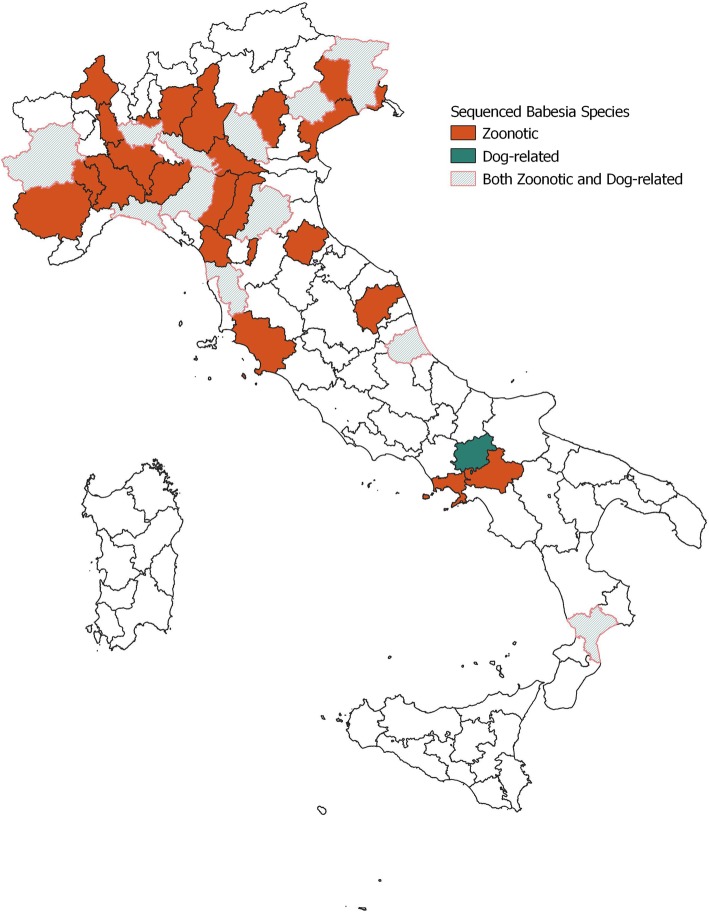
Babesia/Theileria spp. DNA was detected in 435 homogeneous tick-pools (Minimum Infection Rate (MIR) = 27.6%; 95% confidence interval (CI) = 25.4-29.8%) with higher prevalence in Ixodes ricinus and Rhipicephalus sanguneus group. The zoonotic B. venatorum was the most prevalent species (MIR = 7.5%; 95% CI = 6.3-9.0%). Anaplasma and Ehrlichia species were detected in 165 tick-pools (MIR = 10.5%; 95% CI = 9.3-11.8%) and specifically, A. phagocytophilum was identified with MIR = 5.1% (95% CI = 4.1-6.3%). Borrelia burgdorferi s.l. and B. afzelii were detected with MIR = 0.4% (95% CI = 0.2-0.8%) and MIR = 0.3% (95% CI 0.1-0.7%) respectively.
Zoonotic pathogens B. venatorum and A. phagocytophilum were the most frequently detected in ticks collected from privately-owned dogs which might be used as markers of pathogens presence and distribution.
蜱虫和蜱传疾病在全球范围内被认为是犬类疾病的一个日益严重的原因。由于蜱虫传播到城市和城郊地区以及受感染动物的迁移,蜱虫和蜱传原生动物和细菌的流行病学发生了变化,这给动物和人类带来了新的风险。本研究报告了在意大利私人拥有的犬中采集的蜱虫中病原体的分布和流行情况。我们分析了从意大利 1454 只宠物犬中采集的 2681 只硬蜱。使用特定的 PCR 方案来检测 i)巴贝斯虫属和泰勒虫属的梨形虫,ii)革兰氏阴性球菌的阿纳普拉马西亚科和 iii)伯氏疏螺旋体亚种。阳性扩增子的测序允许进行物种鉴定。
在 435 个同质蜱虫群中检测到巴贝斯虫/泰勒虫属 DNA(最小感染率 (MIR) = 27.6%;95%置信区间 (CI) = 25.4-29.8%),在硬蜱和革蜱属中发现了更高的流行率。最流行的种是具有潜在感染性的伯氏疏螺旋体(MIR = 7.5%;95% CI = 6.3-9.0%)。在 165 个蜱虫群中检测到阿氏和埃利希体种(MIR = 10.5%;95% CI = 9.3-11.8%),具体来说,鉴定出 A. phagocytophilum 的 MIR = 5.1%(95% CI = 4.1-6.3%)。检测到伯氏疏螺旋体亚种和 B. afzelii 的 MIR 分别为 0.4%(95% CI = 0.2-0.8%)和 0.3%(95% CI 0.1-0.7%)。
从私人拥有的犬中采集的蜱虫中最常检测到的是具有潜在感染性的伯氏疏螺旋体和 A. phagocytophilum,它们可能被用作病原体存在和分布的标志物。