Department of Veterinary Medicine and Animal Production, University of Naples Federico II, Naples, Italy.
MSD Animal Health, Milan, Italy.
Parasit Vectors. 2018 Jul 16;11(1):420. doi: 10.1186/s13071-018-2994-2.
The geographical distribution of ticks on companion animals needs to be monitored to develop and plan effective control measures, as suggested by the European Scientific Counsel on Companion Animal Parasites. The aim of this study was to conduct the first Italian national survey of tick distribution on privately owned dogs.
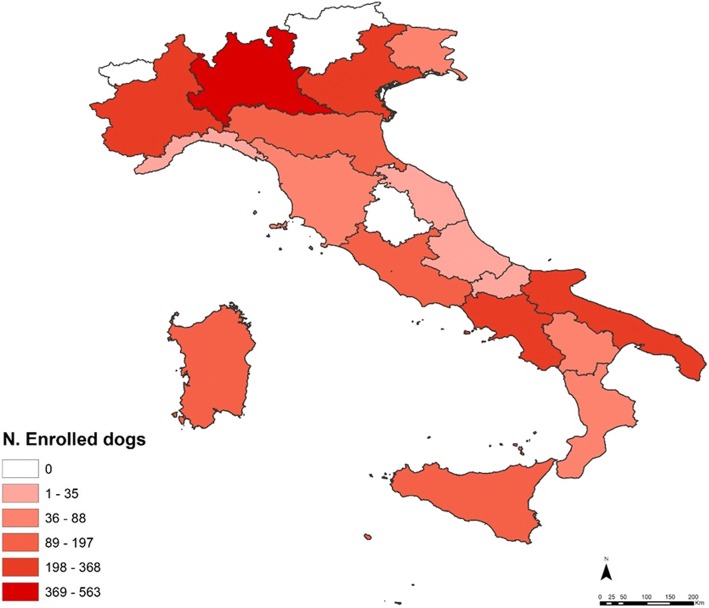
The study was performed over 20 months (February 2016 - September 2017) and involved 153 veterinary practices in 64 different provinces covering 17/20 (85%) Italian regions. Participating practitioners were asked to examine five different dogs per month at random and complete a questionnaire for each dog. Differences in tick infestation associated with: sex, age and hair length (long and short); the dog's habitat (indoor or outdoor/kennel); and the dog's environment (urban or rural/sylvatic) were evaluated. The attachment site of ticks on the dog was also recorded. Acaricide efficacy was evaluated for the subset of dogs for which complete information on product used, date of sampling and date of last ectoparasiticide treatment was available.
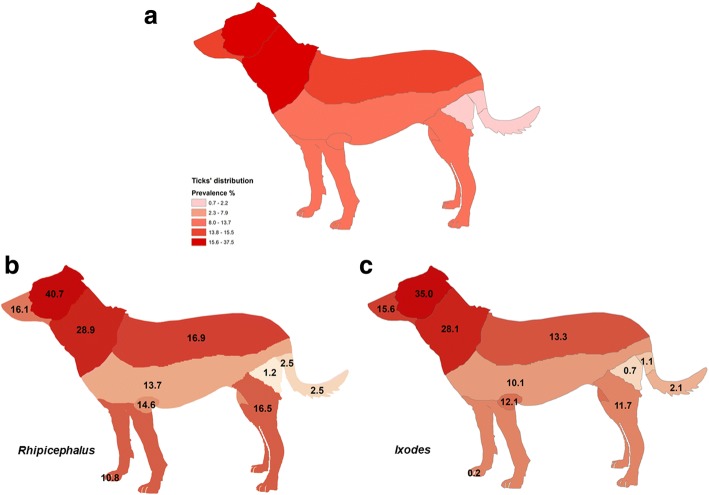
Of the 3026 dogs examined, 1383 (45.7%) were carrying at least one tick. Overall, 2439 tick samples were collected and a total of 14 tick species identified. Rhipicephalus sanguineus group were the most predominant ticks (63.6%), followed by Ixodes ricinus (30.6%) and I. hexagonus (5.6%). Twenty-four dogs had mixed tick infestations. Long-haired dogs had a higher tick infestation risk as did dogs with outdoor and rural/sylvatic lifestyles. Ticks were located on the head (37.4%), the neck (28.8%), the muzzle (15.5%) and the back (15.3%). A higher prevalence of Rhipicephalus was found in the interdigital spaces (10.8%) compared to Ixodes (0.2%). Finally, ectoparasiticide treatments were found significantly protective against tick infestation, especially orally administered formulations.
Privately owned dogs in Italy have a high prevalence (45.7%) of infestation with ixodid ticks and this risk varies by dog phenotype and lifestyle.
正如欧洲伴侣动物寄生虫科学顾问所建议的那样,需要监测宠物身上的蜱虫的地理分布,以制定和规划有效的控制措施。本研究的目的是对意大利私人拥有的犬只的蜱虫分布进行首次全国性调查。
本研究于 2016 年 2 月至 2017 年 9 月进行,涉及意大利 64 个不同省份的 153 家兽医诊所,覆盖了意大利 20 个大区中的 17 个(85%)。参与的执业兽医被要求每月随机检查 5 只不同的狗,并为每只狗填写一份调查问卷。评估了与以下因素相关的蜱虫感染率差异:性别、年龄和毛发长度(长和短);狗的栖息地(室内或室外/犬舍);狗的环境(城市或农村/森林)。还记录了蜱虫在狗身上的附着部位。对于那些提供了有关所用产品、采样日期和上次驱虫处理日期的完整信息的狗子集,评估了杀蜱剂的疗效。
在检查的 3026 只狗中,有 1383 只(45.7%)携带至少一只蜱虫。总共采集了 2439 个蜱虫样本,共鉴定出 14 种蜱虫。硬蜱属血蜱组是最主要的蜱虫(63.6%),其次是璃眼蜱属(30.6%)和扇头蜱属(5.6%)。24 只狗有混合蜱虫感染。长毛狗、有户外和农村/森林生活方式的狗感染蜱虫的风险更高。蜱虫位于头部(37.4%)、颈部(28.8%)、口鼻部(15.5%)和背部(15.3%)。指间(10.8%)的硬蜱属比璃眼蜱属(0.2%)更为常见。最后,驱虫剂治疗对蜱虫感染有明显的保护作用,尤其是口服制剂。
意大利私人拥有的犬只的硬蜱属和璃眼蜱属的感染率很高(45.7%),且这种风险因狗的表型和生活方式而异。