Department of Preclinical Sciences, Faculty of Medical Sciences, The University of the West Indies, St. Augustine Campus, St. Augustine, Trinidad and Tobago.
Poxvirus and Rabies Branch, Centers for Disease Control and Prevention, Atlanta, GA 30329, USA.
Viruses. 2020 Feb 5;12(2):178. doi: 10.3390/v12020178.
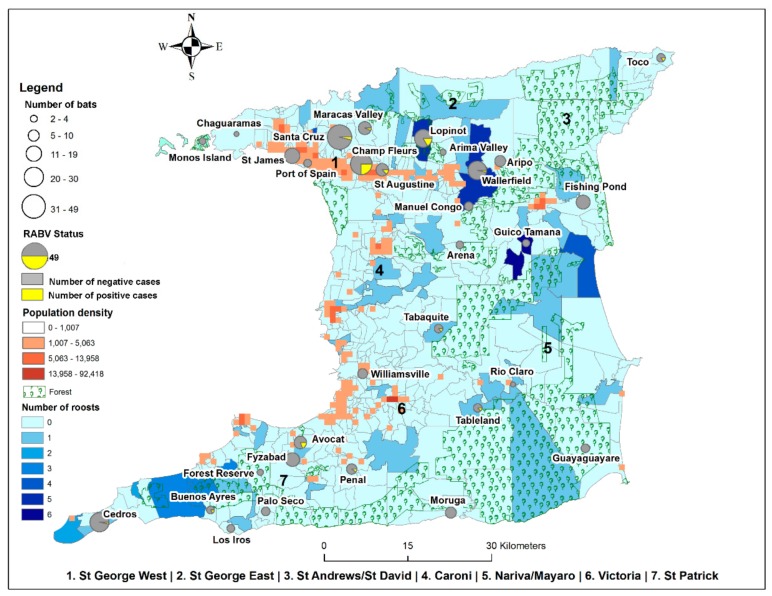
Rabies virus (RABV) is the only lyssavirus known to be present within the Caribbean. The island of Trinidad, is richly diverse in chiropteran fauna and endemic for bat-transmitted rabies with low RABV isolation rates observed in this population. We aimed to determine the seroprevalence of rabies virus neutralizing antibodies (RVNA) in light of spatio-temporal and bat demographic factors to infer the extent of natural exposure to RABV in the Trinidadian bat population. RVNA titers were determined by the RABV micro-neutralization test on 383 bat samples representing 21 species, comprising 30.9% of local bat diversity, from 31 locations across the island over 5 years. RVNA was positively detected in 33 samples (8.6%) representing 6 bat species (mainly frugivorous) with titers ranging from 0.1 to 19 IU/mL (mean 1.66 IU/mL). The analyses based on a multivariable binomial generalised linear mixed-effects model showed that bat age and year of capture were significant predictors of seropositivity. Thus, juvenile bats were more likely to be seropositive when compared to adults (estimate 1.13; = 0.04) which may suggest early exposure to the RABV with possible implications for viral amplification in this population. Temporal variation in rabies seropositivity, 2012-2014 versus 2015-2017 (estimate 1.07; = 0.03) may have been related to the prevailing rabies epizootic situation. Regarding other factors investigated, RVNA was found in bats from both rural and non-rural areas, as well as in both hematophagous and non-hematophagous bat species. The most common seropositive species, is ubiquitous throughout the island which may potentially facilitate human exposure. The findings of this study should be factored into public health assessments on the potential for rabies transmission by non-hematophagous bats in Trinidad.
狂犬病病毒(RABV)是加勒比地区唯一已知存在的狂犬病病毒。特立尼达岛拥有丰富多样的蝙蝠区系,是蝙蝠传播狂犬病的地方,并观察到该人群中的 RABV 分离率较低。我们旨在根据时空和蝙蝠人口统计学因素确定狂犬病病毒中和抗体(RVNA)的血清流行率,以推断 RABV 在特立尼达蝙蝠种群中的自然暴露程度。使用 RABV 微量中和试验在 383 个蝙蝠样本中测定 RVNA 滴度,这些样本代表 21 个物种,占当地蝙蝠多样性的 30.9%,来自岛上 31 个地点,时间跨度为 5 年。在 33 个样本(8.6%)中检测到 RVNA,代表 6 种蝙蝠(主要是食果蝠),滴度范围为 0.1 至 19 IU/mL(平均 1.66 IU/mL)。基于多变量二项广义线性混合效应模型的分析表明,蝙蝠年龄和捕获年份是血清阳性的重要预测因素。因此,与成年蝙蝠相比,幼蝠更有可能呈血清阳性(估计值 1.13; = 0.04),这可能表明它们早期接触了 RABV,这可能对该种群中的病毒扩增产生影响。2012-2014 年与 2015-2017 年之间狂犬病血清阳性率的时间变化(估计值 1.07; = 0.03)可能与流行的狂犬病疫情有关。关于调查的其他因素,在农村和非农村地区的蝙蝠以及吸血和非吸血蝙蝠物种中都发现了 RVNA。最常见的血清阳性物种 无处不在,这可能会增加人类接触的风险。本研究的结果应纳入特立尼达岛非吸血蝙蝠传播狂犬病的潜在公共卫生评估中。