Department of Epidemiology and Biostatistics, School of Public Health, Tongji Medical College, Huazhong University of Science and Technology, Wuhan, Hubei, China.
Key Laboratory of Environment and Health, Ministry of Education & Ministry of Environmental Protection, State Key Laboratory of Environmental Health (Incubating), School of Public Health, Tongji Medical College, Huazhong University of Science and Technology, Wuhan, Hubei, China.
Br J Cancer. 2020 Mar;122(7):1085-1093. doi: 10.1038/s41416-020-0741-x. Epub 2020 Feb 10.
Cancer poses a huge disease burden, which could be reduced by adopting healthy lifestyles mainly composed of healthy diet, body weight, physical activity, limited alcohol consumption, and avoidance of smoking. However, no systematic review has summarised the relations of combined lifestyle factors with cancer morbidity and mortality.
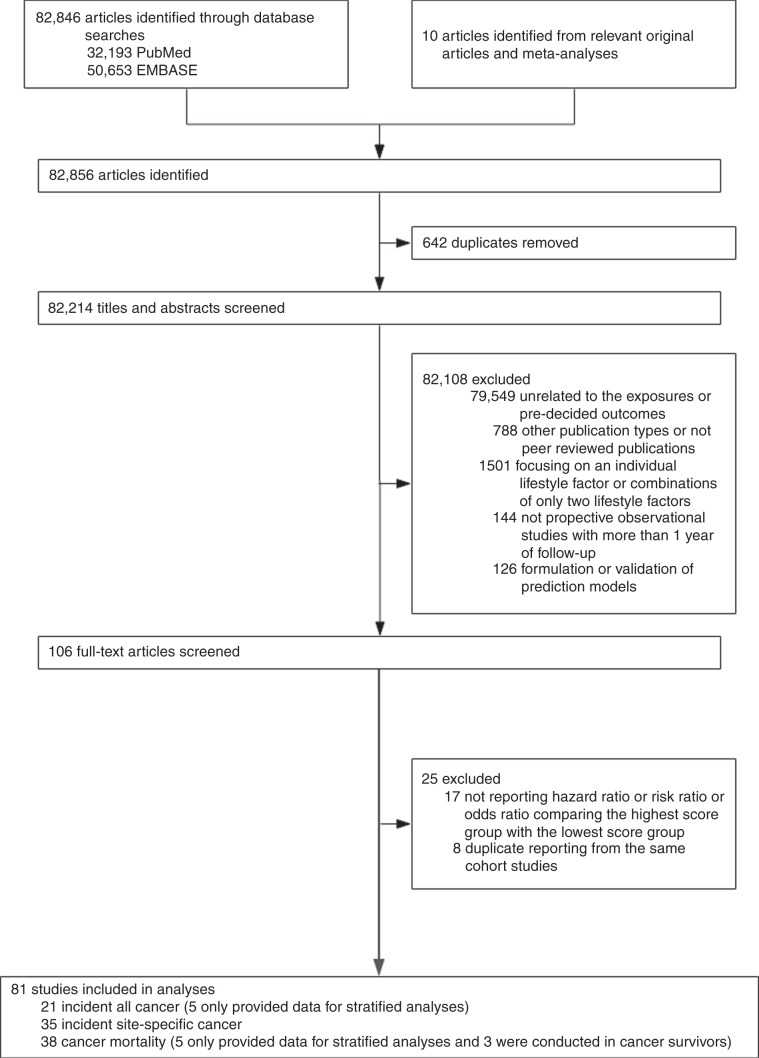
EMBASE and PubMed were searched up to April 2019. Cohort studies investigating the association of combined lifestyle factors with risks of incident cancer and cancer mortality were selected. Summary hazard ratios (HRs) and 95% confidence intervals (CIs) were calculated using random-effects models. Heterogeneity and publication bias tests were conducted.
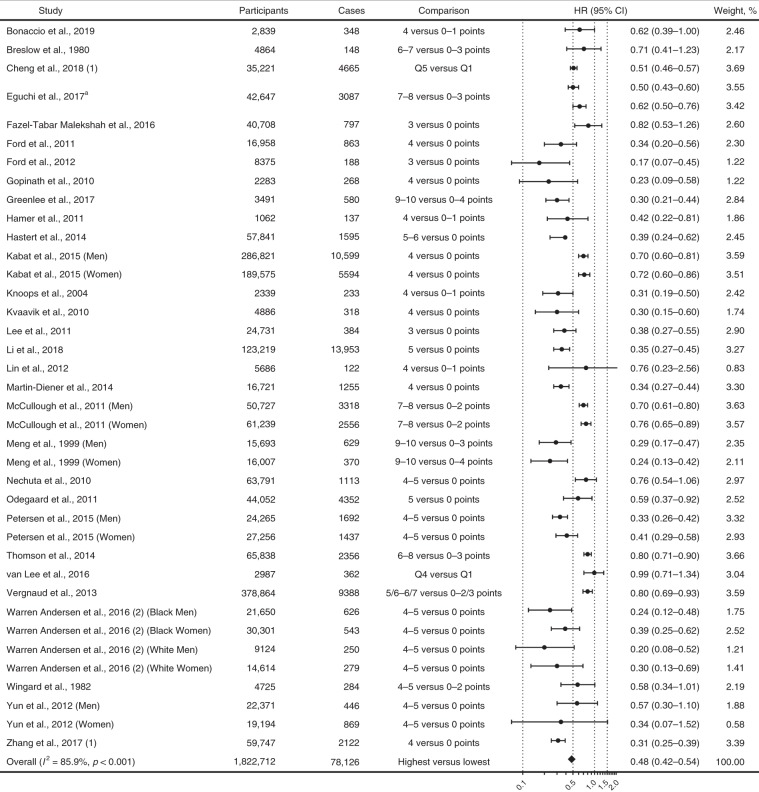
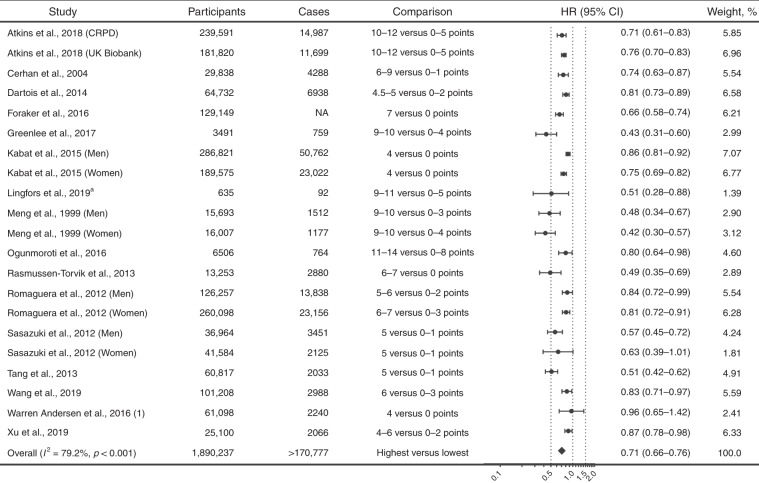
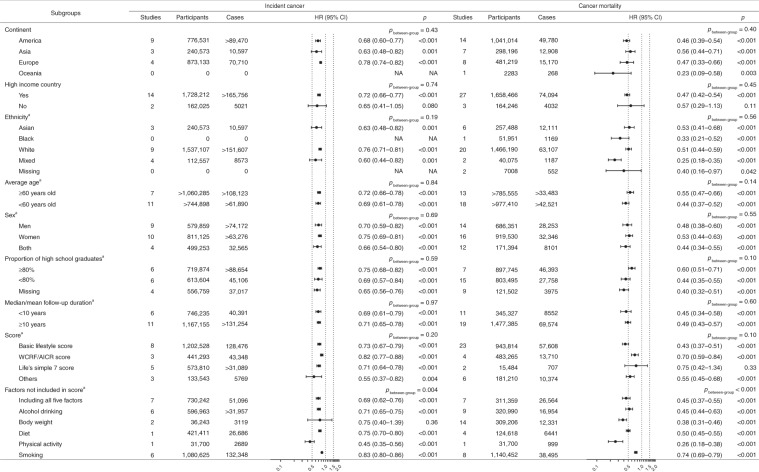
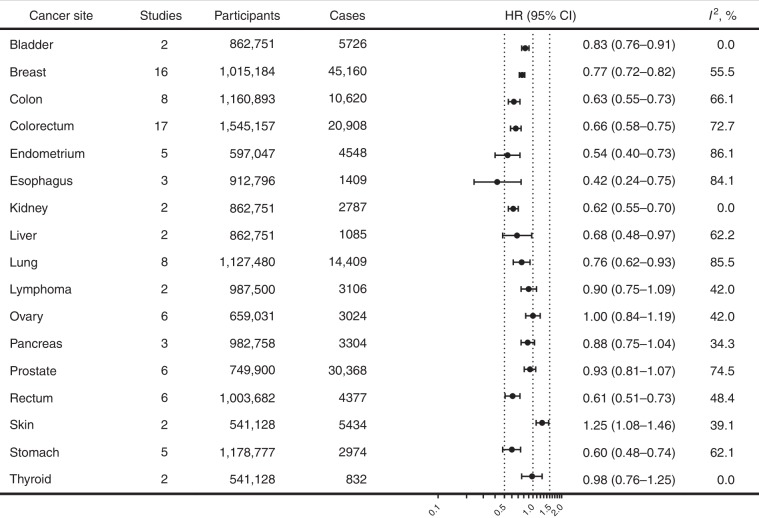
The HRs (95% CIs) comparing individuals with the healthiest versus the least healthy lifestyles were 0.71 (0.66-0.76; 16 studies with 1.9 million participants) for incident cancer and 0.48 (0.42-0.54; 30 studies with 1.8 million participants) for cancer mortality. Adopting the healthiest lifestyles was also associated with 17 to 58% lower risks of bladder, breast, colon, endometrial, oesophageal, kidney, liver, lung, rectal, and gastric cancer. The relations were largely consistent and significant among participants with different characteristics in the subgroup analyses.
Adopting healthy lifestyles is associated with substantial risk reduction in cancer morbidity and mortality, and thus should be given priority for cancer prevention.
癌症造成了巨大的疾病负担,通过采取主要由健康饮食、体重、身体活动、限制饮酒和避免吸烟组成的健康生活方式,可降低癌症负担。然而,尚无系统评价综合生活方式因素与癌症发病率和死亡率之间的关系。
检索 EMBASE 和 PubMed,截至 2019 年 4 月。选择了队列研究,以调查综合生活方式因素与癌症发病风险和癌症死亡率之间的关系。使用随机效应模型计算汇总风险比(HRs)和 95%置信区间(CIs)。进行了异质性和发表偏倚检验。
与生活方式最不健康的人相比,生活方式最健康的人发生癌症的 HR(95%CI)为 0.71(0.66-0.76;16 项研究,190 万参与者),癌症死亡率的 HR(95%CI)为 0.48(0.42-0.54;30 项研究,180 万参与者)。采用最健康的生活方式也与膀胱癌、乳腺癌、结肠癌、子宫内膜癌、食管癌、肾癌、肝癌、肺癌、直肠癌和胃癌的风险降低 17%至 58%相关。在亚组分析中,具有不同特征的参与者中,这些关系基本一致且具有统计学意义。
采用健康的生活方式与癌症发病率和死亡率的大幅降低相关,因此应优先考虑用于癌症预防。