Dahyot Sandrine, Oxaran Virginie, Niepceron Maïté, Dupart Eddy, Legris Stéphanie, Destruel Laurie, Didi Jennifer, Clamens Thomas, Lesouhaitier Olivier, Zerdoumi Yasmine, Flaman Jean-Michel, Pestel-Caron Martine
Groupe de Recherche sur l'Adaptation Microbienne (GRAM 2.0), Department of Bacteriology, Rouen University Hospital, Normandie University, UNIROUEN, UNICAEN, Rouen, France.
Department of Biological Sciences, Border Biomedical Research Center, University of Texas at El Paso, El Paso, TX, United States.
Front Microbiol. 2020 Jan 24;11:39. doi: 10.3389/fmicb.2020.00039. eCollection 2020.
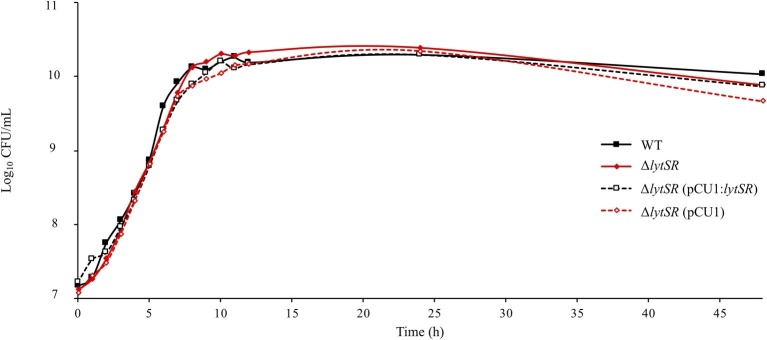
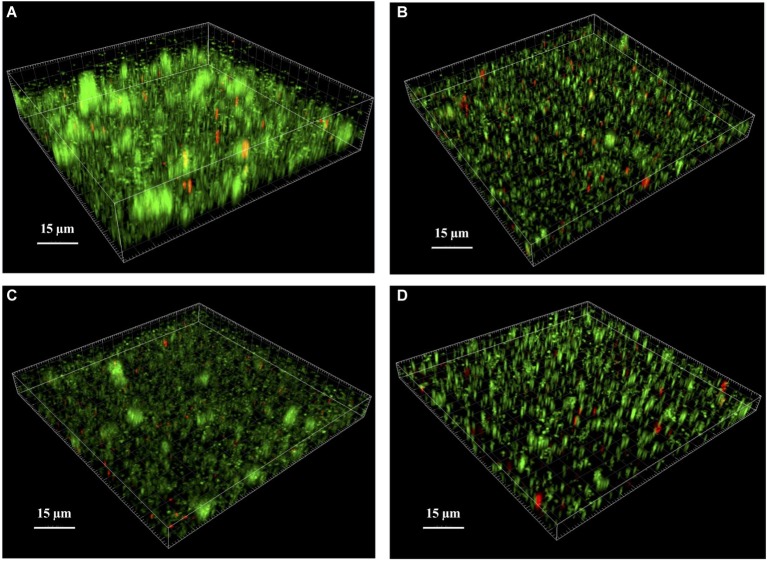
is a coagulase negative recognized as a virulent pathogen. It is responsible for a wide variety of infections, some of which are associated with biofilm production, such as implanted medical device infections or endocarditis. However, little is known about regulation of virulence factor expression. Two-component regulatory systems (TCS) play a critical role in bacterial adaptation, survival, and virulence. Among them, LytSR is widely conserved but has variable roles in different organisms, all connected to metabolism or cell death and lysis occurring during biofilm development. Therefore, we investigated here the functions of LytSR in pathogenesis. Deletion of in DSM 4804 strain did not alter either susceptibility to Triton X-100 induced autolysis or death induced by antibiotics targeting cell wall synthesis. Interestingly, Δ biofilm was characterized by a lower biomass, a lack of tower structures, and a higher rate of dead cells compared to the wild-type strain. Virulence toward using a slow-killing assay was significantly reduced for the mutant compared to the wild-type strain. By contrast, the deletion of had no effect on the cytotoxicity of toward the human keratinocyte cell line HaCaT. Transcriptional analyses conducted at mid- and late-exponential phases showed that deletion affected the expression of 286 genes. Most of them were involved in basic functions such as the metabolism of amino acids, carbohydrates, and nucleotides. Furthermore, LytSR appeared to be involved in the regulation of genes encoding known or putative virulence and colonization factors, including the fibrinogen-binding protein Fbl, the major autolysin AtlL, and the type VII secretion system. Overall, our data suggest that the LytSR TCS is implicated in pathogenesis, through its involvement in biofilm formation and potentially by the control of genes encoding putative virulence factors.
是一种凝固酶阴性菌,被认为是一种致病性病原体。它可引发多种感染,其中一些与生物膜形成有关,如植入式医疗器械感染或心内膜炎。然而,关于其毒力因子表达的调控知之甚少。双组分调节系统(TCS)在细菌适应、存活和毒力方面起着关键作用。其中,LytSR广泛保守,但在不同生物体中具有不同作用,所有这些作用都与生物膜形成过程中发生的代谢或细胞死亡及裂解有关。因此,我们在此研究了LytSR在其致病机制中的功能。在DSM 4804菌株中缺失该基因,既未改变对Triton X-100诱导的自溶的敏感性,也未改变针对细胞壁合成的抗生素诱导的死亡。有趣的是,与野生型菌株相比,Δ生物膜的特征是生物量较低、缺乏塔状结构且死细胞率较高。与野生型菌株相比,使用慢杀试验对其毒力显著降低。相比之下,缺失该基因对其对人角质形成细胞系HaCaT的细胞毒性没有影响。在指数中期和后期进行的转录分析表明,该基因缺失影响了286个基因的表达。其中大多数参与基本功能,如氨基酸、碳水化合物和核苷酸的代谢。此外,LytSR似乎参与了编码已知或推定的毒力和定植因子的基因的调控,包括纤维蛋白原结合蛋白Fbl、主要自溶素AtlL和VII型分泌系统。总体而言,我们的数据表明,LytSR TCS通过参与生物膜形成以及潜在地通过控制编码推定毒力因子的基因而参与其致病机制。