Rouf Anika, Nour Monica, Allman-Farinelli Margaret
The University of Sydney, School of Life and Environmental Sciences, Camperdown, Australia.
JMIR Mhealth Uhealth. 2020 Feb 11;8(2):e16499. doi: 10.2196/16499.
Calcium is an important nutrient for the attainment of peak bone mass during adolescence and young adulthood. However, these life phases are characterized as hard to reach for health promotion. Social media platforms offer a promising channel as they are relatively low cost but used ubiquitously by youth.
The aim of the CAlcium Nutrition-Dietary Opportunities (CAN-DO) study was to conduct a randomized controlled trial to test the effectiveness of Facebook alone or with text messaging as channels to deliver a theory-based program to encourage optimal calcium intake.
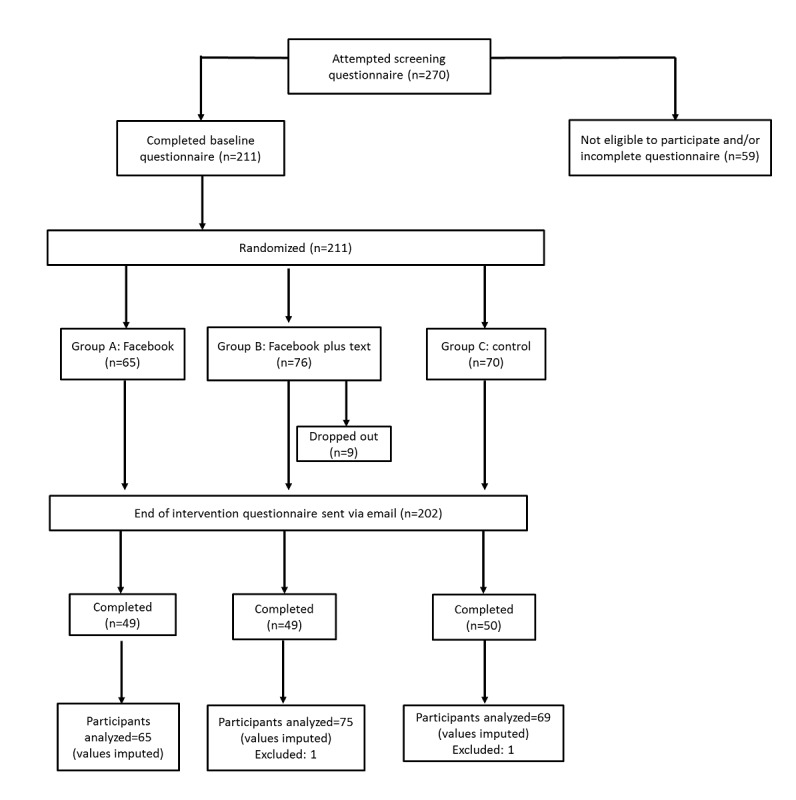
The intervention was a 3-arm parallel trial. Young adults aged 18 to 25 years were recruited through university and social media for a 6-week trial. Participants were randomized to 1 of the 3 arms (ie, Facebook posts, Facebook posts plus text messages, and control group that received an electronic leaflet containing information on calcium intake). The primary outcome was change in intake of milk and other calcium-rich foods, and secondary outcomes were knowledge, self-efficacy, motivation, and habit formation concerning calcium-rich foods. Changes were assessed before and after the intervention, and the differences in change between groups were compared using multivariate regression models with multiple imputations for missing data.
A total of 211 participants (64/211, 30.3% males) participated (mean age 21.4 years, SD 2.1) in this study. At the end of the program, no increase in milk intake (odds ratio [OR] 1.51, 95% CI 0.61-3.75 Facebook; OR 1.77, 95% CI 0.74-4.24 Facebook plus text messages; P=.41) nor calcium-rich food was detected (P=.57). There was a significant improvement in knowledge in the Facebook plus text messages group (P<.001), but habit formation improved less than that in the other 2 groups (P=.01). Our results showed a moderate level of engagement with intervention content and positive qualitative feedback from participants.
The CAN-DO study delivered via Facebook (with the additional support of text messages) was found to improve knowledge and was acceptable among young adults. However, further research is needed to better understand social media engagement and how to optimize the program for participants to be sufficiently motivated to increase their intake of calcium-rich foods.
Australian New Zealand Clinical Trials Registry ACTRN12620000097943; http://www.anzctr.org.au/ACTRN12620000097943.aspx.
钙是青少年和青年时期达到峰值骨量所需的重要营养素。然而,这些生命阶段的健康促进工作很难开展。社交媒体平台提供了一个很有前景的渠道,因为它们成本相对较低,且受到年轻人的广泛使用。
钙营养-饮食机会(CAN-DO)研究的目的是进行一项随机对照试验,以测试仅通过Facebook或结合短信作为渠道来提供一个基于理论的项目,以鼓励最佳钙摄入量的有效性。
干预采用三臂平行试验。通过大学和社交媒体招募18至25岁的年轻人进行为期6周的试验。参与者被随机分配到三个组中的一组(即Facebook帖子组、Facebook帖子加短信组和接受包含钙摄入信息的电子传单的对照组)。主要结局是牛奶和其他富含钙食物的摄入量变化,次要结局是关于富含钙食物的知识、自我效能感、动机和习惯形成。在干预前后评估变化,并使用多变量回归模型对缺失数据进行多重插补来比较组间变化的差异。
共有211名参与者(64/211,30.3%为男性)参与了本研究(平均年龄21.4岁,标准差2.1)。在项目结束时,未发现牛奶摄入量增加(优势比[OR]1.51,95%置信区间0.61 - 3.75,Facebook组;OR 1.77,95%置信区间0.74 - 4.24,Facebook加短信组;P = 0.41),也未发现富含钙食物摄入量增加(P = 0.57)。Facebook加短信组的知识有显著改善(P < 0.001),但习惯形成的改善程度低于其他两组(P = 0.01)。我们的结果显示参与者对干预内容的参与程度适中,并得到了积极的定性反馈。
通过Facebook(并辅以短信)开展的CAN-DO研究被发现能提高知识水平,且在年轻人中是可接受的。然而,需要进一步研究以更好地理解社交媒体参与情况以及如何优化该项目,使参与者有足够的动力增加富含钙食物的摄入量。
澳大利亚新西兰临床试验注册中心ACTRN12620000097943;http://www.anzctr.org.au/ACTRN12620000097943.aspx。