BK21 Plus, College of Health Science, Korea University, Seoul, 02841, Republic of Korea.
Department of Food Science and Technology, Chung-Ang University, Anseong, 17546, Republic of Korea.
BMC Complement Med Ther. 2020 Feb 11;20(1):47. doi: 10.1186/s12906-020-2827-7.
The aim of this study was to investigate the effect of tannase-converted green tea extract with a high (-)-epicatechin (EC), (-)-epigallocatechin (EGC), and gallic acid (GA) content on myotube density and fusion in normal and oxidative stress-induced C2C12 skeletal muscle cells. Although the use of green tea extract is considered beneficial, cellular and molecular mechanisms of action of tannase-converted green tea extracts that are used as potential muscle growth materials have not been thoroughly studied.
This study used histological analysis and molecular biology techniques, and compared the results with those for AMPK activator 5-aminoimidazole-4-carboxamide-1-β-D-ribonucleoside (AICAR) and green tea extracts.
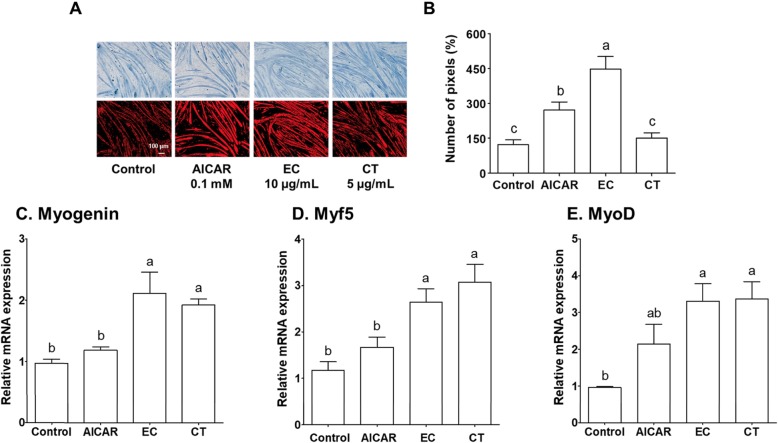
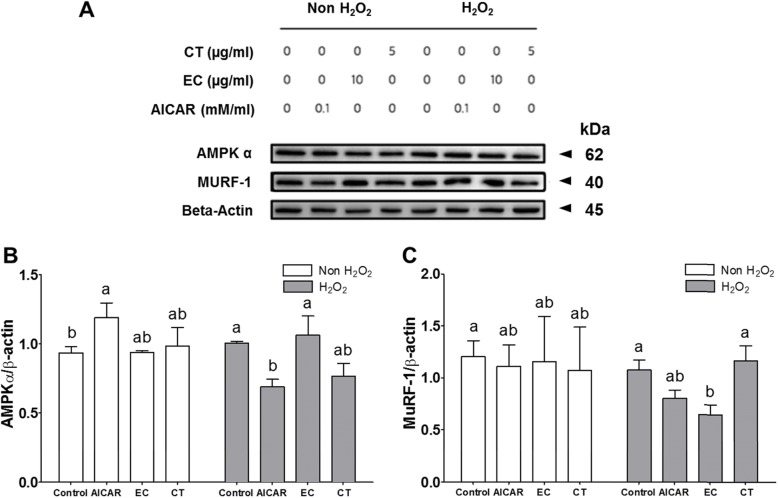
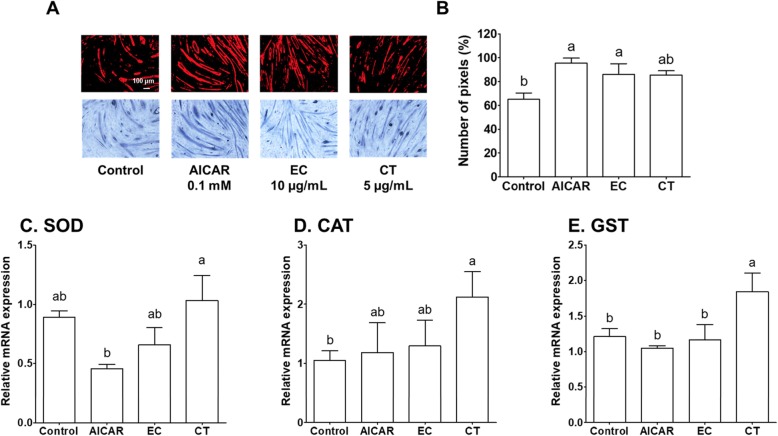
The myotube density of normal and oxidative stress-induced C2C12 cells was significantly higher in the tannase-converted green tea extract-treated group than that observed in the other groups (normal cells: P < 0.01; oxidative stress-induced cells: P < 0.05). In addition, tannase-converted green tea extract and green tea extract treatments significantly upregulated the genetic expression of myogenin, Myf5, and MyoD (P < 0.05). The levels of AMP-activated protein kinase-α (AMPKα) and muscle RING-finger protein-1 (MuRF-1) in the tannase-converted green tea extract group were higher than those in the AICAR and green tea extract groups (P < 0.05).
Taken together, our findings describe that the high levels of EC, EGC, and GA in the tannase-converted green tea extract are attributable to the morphological changes in C2C12 cells and intercellular signaling pathways. Therefore, tannase-converted green tea extract can be used in the treatment of sarcopenia.
本研究旨在探讨单宁酶转化的高(-)-表儿茶素(EC)、(-)-表没食子儿茶素(EGC)和没食子酸(GA)含量的绿茶提取物对正常和氧化应激诱导的 C2C12 骨骼肌细胞肌管密度和融合的影响。虽然绿茶提取物的使用被认为是有益的,但作为潜在肌肉生长物质的单宁酶转化的绿茶提取物的细胞和分子作用机制尚未得到彻底研究。
本研究采用组织学分析和分子生物学技术,并将结果与 AMPK 激活剂 5-氨基咪唑-4-甲酰胺-1-β-D-核糖核苷酸(AICAR)和绿茶提取物进行比较。
与其他组相比,正常和氧化应激诱导的 C2C12 细胞的肌管密度在单宁酶转化的绿茶提取物处理组中明显更高(正常细胞:P<0.01;氧化应激诱导的细胞:P<0.05)。此外,单宁酶转化的绿茶提取物和绿茶提取物处理可显著上调肌生成素、Myf5 和 MyoD 的基因表达(P<0.05)。单宁酶转化的绿茶提取物组的 AMP 激活蛋白激酶-α(AMPKα)和肌肉环指蛋白-1(MuRF-1)水平高于 AICAR 和绿茶提取物组(P<0.05)。
综上所述,我们的研究结果表明,单宁酶转化的绿茶提取物中 EC、EGC 和 GA 的高含量归因于 C2C12 细胞的形态变化和细胞间信号通路。因此,单宁酶转化的绿茶提取物可用于治疗肌肉减少症。