Systems Assessment Center, Energy Systems Division, Argonne National Laboratory, Lemont, IL, USA.
Climate and Sustainability Group, Aramco Research Center-Detroit, Aramco Services Company, Novi, MI, USA.
Nat Commun. 2020 Feb 11;11(1):824. doi: 10.1038/s41467-020-14606-4.
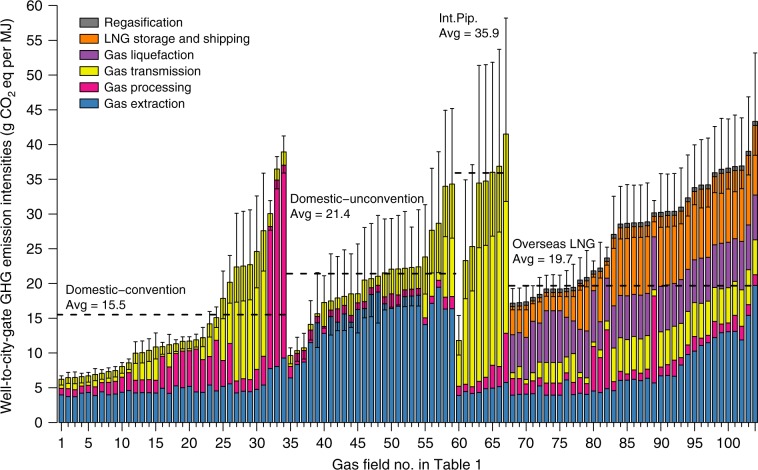
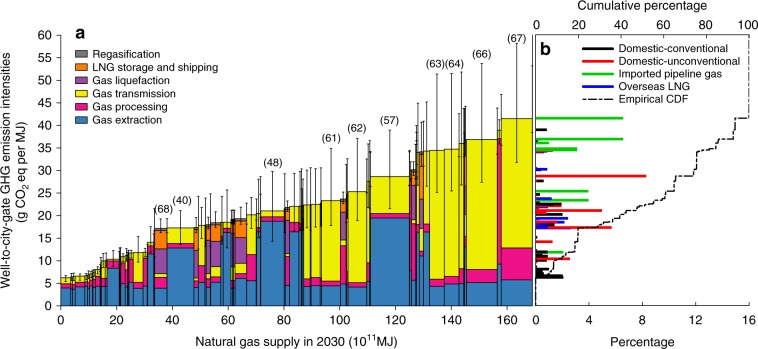
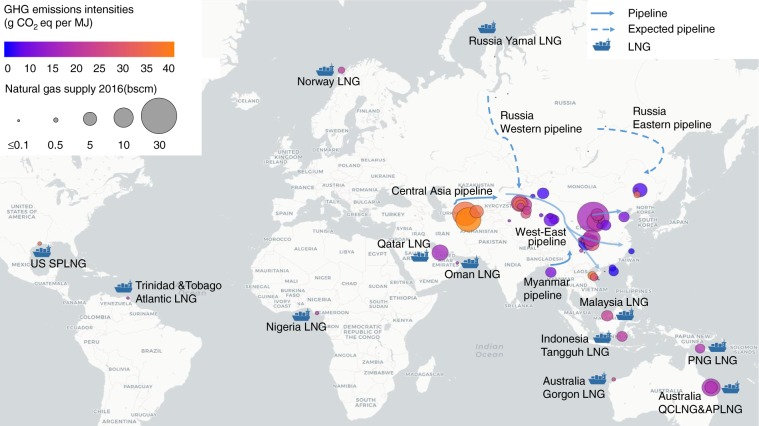
As natural gas demand surges in China, driven by the coal-to-gas switching policy, widespread attention is focused on its impacts on global gas supply-demand rebalance and greenhouse gas (GHG) emissions. Here, for the first time, we estimate well-to-city-gate GHG emissions of gas supplies for China, based on analyses of field-specific characteristics of 104 fields in 15 countries. Results show GHG intensities of supplies from 104 fields vary from 6.2 to 43.3 g COeq MJ. Due to the increase of GHG-intensive gas supplies from Russia, Central Asia, and domestic shale gas fields, the supply-energy-weighted average GHG intensity is projected to increase from 21.7 in 2016 to 23.3 COeq MJ in 2030, and total well-to-city-gate emissions of gas supplies are estimated to grow by ~3 times. While securing gas supply is a top priority for the Chinese government, decreasing GHG intensity should be considered in meeting its commitment to emission reductions.
随着中国“煤改气”政策推动天然气需求飙升,人们普遍关注其对全球天然气供需再平衡和温室气体(GHG)排放的影响。在此,我们首次根据 15 个国家的 104 个气田的具体特征分析,估算了中国天然气供应的井口到城市门站的温室气体排放。结果表明,104 个气田的供应温室气体强度从 6.2 到 43.3g COeq MJ 不等。由于俄罗斯、中亚和国内页岩气田的高温室气体强度天然气供应增加,预计供应能源加权平均温室气体强度将从 2016 年的 21.7 增加到 2030 年的 23.3 COeq MJ,天然气供应的总井口到城市门站的排放量预计将增长约 3 倍。在确保天然气供应是中国政府的首要任务的同时,在履行减排承诺方面,应考虑降低温室气体强度。