Center for Autophagy Research, Department of Internal Medicine, University of Texas Southwestern Medical Center, Dallas, TX, USA.
Howard Hughes Medical Institute, University of Texas Southwestern Medical Center, Dallas, TX, USA.
Nature. 2020 Feb;578(7796):605-609. doi: 10.1038/s41586-020-1992-7. Epub 2020 Feb 12.
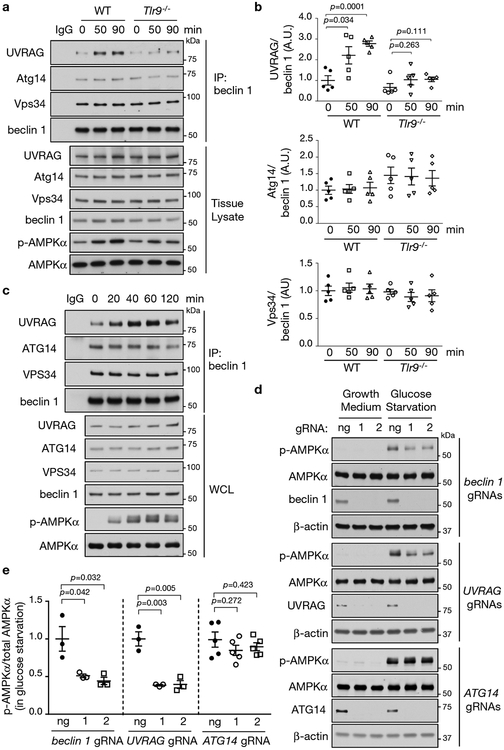
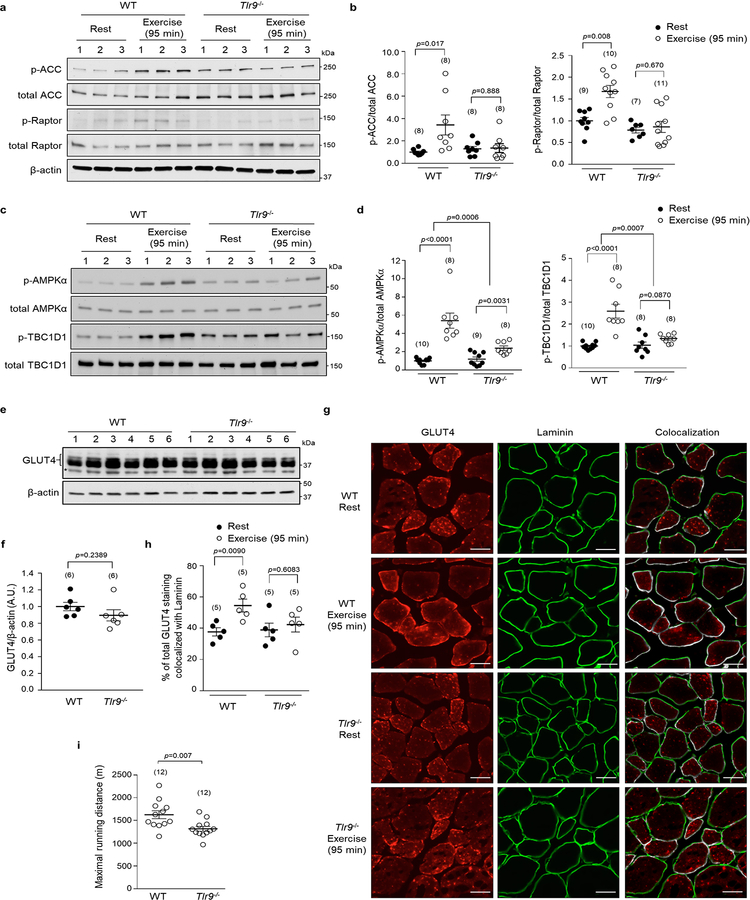
The activation of adenosine monophosphate-activated protein kinase (AMPK) in skeletal muscle coordinates systemic metabolic responses to exercise. Autophagy-a lysosomal degradation pathway that maintains cellular homeostasis-is upregulated during exercise, and a core autophagy protein, beclin 1, is required for AMPK activation in skeletal muscle. Here we describe a role for the innate immune-sensing molecule Toll-like receptor 9 (TLR9), and its interaction with beclin 1, in exercise-induced activation of AMPK in skeletal muscle. Mice that lack TLR9 are deficient in both exercise-induced activation of AMPK and plasma membrane localization of the GLUT4 glucose transporter in skeletal muscle, but are not deficient in autophagy. TLR9 binds beclin 1, and this interaction is increased by energy stress (glucose starvation and endurance exercise) and decreased by a BCL2 mutation that blocks the disruption of BCL2-beclin 1 binding. TLR9 regulates the assembly of the endolysosomal phosphatidylinositol 3-kinase complex (PI3KC3-C2)-which contains beclin 1 and UVRAG-in skeletal muscle during exercise, and knockout of beclin 1 or UVRAG inhibits the cellular AMPK activation induced by glucose starvation. Moreover, TLR9 functions in a muscle-autonomous fashion in ex vivo contraction-induced AMPK activation, glucose uptake and beclin 1-UVRAG complex assembly. These findings reveal a heretofore undescribed role for a Toll-like receptor in skeletal-muscle AMPK activation and glucose metabolism during exercise, as well as unexpected crosstalk between this innate immune sensor and autophagy proteins.
腺苷单磷酸激活蛋白激酶 (AMPK) 在骨骼肌中的激活协调了运动对全身代谢的反应。自噬——一种维持细胞内环境稳定的溶酶体降解途径——在运动过程中被上调,而自噬的核心蛋白 beclin1 是 AMPK 在骨骼肌中激活所必需的。在这里,我们描述了先天免疫感应分子 Toll 样受体 9 (TLR9) 及其与 beclin1 的相互作用在运动诱导的 AMPK 激活中的作用。缺乏 TLR9 的小鼠既缺乏运动诱导的 AMPK 激活,也缺乏骨骼肌中 GLUT4 葡萄糖转运体的质膜定位,但不缺乏自噬。TLR9 与 beclin1 结合,这种相互作用会被能量应激(葡萄糖饥饿和耐力运动)增加,被阻止 BCL2-beclin1 结合破坏的 BCL2 突变减少。TLR9 调节运动过程中骨骼肌内内溶酶体磷脂酰肌醇 3-激酶复合物(PI3KC3-C2)的组装——该复合物包含 beclin1 和 UVRAG——并且 beclin1 或 UVRAG 的缺失抑制了葡萄糖饥饿引起的细胞 AMPK 激活。此外,TLR9 在离体收缩诱导的 AMPK 激活、葡萄糖摄取和 beclin1-UVRAG 复合物组装中以肌肉自主的方式发挥作用。这些发现揭示了 Toll 样受体在运动过程中骨骼肌 AMPK 激活和葡萄糖代谢中的一个以前未被描述的作用,以及这种先天免疫传感器和自噬蛋白之间的意外串扰。