Anaya-Esparza Luis Miguel, Ruvalcaba-Gómez José Martín, Maytorena-Verdugo Claudia Ivette, González-Silva Napoleón, Romero-Toledo Rafael, Aguilera-Aguirre Selene, Pérez-Larios Alejandro, Montalvo-González And Efigenia
Laboratorio Integral de Investigación en Alimentos, Tecnológico Nacional de México-Instituto Tecnológico de Tepic. Av. Tecnológico 2595 Fracc. Lagos del Country, Tepic 63175, Mexico.
Universidad de Guadalajara, Centro Universitario de los Altos, División de Ciencias Agropecuarias e Ingenierías, Laboratorio de Materiales, Agua y Energía, Av. Rafael Casillas Aceves 1200, Tepatitlán de Morelos 47600, Mexico.
Materials (Basel). 2020 Feb 11;13(4):811. doi: 10.3390/ma13040811.
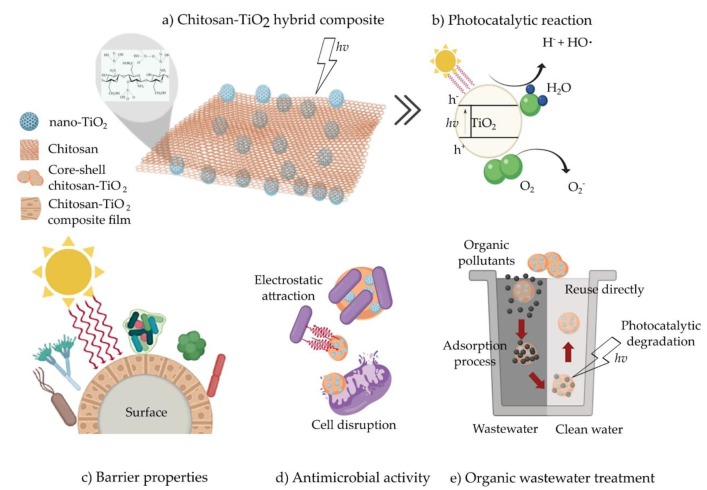
In recent years, a strong interest has emerged in hybrid composites and their potential uses, especially in chitosan-titanium dioxide (CS-TiO) composites, which have interesting technological properties and applications. This review describes the reported advantages and limitations of the functionalization of chitosan by adding TiO nanoparticles. Their effects on structural, textural, thermal, optical, mechanical, and vapor barrier properties and their biodegradability are also discussed. Evidence shows that the incorporation of TiO onto the CS matrix improves all the above properties in a dose-dependent manner. Nonetheless, the CS-TiO composite exhibits great potential applications including antimicrobial activity against bacteria and fungi; UV-barrier properties when it is used for packaging and textile purposes; environmental applications for removal of heavy metal ions and degradation of diverse water pollutants; biomedical applications as a wound-healing material, drug delivery system, or by the development of biosensors. Furthermore, no cytotoxic effects of CS-TiO have been reported on different cell lines, which supports their use for food and biomedical applications. Moreover, CS-TiO has also been used as an anti-corrosive material. However, the development of suitable protocols for CS-TiO composite preparation is mandatory for industrial-scale implementation.
近年来,人们对混合复合材料及其潜在用途产生了浓厚兴趣,尤其是壳聚糖 - 二氧化钛(CS - TiO)复合材料,其具有有趣的技术特性和应用。本综述描述了通过添加TiO纳米颗粒对壳聚糖进行功能化的已报道的优点和局限性。还讨论了它们对结构、织构、热、光学、机械和防潮性能及其生物降解性的影响。证据表明,将TiO掺入CS基质中以剂量依赖的方式改善了上述所有性能。尽管如此,CS - TiO复合材料仍具有巨大的潜在应用,包括对细菌和真菌的抗菌活性;用于包装和纺织目的时的紫外线阻隔性能;用于去除重金属离子和降解各种水污染物的环境应用;作为伤口愈合材料、药物递送系统或通过开发生物传感器的生物医学应用。此外,尚未报道CS - TiO对不同细胞系有细胞毒性作用,这支持了它们在食品和生物医学应用中的使用。此外,CS - TiO还被用作防腐材料。然而,开发适合的CS - TiO复合材料制备方案对于工业规模实施是必不可少的。