Li Jie, Xie Bing, Xia Kai, Li Yingchun, Han Jing, Zhao Chunmao
School of Materials Science and Engineering, North University of China, Taiyuan 030051, China.
School of Mechatronic Engineering, North University of China, Taiyuan 030051, China.
Materials (Basel). 2018 Aug 10;11(8):1403. doi: 10.3390/ma11081403.
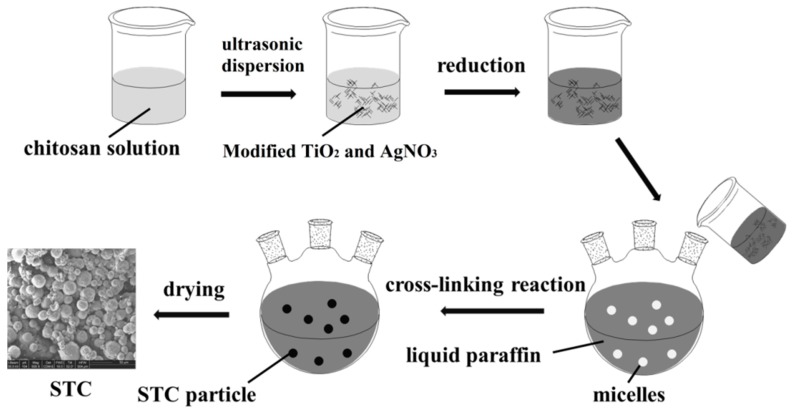
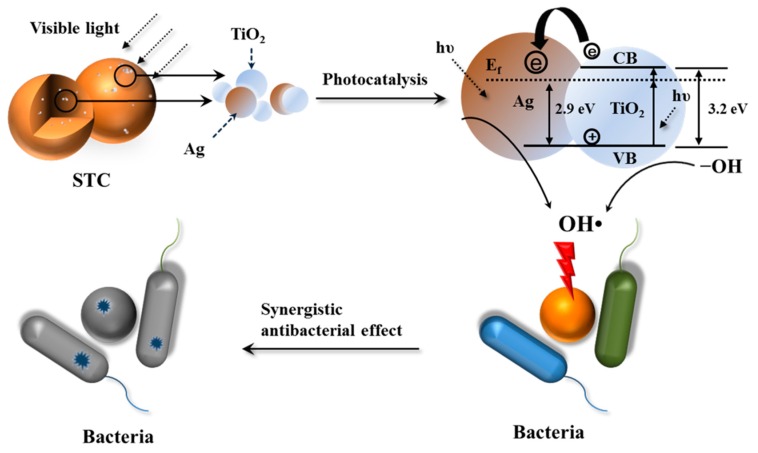
Nano titanium dioxide (TiO₂) with photocatalytic activity was firstly modified by diethanolamine, and it was then doped with broad spectrum antibacterial silver (Ag) by in situ method. Further, both Ag doped TiO₂-chitosan (STC) and TiO₂-chitosan (TC) composites were prepared by the inverse emulsion cross-linking reaction. The antibacterial activities of STC composites were studied and their antibacterial mechanisms under visible light were investigated. The results show that in situ doping and inverse emulsion method led to good dispersion of Ag and TiO₂ nanoparticles on the cross-linked chitosan microsphere. The STC with regular particle size of 1⁻10 μm exhibited excellent antibacterial activity against , and under visible light. It is believed that STC with particle size of 1⁻10 μm has large specific surface area to contact with bacterial cell wall. The increased antibacterial activity was attributed to the enhancement of both electron-hole separations at the surface of nano-TiO₂ by the silver ions under the visible light, and the synergetic and sustained release of strong oxidizing hydroxyl radicals of nano-TiO₂, together with silver ions against bacteria. Thus, STC composites have great potential applications as antibacterial agents in the water treatment field.
具有光催化活性的纳米二氧化钛(TiO₂)首先用二乙醇胺进行改性,然后通过原位法掺杂广谱抗菌银(Ag)。此外,通过反相乳液交联反应制备了Ag掺杂的TiO₂-壳聚糖(STC)和TiO₂-壳聚糖(TC)复合材料。研究了STC复合材料的抗菌活性,并研究了其在可见光下的抗菌机制。结果表明,原位掺杂和反相乳液法使Ag和TiO₂纳米颗粒在交联壳聚糖微球上具有良好的分散性。粒径为1⁻10μm的STC在可见光下对 、 和 表现出优异的抗菌活性。据信,粒径为1⁻10μm的STC具有较大的比表面积以与细菌细胞壁接触。抗菌活性的提高归因于可见光下银离子增强了纳米TiO₂表面的电子-空穴分离,以及纳米TiO₂与银离子协同并持续释放强氧化性的羟基自由基来对抗细菌。因此,STC复合材料在水处理领域作为抗菌剂具有巨大的潜在应用价值。