Department of Urology, Tongji Hospital, Tongji Medical College, Huazhong University of Science and Technology, Wuhan, People's Republic of China.
School of Public Health, Tongji Medical College, Huazhong University of Science and Technology, Wuhan, People's Republic of China.
BMC Urol. 2020 Feb 14;20(1):13. doi: 10.1186/s12894-020-0582-1.
Endourological procedures are widely used to treat benign urinary disorders and the double-J stent is routinely used. However, its potential impact on sexual function remains unclear. Therefore, we performed a quantitative systematic review to determine the relationship between endourological procedures with or without double-J stent and post-operative sexual function.
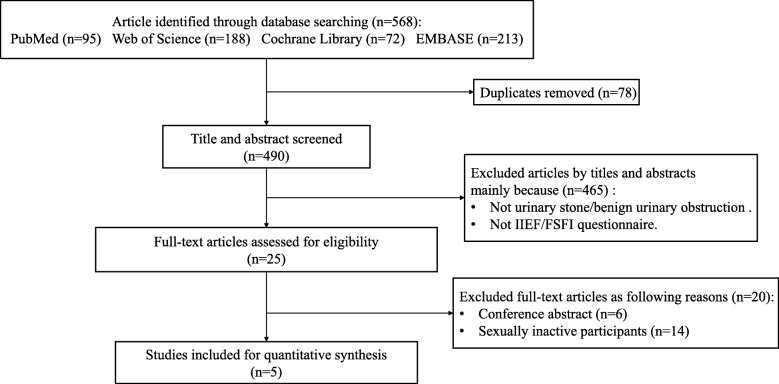
We conducted a search of PubMed, EMBASE, Web of Science, and Cochrane Library databases up to December 2018 for studies that compared sexual function before and after endourological procedures. The quality of the included studies was evaluated using the Risk Of Bias In Non-randomized Studies of Interventions (ROBINS-I). We performed subgroup analyses to explore heterogeneity. A random effects model was used to combine the results.
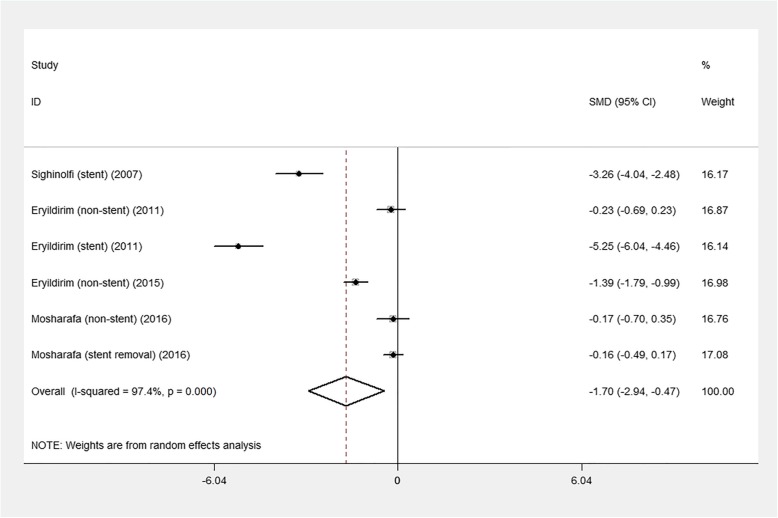
Five prospective studies involving 485 sexually active participants were identified. Pooled results showed that, in patients without a double-J stent, the change in sexual function after endourological procedures was not significant in men (mean difference [MD]: - 0.61, 95% confidence interval [CI]: - 1.43 to 0.22, p = 0.148) or women (MD: 0.53, 95% CI: - 0.52 to 1.57, p = 0.322). However, in patients with indwelling double-J stent, sexual function scores significantly declined after the procedure in both men (MD: -4.25, 95% CI: - 6.20 to - 2.30, p < 0.001) and women (MD: -7.17, 95% CI: - 7.88 to - 6.47, p < 0.001).
Our meta-analysis suggests that indwelling double-J stent after endourological procedures could be a crucial factor causing temporary sexual dysfunction post-operatively. Our results may be used to provide evidence-based advice to patients.
腔内泌尿外科手术广泛用于治疗良性泌尿道疾病,通常使用双 J 支架。然而,其对性功能的潜在影响尚不清楚。因此,我们进行了一项定量系统评价,以确定腔内泌尿外科手术联合或不联合双 J 支架与术后性功能之间的关系。
我们检索了 PubMed、EMBASE、Web of Science 和 Cochrane Library 数据库,截至 2018 年 12 月,以比较腔内泌尿外科手术后性功能的研究。使用干预措施的非随机研究风险偏倚(ROBINS-I)评估纳入研究的质量。我们进行了亚组分析以探索异质性。使用随机效应模型合并结果。
共纳入 5 项前瞻性研究,涉及 485 例有性生活的参与者。汇总结果显示,在无双 J 支架的患者中,腔内泌尿外科手术后性功能的变化在男性中不显著(平均差值 [MD]:-0.61,95%置信区间 [CI]:-1.43 至 0.22,p=0.148)或女性中(MD:0.53,95%CI:-0.52 至 1.57,p=0.322)。然而,在留置双 J 支架的患者中,手术后男性(MD:-4.25,95%CI:-6.20 至-2.30,p<0.001)和女性(MD:-7.17,95%CI:-7.88 至-6.47,p<0.001)的性功能评分均显著下降。
我们的荟萃分析表明,腔内泌尿外科手术后留置双 J 支架可能是术后暂时性功能障碍的关键因素。我们的结果可用于为患者提供循证建议。