Ramirez-Bajo Maria Jose, Rovira Jordi, Lazo-Rodriguez Marta, Banon-Maneus Elisenda, Tubita Valeria, Moya-Rull Daniel, Hierro-Garcia Natalia, Ventura-Aguiar Pedro, Oppenheimer Federico, Campistol Josep M, Diekmann Fritz
Laboratori Experimental de Nefrologia i Trasplantament (LENIT), Institut d'Investigacions Biomèdiques August Pi i Sunyer (IDIBAPS), Barcelona, Spain.
Red de Investigación Renal (REDINREN), Madrid, Spain.
Front Cell Dev Biol. 2020 Jan 29;8:10. doi: 10.3389/fcell.2020.00010. eCollection 2020.
Mesenchymal stromal cells (MSCs) from different sources possess great therapeutic potential due to their immunomodulatory properties associated with allograft tolerance. However, a crucial role in this activity resides in extracellular vesicles (EVs) and signaling molecules secreted by cells. This study aimed to evaluate the immunomodulatory properties of donor and recipient MSCs isolated from adipose tissue (AD) or bone marrow (BM) and their EVs on kidney outcome in a rat kidney transplant model.
The heterotopic-kidney-transplant Fisher-to-Lewis rat model (F-L) was performed to study mixed cellular and humoral rejection. After kidney transplantation, Lewis recipients were assigned to 10 groups; two control groups; four groups received autologous MSCs (either AD- or BM- MSC) or EVs (derived from both cell types); and four groups received donor-derived MSCs or EVs. AD and BM-EVs were purified by ultracentrifugation. Autologous cell therapies were administered three times intravenously; immediately after kidney transplantation, 4 and 8 weeks, whereas donor-derived cell therapies were administered once intravenously immediately after transplantation. Survival and renal function were monitored. Twelve weeks after kidney transplantation grafts were harvested, infiltrating lymphocytes were analyzed by flow cytometry and histological lesions were characterized.
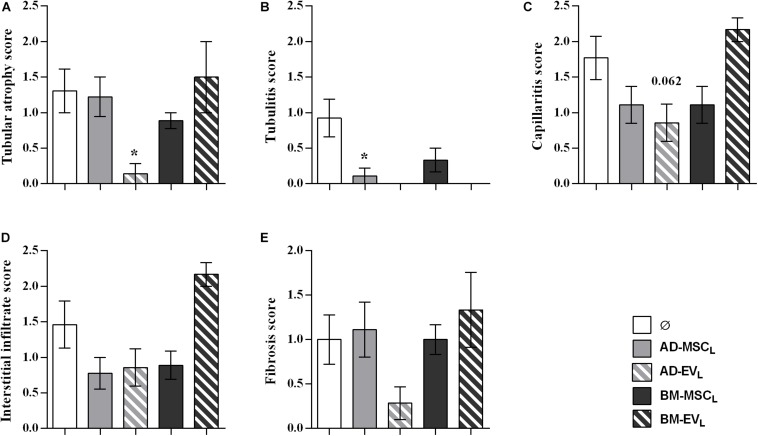
Autologous AD- and BM-MSCs, but not their EVs, prolonged graft and recipient survival in a rat model of kidney rejection. Autologous AD- and BM-MSCs significantly improved renal function during the first 4 weeks after transplantation. The amelioration of graft function could be associated with an improvement in tubular damage, as well as in T, and NK cell infiltration. On the other side, the application of donor-derived AD-MSC was harmful, and all rats died before the end of the protocol. AD-EVs did not accelerate the rejection. Contrary to autologous MSCs results, the single dose of donor-derived BM-MSCs is not enough to ameliorate kidney graft damage.
EVs treatments did not exert any benefit in our experimental settings. In the autologous setting, BM-MSCs prompted as a potentially promising therapy to improve kidney graft outcomes in rats with chronic mixed rejection. In the donor-derived setting, AD-MSC accelerated progression to end-stage kidney disease. Further experiments are required to adjust timing and dose for better long-term outcomes.
来自不同来源的间充质基质细胞(MSC)因其与同种异体移植耐受相关的免疫调节特性而具有巨大的治疗潜力。然而,这种活性的关键作用在于细胞分泌的细胞外囊泡(EV)和信号分子。本研究旨在评估从脂肪组织(AD)或骨髓(BM)分离的供体和受体MSC及其EV对大鼠肾移植模型中肾脏结局的免疫调节特性。
采用异位肾移植Fisher-to-Lewis大鼠模型(F-L)研究混合细胞和体液排斥反应。肾移植后,将Lewis受体分为10组;两个对照组;四组接受自体MSC(AD-MSC或BM-MSC)或EV(源自两种细胞类型);四组接受供体来源的MSC或EV。AD和BM-EV通过超速离心纯化。自体细胞疗法静脉注射三次;肾移植后立即注射,以及在第4周和第8周注射,而供体来源的细胞疗法在移植后立即静脉注射一次。监测生存情况和肾功能。肾移植12周后收获移植物,通过流式细胞术分析浸润淋巴细胞,并对组织学病变进行特征描述。
自体AD-MSC和BM-MSC可延长大鼠肾排斥模型中移植物和受体的存活时间,但其EV则不能。自体AD-MSC和BM-MSC在移植后的前4周显著改善了肾功能。移植物功能的改善可能与肾小管损伤以及T细胞和NK细胞浸润的改善有关。另一方面,应用供体来源的AD-MSC是有害的,所有大鼠在实验方案结束前死亡。AD-EV并未加速排斥反应。与自体MSC的结果相反,单剂量的供体来源BM-MSC不足以改善肾移植损伤。
在我们的实验环境中,EV治疗没有带来任何益处。在自体情况下,BM-MSC作为一种潜在的有前景的疗法,可改善慢性混合排斥大鼠的肾移植结局。在供体来源的情况下,AD-MSC加速了终末期肾病的进展。需要进一步的实验来调整时间和剂量,以获得更好的长期结局。