Jozef Stefan Institute, Ljubljana, Slovenia.
Faculty of Mechanical Engineering, University of Ljubljana, Aškerčeva 6, Ljubljana, 1000, Slovenia.
Lasers Surg Med. 2020 Nov;52(9):907-915. doi: 10.1002/lsm.23226. Epub 2020 Feb 17.
Laser-activated irrigation of dental root canals is being increasingly used as its efficacy has been shown to be superior compared with conventional techniques. The method is based on laser-initiated localized fluid evaporation and subsequent rapid bubble expansions and collapses, inducing microfluid flow throughout the entire volume of the cavity. The irrigation efficacy can be further improved if optimally delayed "SWEEPS" double laser pulses are delivered into the canal. This study aims to show that the irrigation efficacy, as measured by the induced pressure within the canal, is related to the double pulse delay, with the maximal pressure generated at an optimal delay. The second aim is to find a method of determining the optimal delay for different cavity dimensions and/or laser parameters.
STUDY DESIGN/MATERIALS AND METHODS: Experiments were made in transparent models of root canals where Er:YAG laser (λ = 2.94 μm, pulse duration t = 25 or 50 microseconds, and pulse energies up to E = 40 mJ) was used with a combination of cylindrical and conical fiber-tip geometries (diameters 400 and 600 µm). High-speed photography (60,000 fps) and average pressure measurements inside the canal were used for process characterization.
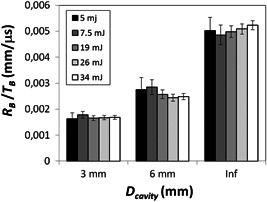
The results show that a pressure amplification of more than 1.5 times occurs if the laser pulse delay approximately coincides with the bubble oscillation time. Correlations between normalized oscillation time and canal diameter for a wide range of laser pulse energies (R = 0.96) and between the average pressure within the canal and the bubble oscillation periods (R = 0.90) were found. A relationship between the bubble oscillation time and the diameter of the treated cavity was found depending on the bubble oscillation time in an infinite fluid reservoir.
The bubble oscillation time within a constrained volume can be determined based on the known oscillation time in infinite space, which offers a fast and simple solution for optimization of the laser parameters. These findings enable determination of optimal conditions for shock wave generation, and improvement of root canal irrigation at the same dose of laser energy input, leading to improved treatment efficacy and safety. Lasers Surg. Med. © 2020 The Authors. Lasers in Surgery and Medicine published by Wiley Periodicals, Inc.
激光激活根管冲洗技术的应用日益广泛,因为其疗效优于传统技术。该方法基于激光引发的局部流体蒸发,随后迅速产生气泡膨胀和收缩,从而在整个腔体体积内诱导微流。如果能将最佳延迟的“SWEEPS”双激光脉冲输送到根管中,则可以进一步提高冲洗效果。本研究旨在表明,通过腔内产生的压力来衡量的冲洗效果与双脉冲延迟有关,在最佳延迟时产生最大压力。第二个目的是找到一种方法来确定不同腔体尺寸和/或激光参数的最佳延迟。
在根管透明模型中进行了实验,其中使用了 Er:YAG 激光(λ=2.94μm,脉冲持续时间 t=25 或 50μs,脉冲能量高达 E=40mJ),并结合了圆柱形和圆锥形光纤尖端几何形状(直径 400 和 600μm)。高速摄影(60,000fps)和腔内平均压力测量用于对过程进行特征描述。
结果表明,如果激光脉冲延迟与气泡振荡时间大致吻合,则会产生超过 1.5 倍的压力放大。发现归一化振荡时间与大范围激光脉冲能量的根管直径之间存在相关性(R=0.96),以及腔内平均压力与气泡振荡周期之间存在相关性(R=0.90)。发现气泡振荡时间与处理腔直径之间存在关系,该关系取决于无限流体储器中的气泡振荡时间。
可以根据在无限空间中已知的振荡时间确定受限体积内的气泡振荡时间,这为激光参数的优化提供了一种快速简单的解决方案。这些发现使我们能够确定冲击波产生的最佳条件,并在相同的激光能量输入剂量下提高根管冲洗效果,从而提高治疗效果和安全性。激光外科医学。©2020 作者。Wiley Periodicals,Inc. 发表的《激光外科学与医学》