Evolve BioSytems, Inc. Davis, California, 95618 USA.
Dept. of Women and Children's Health, School of Life Course Sciences, St Thomas' Hospital, London SE1 7EH UK.
FEMS Microbiol Lett. 2020 Mar 1;367(6). doi: 10.1093/femsle/fnaa032.
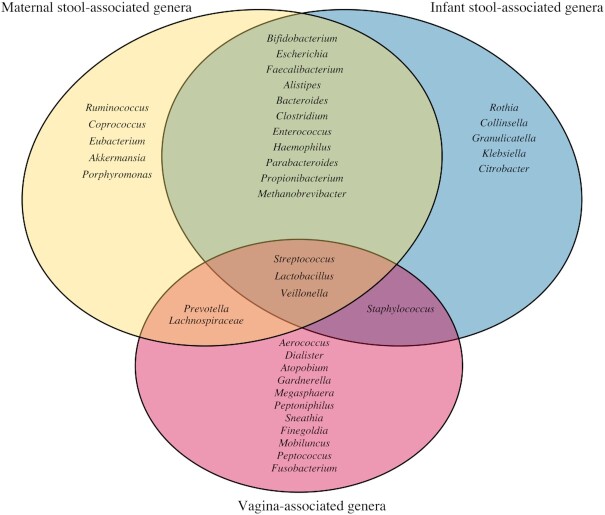
There is a burgeoning literature highlighting differences in health outcomes between babies born vaginally and by caesarean section (c-section) This has led to the suggestion that infants born by c-section may benefit from vaginal swabbing/seeding. Here, we discuss from an ecological perspective that it is gut-adapted, not vagina-adapted microbes that are likely to take up residence in the gut and have the most beneficial impact on the developing neonate. Further, we caution the practice of 'vaginal seeding' may be potentially unsafe and also give parents and health professionals a false sense of action in restoring the infant gut microbiome following c-section. Instead, we argue that restoring B. longum subsp. infantis, which has evolved to colonize the infant gut, is a safe and ecologically-sound approach to restoring the gut microbiome of infants born by c-section.
有大量文献强调了阴道分娩和剖宫产(c-section)婴儿之间健康结果的差异。这导致了一种观点,即剖宫产婴儿可能受益于阴道拭子/播种。在这里,我们从生态角度讨论了适应肠道的微生物,而不是适应阴道的微生物,更有可能在肠道中定居,并对发育中的新生儿产生最有益的影响。此外,我们警告说,“阴道播种”的做法可能存在潜在的不安全因素,并给父母和卫生专业人员一种在 c 剖产后恢复婴儿肠道微生物组的虚假行动感。相反,我们认为恢复婴儿双歧杆菌亚种,它已经进化到可以在婴儿肠道中定植,是一种安全且符合生态要求的方法,可以恢复 c 剖产后婴儿的肠道微生物组。