Department of Epidemiology, Johns Hopkins University Bloomberg School of Public Health, Baltimore, Maryland, USA.
Welch Center for Prevention, Epidemiology and Clinical Research, Baltimore, Maryland, USA.
mBio. 2023 Jun 27;14(3):e0049123. doi: 10.1128/mbio.00491-23. Epub 2023 Apr 19.
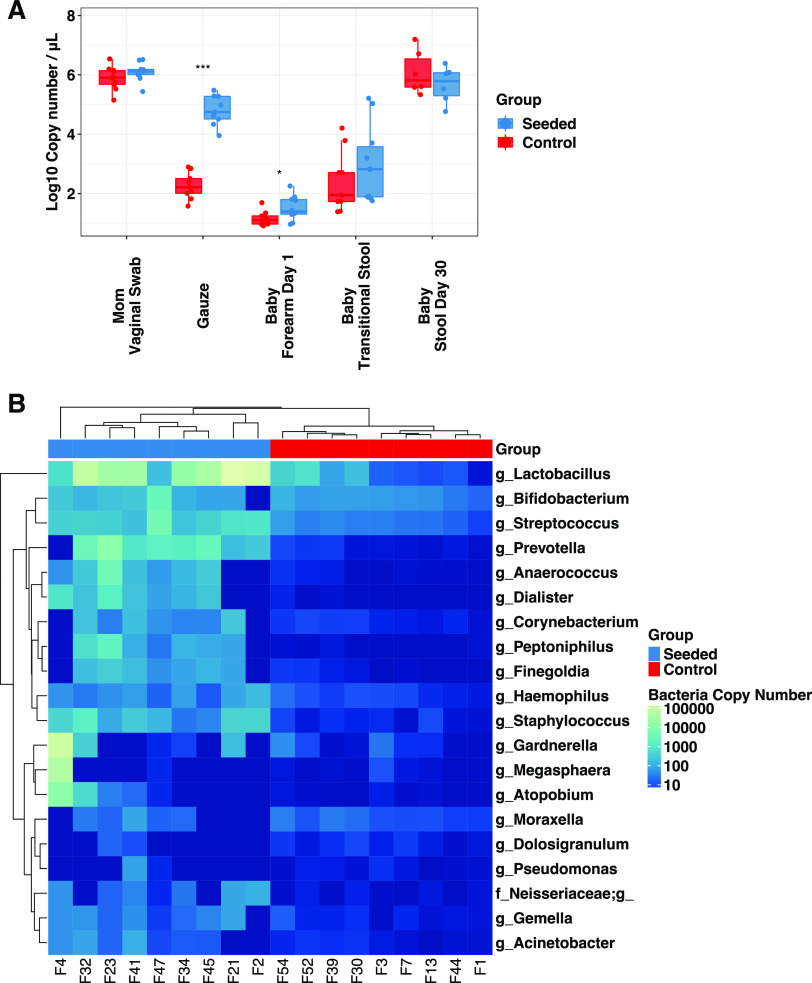
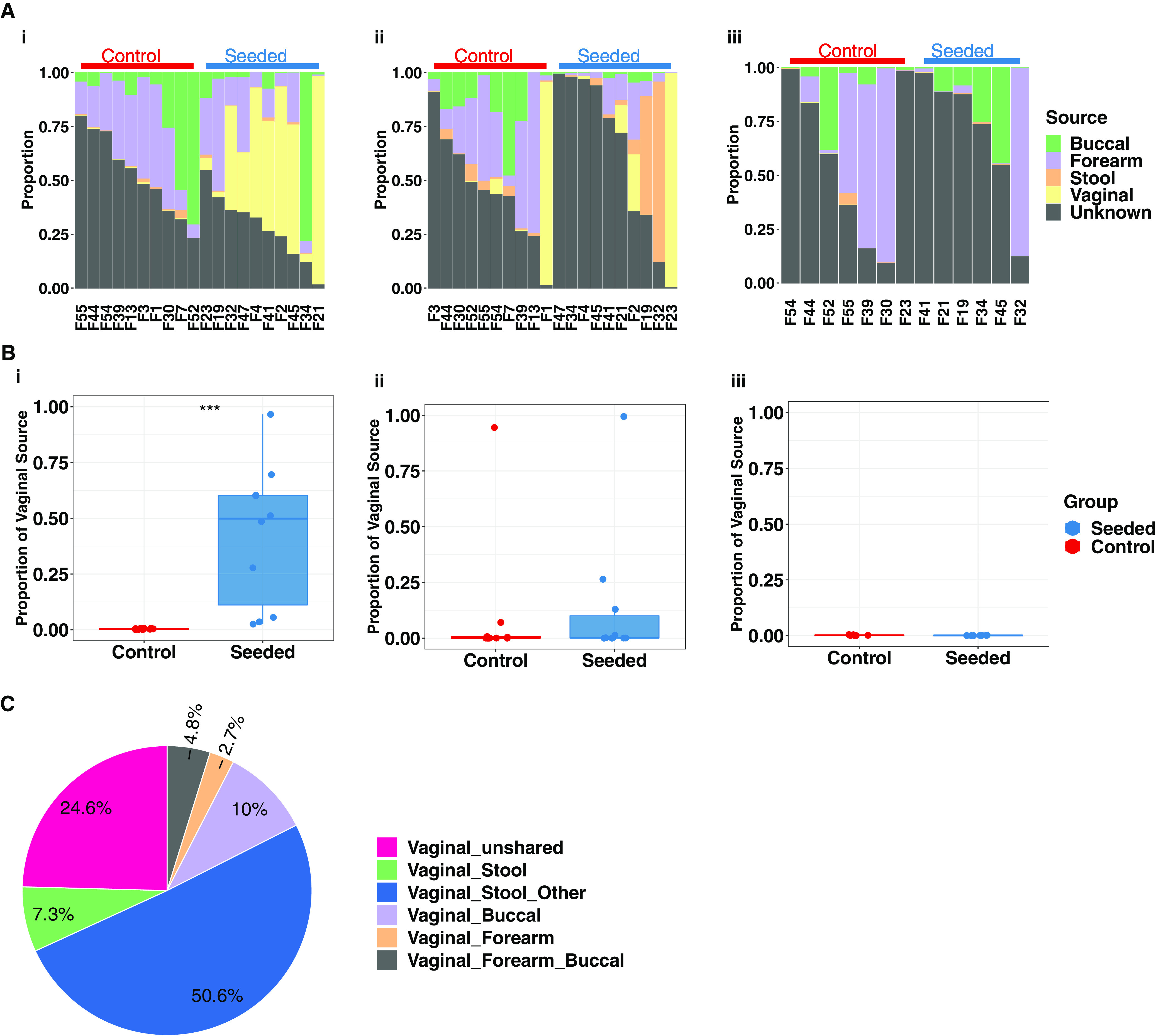
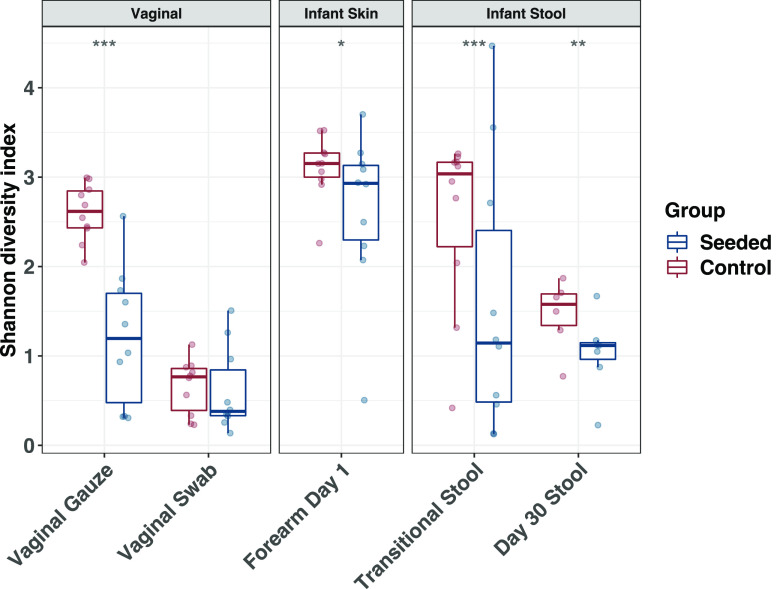
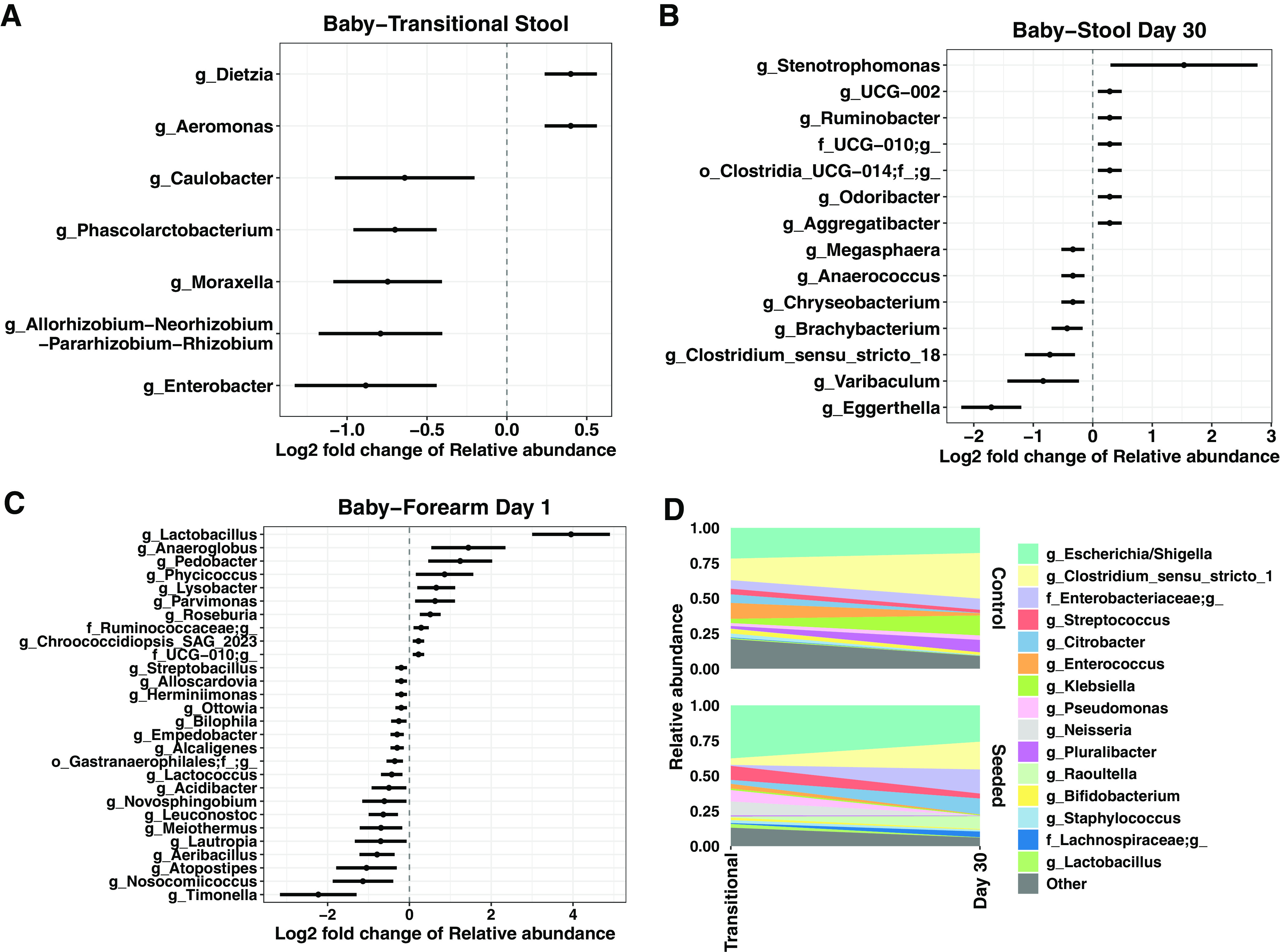
Children delivered by elective, prelabor Cesarean section (C-section) are not exposed to the birth canal microbiota and, in relation to vaginally delivered children, show altered microbiota development. Perturbed microbial colonization during critical early-life windows of development alters metabolic and immune programming and is associated with an increased risk of immune and metabolic diseases. In nonrandomized studies, vaginal seeding of C-section-born neonates partially restores their microbiota colonization to that of their vaginally delivered counterparts, but without randomization, confounding factors cannot be excluded. In a double-blind, randomized, placebo-controlled trial, we determined the effect of vaginal seeding versus placebo seeding (control arm) on the skin and stool microbiota of elective, prelabor C-section-born neonates ( = 20) at 1 day and 1 month after birth. We also examined whether there were between-arm differences in engraftment of maternal microbes in the neonatal microbiota. In relation to the control arm, vaginal seeding increased mother-to-neonate microbiota transmission and caused compositional changes and a reduction in alpha diversity (Shannon Index) of the skin and stool microbiota. The neonatal skin and stool microbiota alpha diversity when maternal vaginal microbiota is provided is intriguing and highlights the need of larger randomized studies to determine the ecological mechanisms and effects of vaginal seeding on clinical outcomes. Children delivered by elective C-section are not exposed to the birth canal and show altered microbiota development. Impairing microbial colonization during early life alters metabolic and immune programming and is associated with an increased risk of immune and metabolic diseases. In a double-blind, randomized, placebo-controlled trial, we determined the effect of vaginal seeding on the skin and stool microbiota of elective C-section born neonates and found that vaginal seeding increased mother-to-neonate microbiota transmission and caused compositional changes and a reduction in the skin and stool microbiota diversity. The reduction of neonatal skin and stool microbiota diversity when maternal vaginal microbiota is provided is intriguing and highlights the need of larger randomized studies to determine the ecological mechanisms and effects of vaginal seeding on clinical outcomes.
择期剖宫产(C -section)分娩的婴儿不会接触到产道微生物群,与阴道分娩的婴儿相比,其微生物群发育会发生改变。在发育的关键早期窗口期,微生物定植受到干扰会改变代谢和免疫编程,并与免疫和代谢疾病的风险增加相关。在非随机研究中,阴道定植 C -section 出生的新生儿部分恢复了其微生物定植,使其与阴道分娩的新生儿相似,但由于没有随机化,不能排除混杂因素。在一项双盲、随机、安慰剂对照试验中,我们确定了阴道定植与安慰剂定植(对照组)对择期、预产前 C 段分娩的新生儿(n=20)皮肤和粪便微生物群的影响,分别在出生后 1 天和 1 个月进行。我们还研究了在新生儿微生物群中,母体微生物定植是否存在组间差异。与对照组相比,阴道定植增加了母婴微生物传递,并导致皮肤和粪便微生物群的组成变化和 alpha 多样性(香农指数)降低。当提供母体阴道微生物群时,新生儿皮肤和粪便微生物群 alpha 多样性令人着迷,这突出表明需要进行更大规模的随机研究,以确定阴道定植对临床结果的生态机制和影响。择期剖宫产分娩的婴儿不会接触到产道,且其微生物群发育发生改变。生命早期微生物定植受损会改变代谢和免疫编程,并与免疫和代谢疾病的风险增加相关。在一项双盲、随机、安慰剂对照试验中,我们确定了阴道定植对择期剖宫产出生新生儿皮肤和粪便微生物群的影响,发现阴道定植增加了母婴微生物传递,并导致皮肤和粪便微生物群的组成变化和多样性降低。当提供母体阴道微生物群时,新生儿皮肤和粪便微生物群多样性减少令人着迷,这突出表明需要进行更大规模的随机研究,以确定阴道定植对临床结果的生态机制和影响。