Alharbi Mohammed, Farah Ra'fat
Dentist, Dentistry General Department, Ministry of Health, Qassim, Kingdom of Saudi Arabia.
Assistant Professor, Department of Prosthodontics, College of dentistry, Qassim University, Kingdom of Saudi Arabia.
J Clin Exp Dent. 2020 Feb 1;12(2):e169-e177. doi: 10.4317/jced.56153. eCollection 2020 Feb.
The purpose of this study was to investigate the effects of water-jet flossing on the color stability and surface roughness of five resin-based composites.
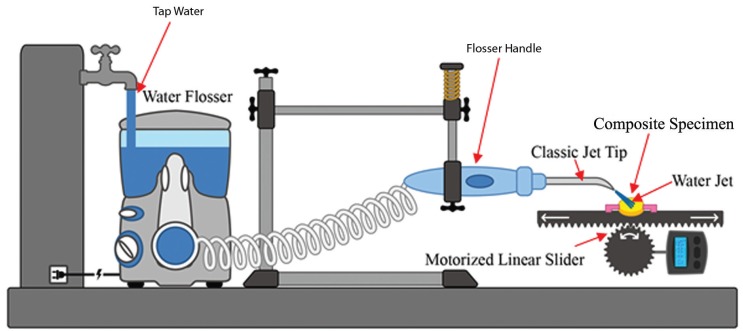
Five commercially available composite resins were studied. Nine disc-shaped specimens (6x2mm) were fabricated from each composite. The specimens were randomly allocated into three groups and three different treatments were performed on each group: storage in water (control group), water-jet flossing using 50 Psi water pressure, and water-jet flossing using 100 Psi water pressure. The water-jet flossing was performed in a standardized manner using a Waterpik® Aquarius® water flosser. Color and roughness were measured at baseline and at the end of 30 minutes of treatment, which is approximately equivalent to 5 years of simulated water-jet flossing for 1 minute once a day. The data were statistically analyzed using two-way analysis of variance (ANOVA) with Bonferroni and Tukey's post-hoc tests.
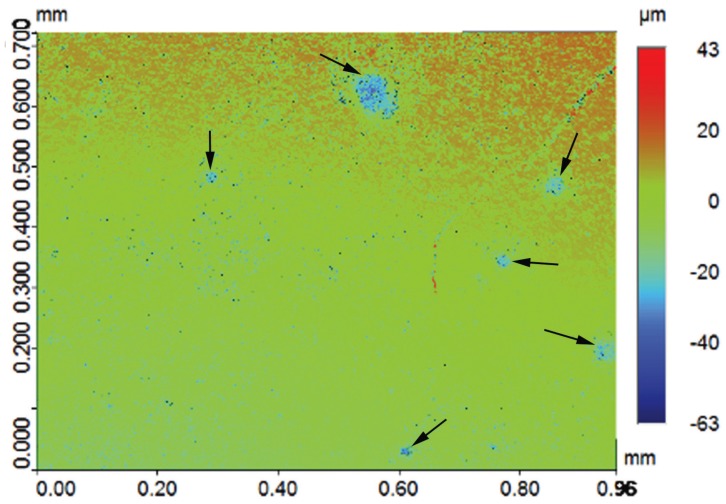
No significant color change was found after 5 simulated years of water-jet flossing, irrespective of composite type and water-flossing pressure setting ( > 0.05). Furthermore, none of composite specimens showed any significant surface roughness changes except for the two composites with spherical filler specimens in the 100 Psi treatment group. These composites exhibited a significant increase in surface roughness compared with the nano-filled composite ( = 0.001 and = 0.006). However, the differences were clinically acceptable (≈0.2 µm).
In terms of surface roughness and color, water-jet flossing is safe to be used on composite restorations within the settings of this study. Color difference (∆E), resin composites, surface roughness, water flosser.
本研究旨在探讨水喷射牙线清洁对五种树脂基复合材料颜色稳定性和表面粗糙度的影响。
研究了五种市售复合树脂。每种复合材料制备九个圆盘形试样(6×2mm)。将试样随机分为三组,每组进行三种不同处理:储存在水中(对照组)、使用50磅力/平方英寸水压的水喷射牙线清洁、使用100磅力/平方英寸水压的水喷射牙线清洁。使用Waterpik® Aquarius®水牙线以标准化方式进行水喷射牙线清洁。在基线和处理30分钟结束时测量颜色和粗糙度,这大约相当于每天进行1分钟的水喷射牙线清洁模拟5年。使用双向方差分析(ANOVA)以及Bonferroni和Tukey事后检验对数据进行统计分析。
经过5年模拟水喷射牙线清洁后,无论复合材料类型和水牙线清洁压力设置如何,均未发现明显的颜色变化(P>0.05)。此外除了100磅力/平方英寸处理组中两种含球形填料试样的复合材料外,没有复合树脂试样表现出任何明显的表面粗糙度变化。与纳米填料复合材料相比,这些复合材料的表面粗糙度显著增加(P = 0.001和P = 0.006)。然而,这些差异在临床上是可接受的(约0.2μm)。
就表面粗糙度和颜色而言,在本研究设定的条件下,水喷射牙线清洁用于复合树脂修复体是安全的。颜色差异(∆E)、树脂复合材料、表面粗糙度、水牙线。