Department of Cellular Biology, Histology and Pharmacology, Faculty of Health Sciences, University of Valladolid, Campus of Soria, 42003 Soria, Spain.
Department of Biochemistry and Physiology, Faculty of Health Sciences, University of Valladolid, Campus of Soria, 42003 Soria, Spain.
Nutrients. 2020 Feb 15;12(2):501. doi: 10.3390/nu12020501.
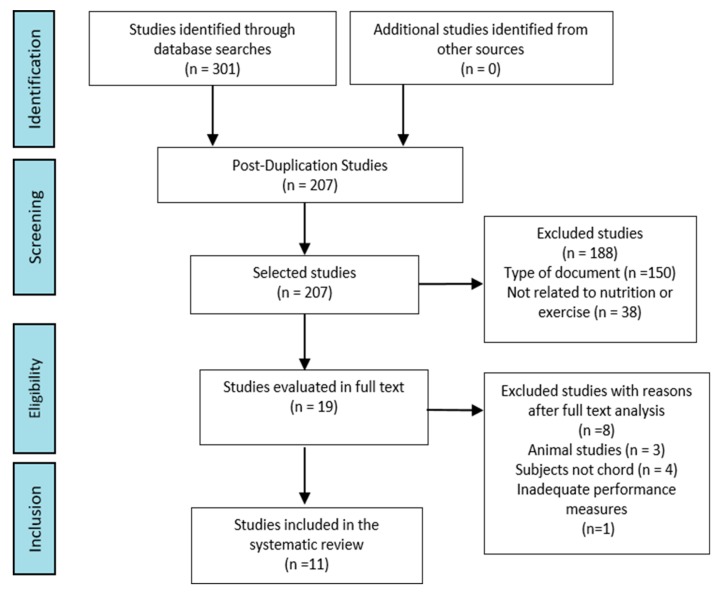
Physical activity, particularly high-intensity eccentric muscle contractions, produces exercise-induced muscle damage (EIMD). The breakdown of muscle fibers and the consequent inflammatory responses derived from EIMD affect exercise performance. Curcumin, a natural polyphenol extracted from turmeric, has been shown to have mainly antioxidant and also anti-inflammatory properties. This effect of curcumin could improve EIMD and exercise performance. The main objective of this systematic review was to critically evaluate the effectiveness of curcumin supplementation on EIMD and inflammatory and oxidative markers in a physically active population. A structured search was carried out following Preferred Reporting Items for Systematic Review and Meta-Analyses (PRISMA) guidelines in the databases SCOPUS, Web of Science (WOS), and Medline (PubMed) from inception to October 2019. The search included original articles with randomized controlled crossover or parallel design in which the intake of curcumin administered before and/or after exercise was compared with an identical placebo situation. No filters were applied to the type of physical exercise performed, the sex or the age of the participants. Of the 301 articles identified in the search, 11 met the established criteria and were included in this systematic review. The methodological quality of the studies was assessed using the McMaster Critical Review Form. The use of curcumin reduces the subjective perception of the intensity of muscle pain; reduces muscle damage through the decrease of creatine kinase (CK); increases muscle performance; has an anti-inflammatory effect by modulating the pro-inflammatory cytokines, such as TNF-α, IL-6, and IL-8; and may have a slight antioxidant effect. In summary, the administration of curcumin at a dose between 150-1500 mg/day before and during exercise, and up until 72 h' post-exercise, improved performance by reducing EIMD and modulating the inflammation caused by physical activity. In addition, humans appear to be able to tolerate high doses of curcumin without significant side-effects.
身体活动,特别是高强度的离心肌肉收缩,会导致运动引起的肌肉损伤(EIMD)。肌肉纤维的破坏以及由此产生的炎症反应会影响运动表现。姜黄素是一种从姜黄中提取的天然多酚,具有主要的抗氧化和抗炎特性。姜黄素的这种作用可以改善 EIMD 和运动表现。本系统评价的主要目的是批判性地评估姜黄素补充剂对活跃人群中 EIMD 以及炎症和氧化标志物的有效性。根据系统评价和荟萃分析的首选报告项目(PRISMA)指南,在 SCOPUS、Web of Science(WOS)和 Medline(PubMed)数据库中进行了结构化搜索,从创建到 2019 年 10 月进行了搜索。搜索包括随机对照交叉或平行设计的原始文章,其中比较了运动前后摄入姜黄素与相同安慰剂的情况。未对所进行的运动类型、性别或参与者的年龄对搜索进行过滤。在搜索中确定了 301 篇文章,其中 11 篇符合既定标准,并纳入本系统评价。使用麦克马斯特批判性评价表评估研究的方法学质量。姜黄素的使用降低了肌肉疼痛强度的主观感知;通过降低肌酸激酶(CK)来减少肌肉损伤;通过调节促炎细胞因子(如 TNF-α、IL-6 和 IL-8)来发挥抗炎作用;并且可能具有轻微的抗氧化作用。总之,在运动前、运动中和运动后 72 小时内,以 150-1500mg/天的剂量给予姜黄素,可以通过减少 EIMD 和调节由身体活动引起的炎症来改善运动表现。此外,人类似乎能够耐受高剂量的姜黄素而没有明显的副作用。