Malik Romana Fattimah, Buljac-Samardžić Martina, Akdemir Nesibe, Hilders Carina, Scheele Fedde
Medical Education, OLVG, Amsterdam, the Netherlands
Athena Institute, VU University Amsterdam, Amsterdam, the Netherlands.
BMJ Open Qual. 2020 Feb;9(1). doi: 10.1136/bmjoq-2019-000826.
A toxic organisational culture (OC) is a major contributing factor to serious failings in healthcare delivery. Poor OC with its consequences of unprofessional behaviour, unsafe attitudes of professionals and its impact on patient care still need to be addressed. Although various tools have been developed to determine OC and improve patient safety, it remains a challenge to decide on the suitability of tools for uncovering the underlying factors which truly impact OC, such as behavioural norms, or the unwritten rules. A better understanding of the underlying dimensions that these tools do and do not unravel is required.
The aim of this study is to provide an overview of existing tools to assess OC and the tangible and intangible OC dimensions these tools address.
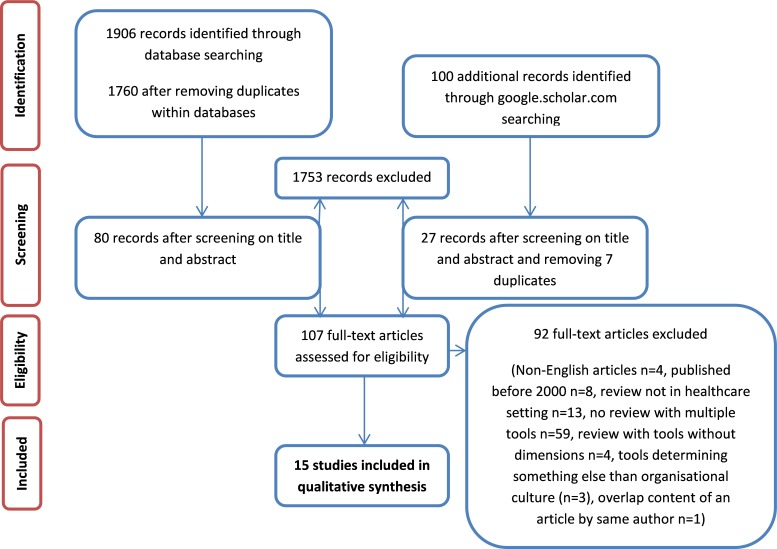
An interpretive umbrella review was conducted. Literature reviews were considered for inclusion if they described multiple tools and their dimensional characteristics in the context of OC, organisational climate, patient safety culture or climate. OC tools and the underlying dimensions were extracted from the reviews. A qualitative data analysis software program (MAX.QDA 2007) was used for coding the dimensions, which resulted in tangible and intangible themes.
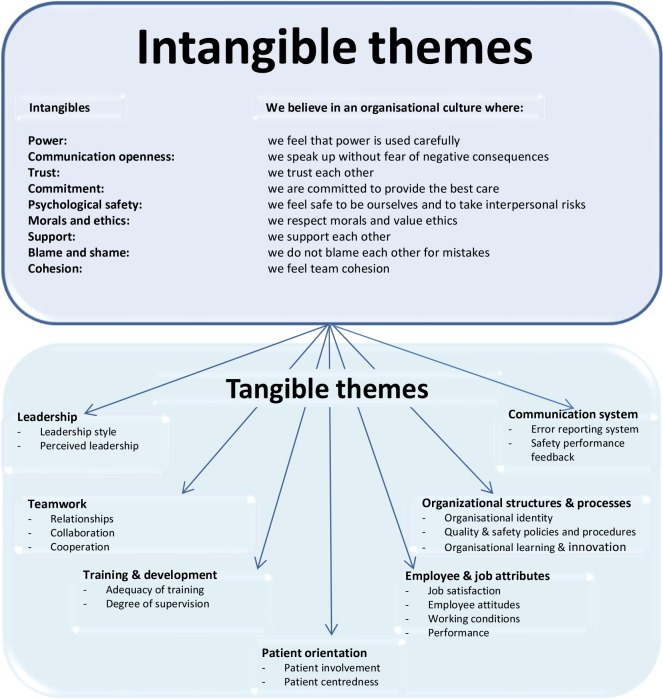
Fifteen reviews met our inclusion criteria. A total of 127 tools were identified, which were mainly quantitative questionnaires covering tangible key dimensions. Qualitative analyses distinguished nine intangible themes (commitment, trust, psychological safety, power, support, communication openness, blame and shame, morals and valuing ethics, and cohesion) and seven tangible themes (leadership, communication system, teamwork, training and development, organisational structures and processes, employee and job attributes, and patient orientation).
This umbrella review identifies the essential tangible and intangible themes of OC tools. OC tools in healthcare do not seem to be designed to determine deeper underlying dimensions of culture. We suggest approaching complex underlying OC problems by focusing on the intangible dimensions, rather than putting the tangible dimensions up front.
不良的组织文化是医疗服务严重失误的一个主要促成因素。不良的组织文化及其导致的不专业行为、专业人员不安全的态度以及对患者护理的影响仍有待解决。尽管已经开发了各种工具来确定组织文化并提高患者安全,但要确定哪些工具适合揭示真正影响组织文化的潜在因素,如行为规范或不成文规则,仍然是一项挑战。需要更好地理解这些工具所揭示和未揭示的潜在维度。
本研究的目的是概述用于评估组织文化的现有工具以及这些工具所涉及的组织文化的有形和无形维度。
进行了一项解释性综合评价。如果文献综述在组织文化、组织氛围、患者安全文化或氛围的背景下描述了多种工具及其维度特征,则将其纳入考虑范围。从综述中提取组织文化工具及其潜在维度。使用定性数据分析软件程序(MAX.QDA 2007)对维度进行编码,从而得出有形和无形主题。
15篇综述符合我们的纳入标准。共识别出127种工具,这些工具主要是涵盖有形关键维度的定量问卷。定性分析区分出九个无形主题(承诺、信任、心理安全、权力、支持、沟通开放性、责备与羞耻、道德与重视伦理、凝聚力)和七个有形主题(领导力、沟通系统、团队合作、培训与发展、组织结构与流程、员工与工作属性、患者导向)。
本综合评价确定了组织文化工具的基本有形和无形主题。医疗保健领域的组织文化工具似乎并非旨在确定文化的更深层次潜在维度。我们建议通过关注无形维度而非将有形维度置于首位来处理复杂的潜在组织文化问题。