Institute of Molecular Virology and Cell Biology, Friedrich-Loeffler-Institut, WHO Collaborating Centre for Rabies Surveillance and Research, OIE Reference Laboratory for Rabies, Greifswald-Insel Riems, Germany.
Thescon GmbH, 48653, Coesfeld, Germany.
Sci Rep. 2020 Feb 19;10(1):2919. doi: 10.1038/s41598-020-59719-4.
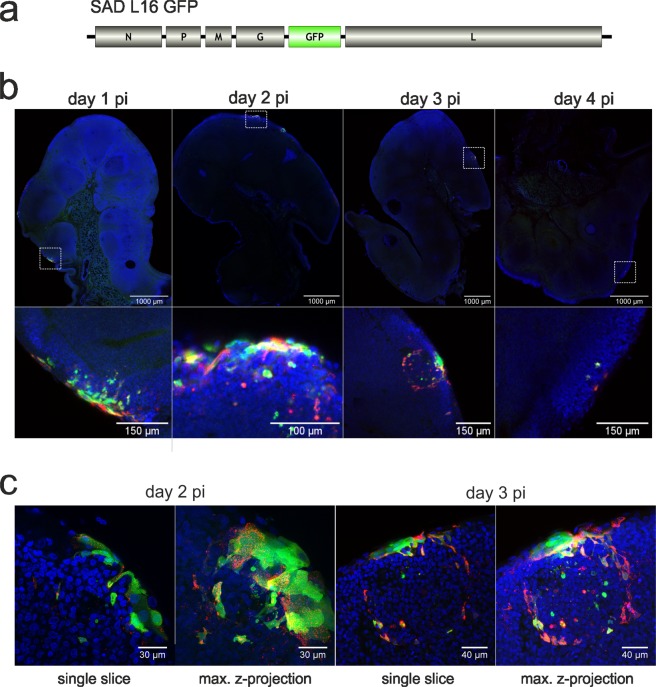
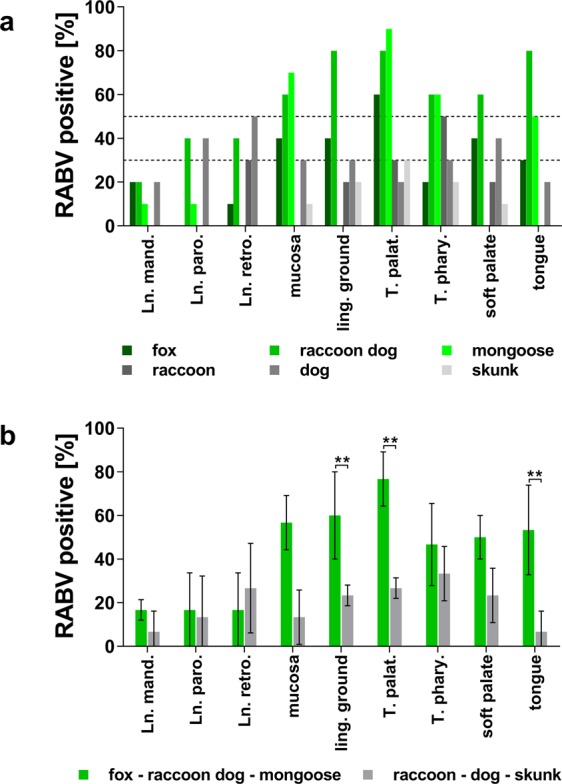
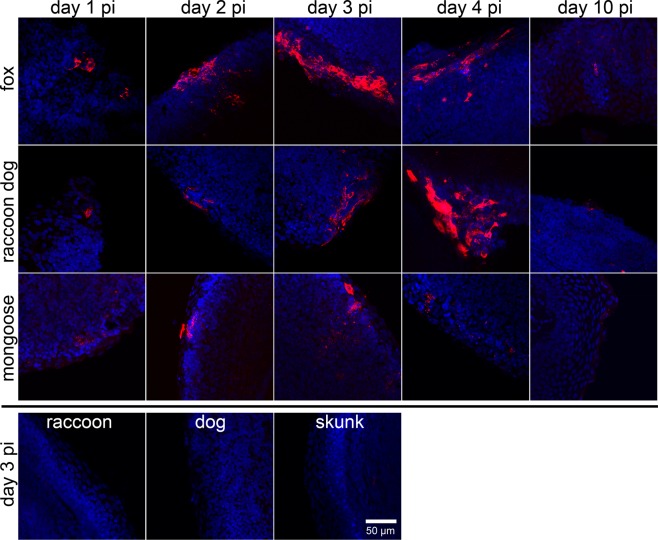
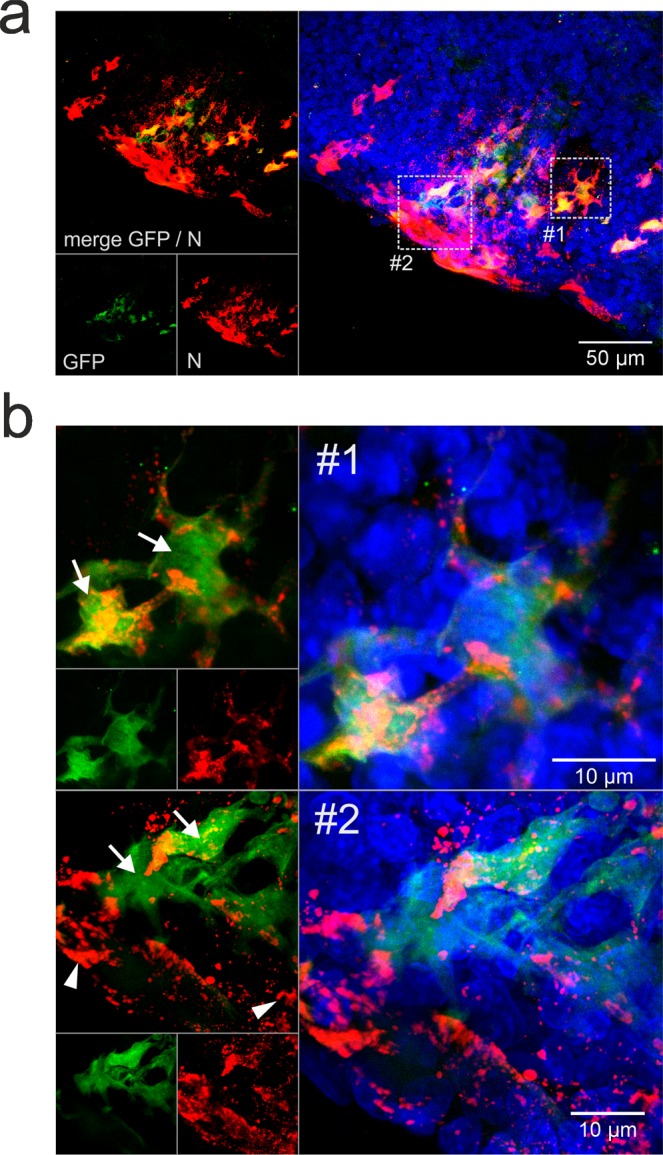
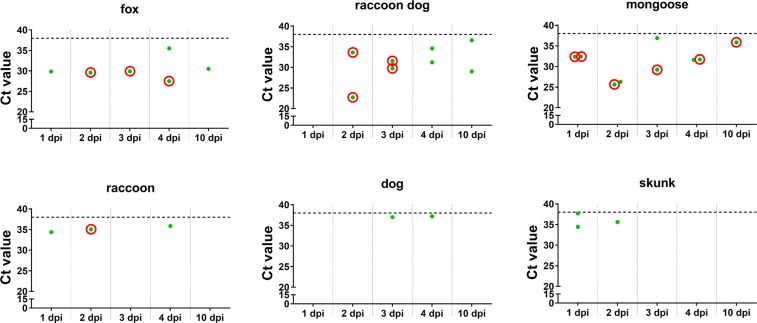
Oral rabies vaccination (ORV) is highly effective in foxes and raccoon dogs, whereas for unknown reasons the efficacy of ORV in other reservoir species is less pronounced. To investigate possible variations in species-specific cell tropism and local replication of vaccine virus, different reservoir species including foxes, raccoon dogs, raccoons, mongooses, dogs and skunks were orally immunised with a highly attenuated, high-titred GFP-expressing rabies virus (RABV). Immunofluorescence and RT-qPCR screenings revealed clear differences among species suggesting host specific limitations to ORV. While for responsive species the palatine tonsils (tonsilla palatina) were identified as a main site of virus replication, less virus dissemination was observed in the tonsils of rather refractory species. While our comparison of vaccine virus tropism emphasizes the important role that the tonsilla palatina plays in eliciting an immune response to ORV, our data also indicate that other lymphoid tissues may have a more important role than originally anticipated. Overall, these data support a model in which the susceptibility to oral live RABV vaccine infection of lymphatic tissue is a major determinant in vaccination efficacy. The present results may help to direct future research for improving vaccine uptake and efficacy of oral rabies vaccines under field conditions.
口服狂犬病疫苗(ORV)在狐狸和浣熊犬中非常有效,而由于未知原因,ORV 在其他储存宿主中的功效则不那么明显。为了研究疫苗病毒在物种特异性细胞嗜性和局部复制方面可能存在的差异,我们用高度减毒、高滴度表达 GFP 的狂犬病病毒(RABV)对不同的储存宿主(包括狐狸、浣熊犬、浣熊、黄鼠狼、狗和臭鼬)进行了口服免疫。免疫荧光和 RT-qPCR 筛选显示出物种间存在明显差异,这表明 ORV 存在宿主特异性限制。虽然对于有反应的物种,腭扁桃体(palatine tonsils)被确定为病毒复制的主要部位,但在反应较差的物种中,扁桃体中的病毒传播较少。虽然我们比较了疫苗病毒的嗜性,强调了腭扁桃体在引发 ORV 免疫反应方面的重要作用,但我们的数据也表明,其他淋巴组织可能比最初预期的更为重要。总的来说,这些数据支持了这样一种模式,即淋巴组织对口服活 RABV 疫苗感染的易感性是疫苗功效的主要决定因素。目前的结果可能有助于指导未来的研究,以提高口服狂犬病疫苗在野外条件下的接种率和功效。