Chanachai Karoon, Wongphruksasoong Vilaiporn, Vos Ad, Leelahapongsathon Kansuda, Tangwangvivat Ratanaporn, Sagarasaeranee Onpawee, Lekcharoen Paisin, Trinuson Porathip, Kasemsuwan Suwicha
USAID Regional Development Mission Asia (Former at the Department of Livestock Development, Thailand), Athenee Tower, 25th Floor, 63 Wireless Road, Lumpini, Patumwan, Bangkok 10330, Thailand.
Department of Livestock Development, Ministry of Agriculture, Ratchathewi, Bangok 10400, Thailand.
Viruses. 2021 Mar 29;13(4):571. doi: 10.3390/v13040571.
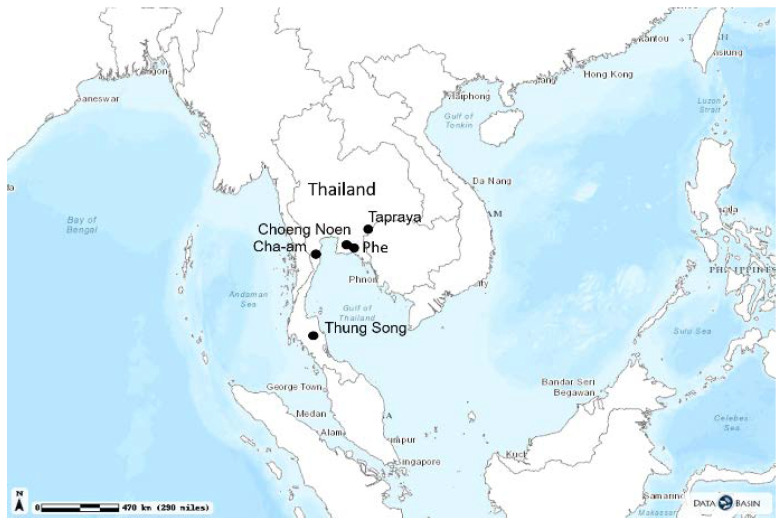
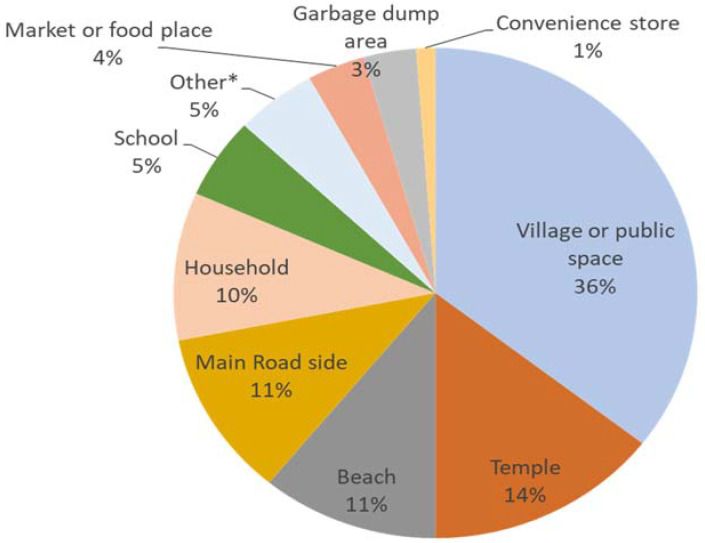
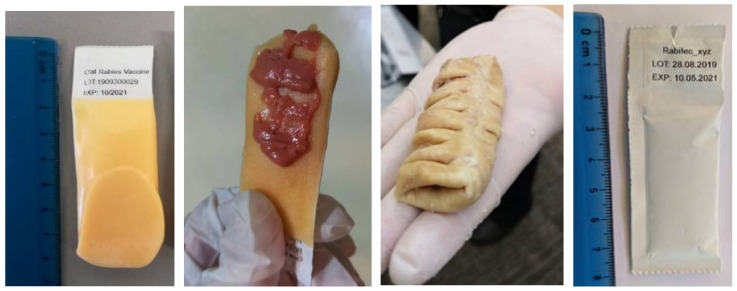
(1) Background: Thailand has made significant progress in reducing the number of human and animal rabies cases. However, control and elimination of the last remaining pockets of dog-mediated rabies have shown to be burdensome, predominantly as a result of the large numbers of free-roaming dogs without an owner that cannot be restrained without special efforts and therefore remain unvaccinated. To reach these dogs, the feasibility, and benefits of oral rabies vaccination (ORV) as a complementary tool has been examined under field conditions. (2) Methods: ORV of dogs was tested in five study areas of four provinces in Thailand. In these areas, sites with free-roaming dogs were identified with the support of local municipal workers and dog caretakers. ORV teams visited each of five study areas and distributed rabies vaccine (SPBN GASGAS) in three bait formats that were offered to the dogs using a hand-out and retrieval model. The three bait types tested included: egg-flavored baits, egg-flavored baits pasted with commercially available cat liquid snack, and boiled-intestine baits. A dog offered a vaccine bait was considered vaccinated when the discarded sachet was perforated or if a dog chewed vaccine bait at least 5 times before it swallowed the bait, including the sachet. (3) Results: A total of 2444 free-roaming dogs considered inaccessible for parenteral vaccination were identified at 338 sites. As not all dogs were approachable, 79.0% were offered a bait; of these dogs, 91.6% accepted the bait and subsequently 83.0% were considered successfully vaccinated. (4) Conclusion: Overall, 65.6% of the free-roaming dogs at these sites were successfully vaccinated by the oral route. Such a significant increase of the vaccination coverage of the free-roaming dog population could interrupt the rabies transmission cycle and offers a unique opportunity to reach the goal to eliminate dog-mediated human rabies in Thailand by 2030.
(1) 背景:泰国在减少人类和动物狂犬病病例数量方面取得了重大进展。然而,控制和消除最后残留的由狗传播狂犬病的疫点已被证明是一项艰巨的任务,主要原因是大量无主的流浪狗,如果不付出特殊努力就无法加以约束,因此仍未接种疫苗。为了接触到这些狗,已在实地条件下研究了口服狂犬病疫苗(ORV)作为一种补充工具的可行性和益处。(2) 方法:在泰国四个省份的五个研究区域对狗进行口服狂犬病疫苗测试。在这些区域,在当地市政工作人员和狗看护人的支持下确定有流浪狗的地点。口服狂犬病疫苗团队走访了五个研究区域中的每一个区域,并以三种诱饵形式分发狂犬病疫苗(SPBN GASGAS),采用分发和回收模式将诱饵提供给狗。测试的三种诱饵类型包括:鸡蛋味诱饵、粘贴有市售猫用液体零食的鸡蛋味诱饵和煮肠诱饵。当丢弃的药包有穿孔,或者狗在吞下诱饵(包括药包)之前至少咀嚼疫苗诱饵5次时,提供疫苗诱饵的狗被视为已接种疫苗。(3) 结果:在338个地点共识别出2444只无法进行非肠道接种的流浪狗。由于并非所有狗都能接近,79.0%的狗被提供了诱饵;在这些狗中,91.6%接受了诱饵,随后83.0%的狗被视为成功接种疫苗。(4) 结论:总体而言,这些地点65.6%的流浪狗通过口服途径成功接种了疫苗。流浪狗群体疫苗接种覆盖率的如此显著提高可以中断狂犬病传播周期,并为在2030年前实现泰国消除狗传播的人类狂犬病这一目标提供了独特机会。