Luberto Christina M, Hall Daniel L, Park Elyse R, Haramati Aviad, Cotton Sian
Benson-Henry Institute for Mind-Body Medicine, Massachusetts General Hospital/Harvard Medical School, Boston, Massachusetts.
Mongan Institute Health Policy Research Center, Massachusetts General Hospital/Harvard Medical School, Boston, MA.
Glob Adv Health Med. 2020 Feb 5;9:2164956120905597. doi: 10.1177/2164956120905597. eCollection 2020.
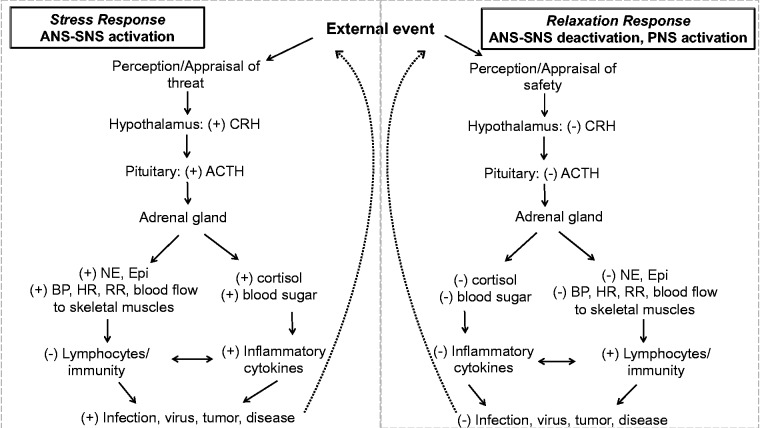
Mind-body medicine is an evidence-based approach to health and healing that focuses on interactions between the mind, body, and behavior. It encompasses a wide range of interventions that are similar yet different in meaningful ways. Mindfulness and relaxation practices are 2 mind-body techniques that have similarities and differences; however, these techniques are often used or discussed interchangeably, such that the differences between them become obscured. A greater understanding of the unique facets of mindfulness and relaxation is needed for researchers and clinicians to make informed decisions when selecting an approach. The purpose of the current article is to offer an evidence-informed perspective on similarities and differences between mindfulness and relaxation. Specifically, mindfulness and relaxation practices are compared and contrasted in terms of theoretical foundation, intention, and psychological and physiological effects and mechanisms. Implications for clinical practice and suggestions for future research are discussed.
身心医学是一种基于证据的健康与康复方法,专注于心理、身体和行为之间的相互作用。它涵盖了一系列干预措施,这些干预措施在有意义的方面既有相似之处又有不同之处。正念和放松练习是两种身心技巧,它们既有相似之处又有不同之处;然而,这些技巧经常被互换使用或讨论,以至于它们之间的差异变得模糊不清。研究人员和临床医生在选择一种方法时需要更深入地了解正念和放松的独特方面,以便做出明智的决定。本文的目的是提供一个基于证据的视角,探讨正念和放松之间的异同。具体而言,将从理论基础、意图以及心理和生理影响及机制方面对正念和放松练习进行比较和对比。还将讨论对临床实践的启示以及对未来研究的建议。