Department of Medicine, The University of Chicago, Chicago, IL 60637, USA.
Center for Circadian and Sleep Medicine, Department of Neurology, Northwestern University Feinberg School of Medicine, Chicago, IL 60611, USA.
Nutrients. 2020 Feb 16;12(2):503. doi: 10.3390/nu12020503.
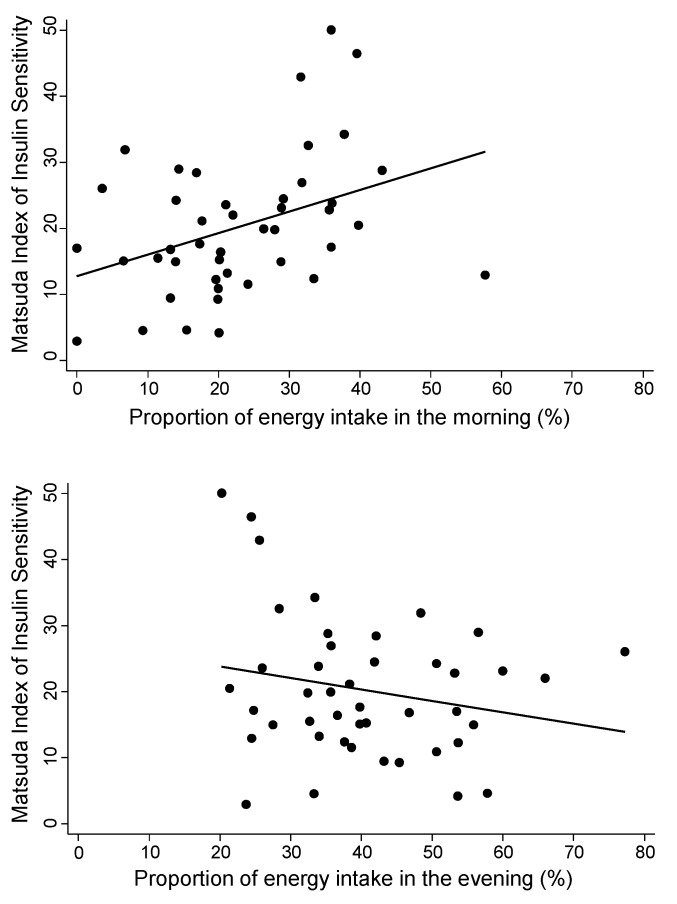
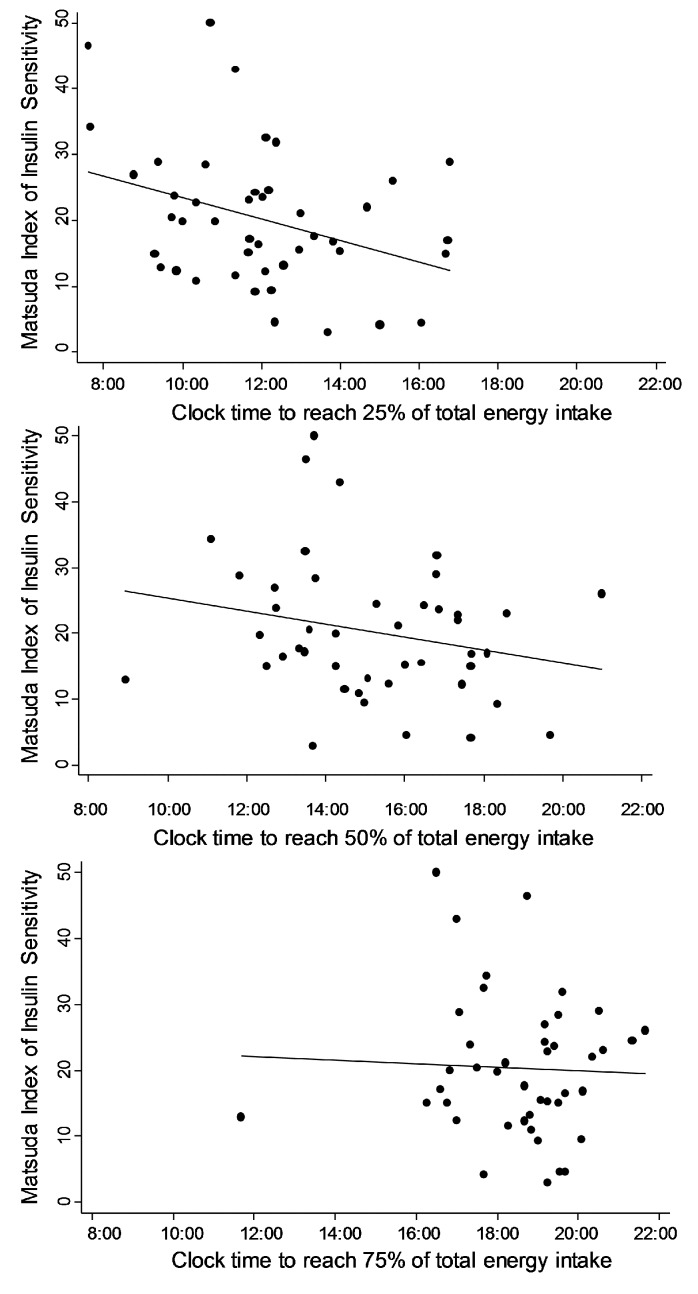
In addition to the caloric and macronutrient composition of meals, timing of energy consumption may be important for optimal glucose metabolism. Our goal was to examine whether the habitual timing of energy intake was associated with insulin sensitivity in healthy volunteers. Volunteers without diabetes aged 21-50 years completed a 3-day food diary and underwent an oral glucose tolerance test to estimate insulin sensitivity ( = 44). From the food diary, we calculated the proportions of the total energy and macronutrients consumed in the morning and evening, and the clock time at which 25%, 50% and 75% of total energy was consumed. A greater proportion of energy intake in the morning was significantly associated with higher insulin sensitivity estimated by Matsuda Index (B = 2.8 per 10%; 95%CI: 0.3, 5.2). The time at which 25% of energy was consumed was associated with insulin sensitivity estimated by Matsuda Index (B = -1.6 per hour; 95%CI: -3.0, -0.3) and QUICKI (B = -1.4 per hour, 95%CI: -2.8, -0.1). The timing of carbohydrate consumption demonstrated similar associations. Greater energy intake earlier in the day was associated with higher insulin sensitivity in individuals without diabetes.
除了膳食的热量和宏量营养素组成外,能量消耗的时间可能对最佳葡萄糖代谢也很重要。我们的目标是研究健康志愿者的习惯性能量摄入时间与胰岛素敏感性之间是否存在关联。无糖尿病的 21-50 岁志愿者完成了 3 天的饮食日记,并进行了口服葡萄糖耐量试验以估计胰岛素敏感性(= 44)。根据饮食日记,我们计算了早晨和晚上摄入的总能量和宏量营养素的比例,以及摄入 25%、50%和 75%总能量的时钟时间。早晨摄入的能量比例与通过 Matsuda 指数估计的胰岛素敏感性呈显著正相关(B = 2.8%;95%CI:0.3,5.2)。摄入 25%能量的时间与通过 Matsuda 指数(B = -1.6 小时;95%CI:-3.0,-0.3)和 QUICKI(B = -1.4 小时,95%CI:-2.8,-0.1)估计的胰岛素敏感性相关。碳水化合物消耗的时间也表现出类似的关联。一天中早些时候摄入更多的能量与无糖尿病个体的胰岛素敏感性升高有关。