Li Long-Qing, Bai Zhen-Hua, Zhang Liang-Hao, Zhang Yan, Lu Xin-Chang, Zhang Yi, Liu Yong-Kui, Wen Jia, Li Jia-Zhen
Department of Orthopedic Surgery, The First Affiliated Hospital of Zhengzhou University, Zhengzhou, China.
Department of Urology, The First Affiliated Hospital of Zhengzhou University, Zhengzhou, China.
Front Oncol. 2020 Jan 30;10:30. doi: 10.3389/fonc.2020.00030. eCollection 2020.
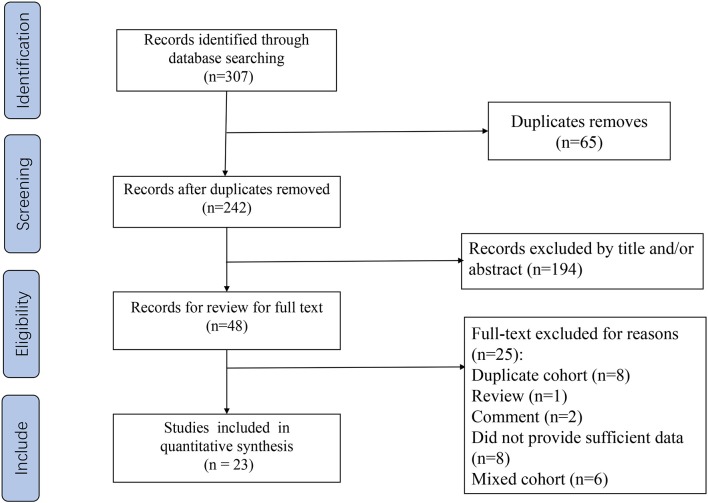
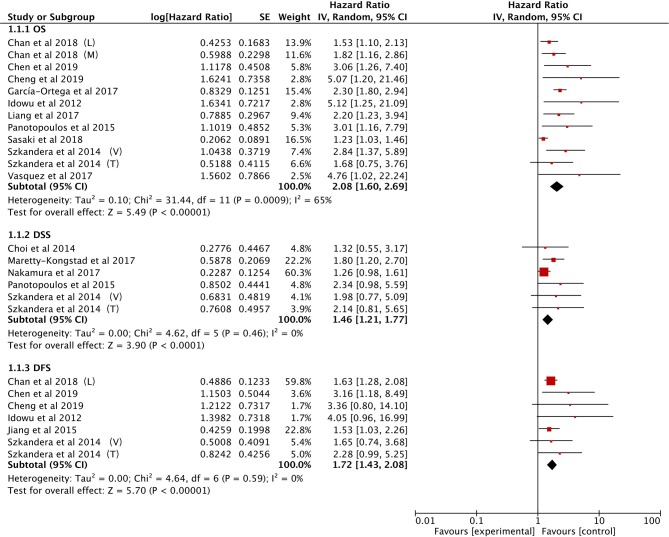
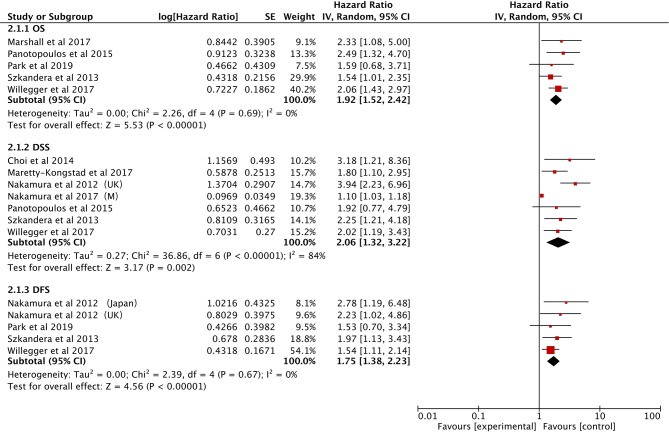
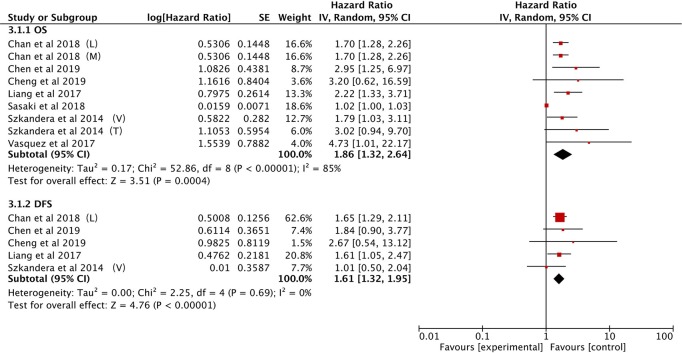
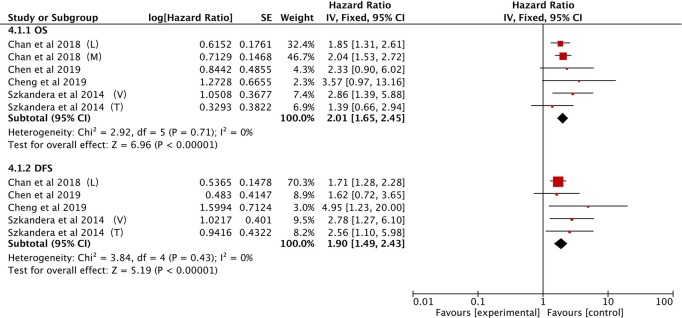
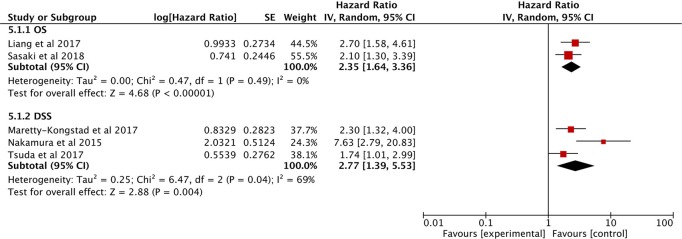
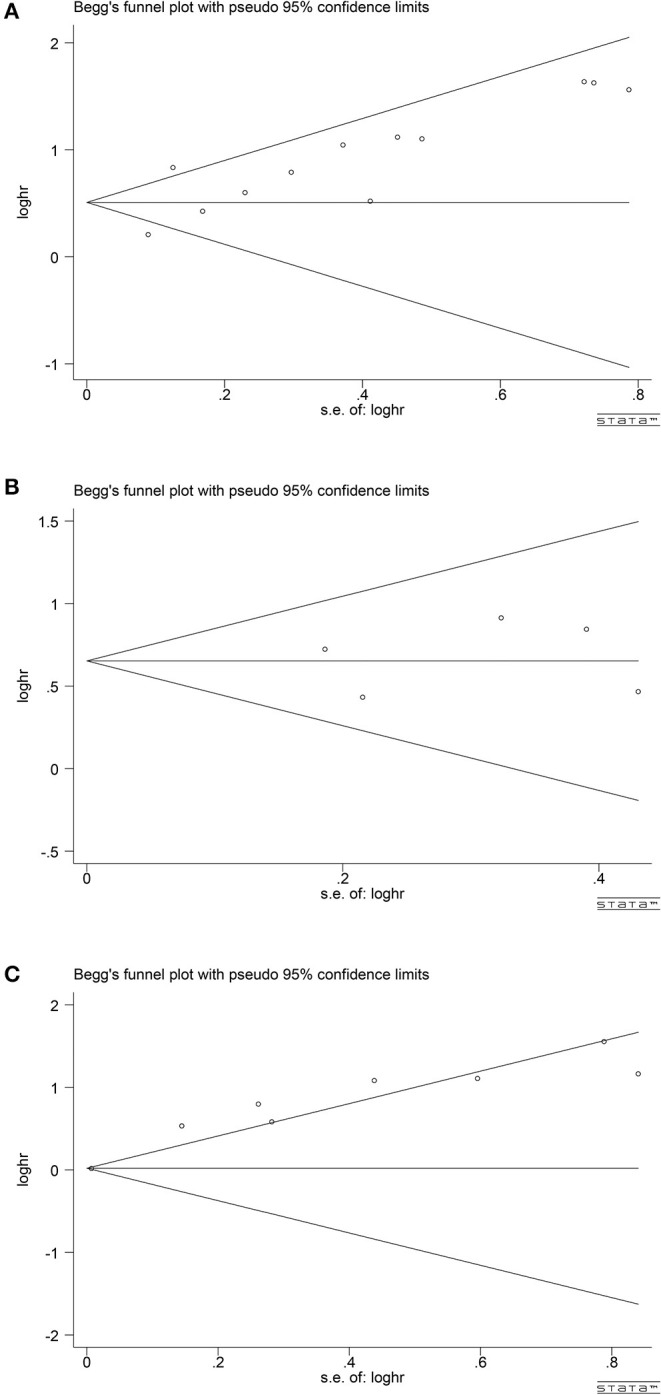
Several recent studies have reported the reliable prognostic effect of hematological biomarkers in various tumors. Yet, the prognostic value of these hematological markers in soft tissue sarcoma (STS) remains inconclusive. Thus, the aim of this meta-analysis was to check the effect of hematological markers on the prognosis of STS. We systematically searched for relevant papers published before October 2019 in the PubMed and EMBASE databases. Overall survival (OS) and disease-specific survival (DSS) were the primary outcome, whereas disease-free survival was the secondary outcome. A thorough study of hazard ratios (HR) and 95% of confidence intervals (CIs) was done for determining the prognostic significance. We performed 23 studies that comprised of 4,480 patients with STS. The results revealed that higher neutrophil-to-lymphocyte ratio (NLR), C-reactive protein (CRP), and platelet-to-lymphocyte ratio (PLR) were associated with poor OS/DFS (HR = 2.08/1.72, for NLR; HR = 1.92/1.75, for CRP, and HR = 1.86/1.61, for PLR). In contrast, a low lymphocyte-to-monocyte ratio (LMR) was relate to worse OS/DFS (HR = 2.01/1.90, for LMR). Moreover, pooled analysis illustrated that elevated NLR and CRP represents poor DSS, with HRs of 1.46 and 2.06, respectively. In addition, combined analysis revealed that higher Glasgow prognostic score (GPS) was linked to an adverse OS/DSS (HR = 2.35/2.77). Our meta-analysis suggested that hematological markers (NLR, CRP, PLR, LMR, and GPS) are one of the important prognostic indicators for patients affected by high-grade STS and patients with the STS being located in the extremity.
最近的几项研究报告了血液生物标志物在各种肿瘤中具有可靠的预后作用。然而,这些血液标志物在软组织肉瘤(STS)中的预后价值仍尚无定论。因此,本荟萃分析的目的是检验血液标志物对STS预后的影响。我们系统检索了截至2019年10月在PubMed和EMBASE数据库中发表的相关论文。总生存期(OS)和疾病特异性生存期(DSS)是主要结局,而无病生存期是次要结局。通过对风险比(HR)和95%置信区间(CI)进行全面研究来确定预后意义。我们纳入了23项研究,共4480例STS患者。结果显示,较高的中性粒细胞与淋巴细胞比值(NLR)、C反应蛋白(CRP)和血小板与淋巴细胞比值(PLR)与较差的OS/DFS相关(NLR的HR = 2.08/1.72;CRP的HR = 1.92/1.75;PLR的HR = 1.86/1.61)。相反,较低的淋巴细胞与单核细胞比值(LMR)与较差的OS/DFS相关(LMR的HR = 2.01/1.90)。此外,汇总分析表明,NLR和CRP升高代表DSS较差,HR分别为1.46和2.06。另外,综合分析显示,较高的格拉斯哥预后评分(GPS)与不良的OS/DSS相关(HR = 2.35/2.77)。我们的荟萃分析表明,血液标志物(NLR、CRP、PLR、LMR和GPS)是高级别STS患者和四肢STS患者重要的预后指标之一。