Fujimori Haruka, Hyodo Mai, Matsuno Yusuke, Shimizu Atsuhiro, Minakawa Yusuke, Atsumi Yuko, Nakatsu Yoshimichi, Tsuzuki Teruhisa, Murakami Yasufumi, Yoshioka Ken-Ichi
Division of Carcinogenesis and Cancer Prevention, National Cancer Center Research Institute, Tsukiji, Chuo-ku, Tokyo, 104-0045, Japan.
Biological Science and Technology, Tokyo University of Science, 6-1-1 Niijuku, Katsushika-ku, Tokyo, 125-8585, Japan.
Heliyon. 2019 Dec 24;5(12):e03057. doi: 10.1016/j.heliyon.2019.e03057. eCollection 2019 Dec.
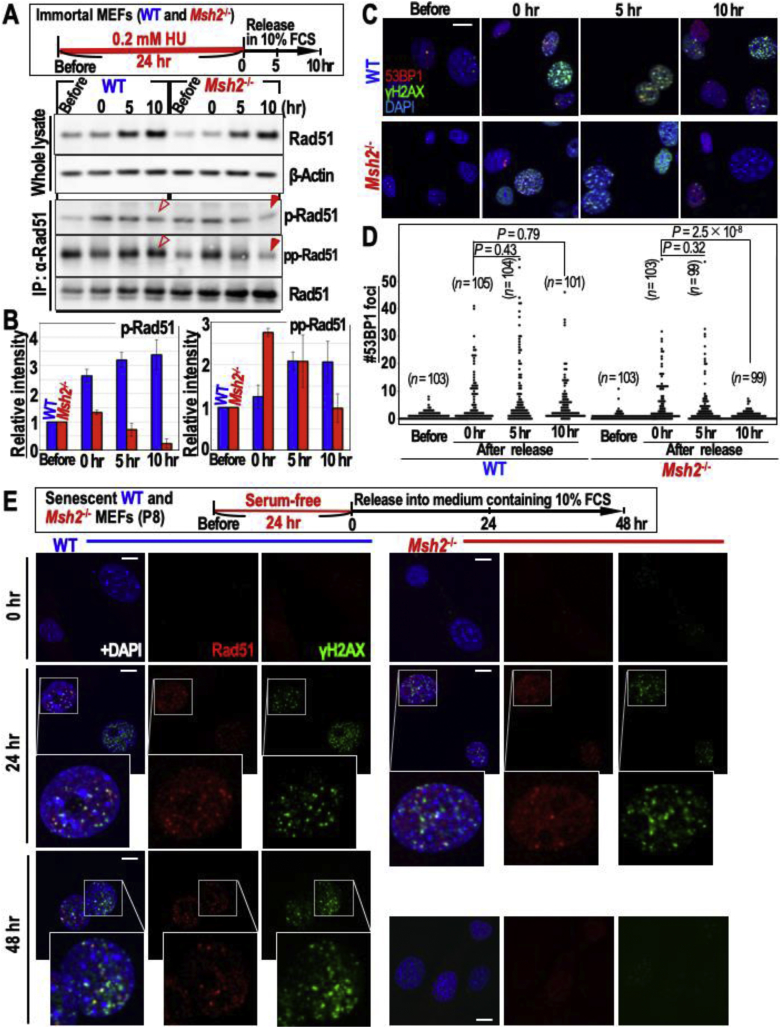
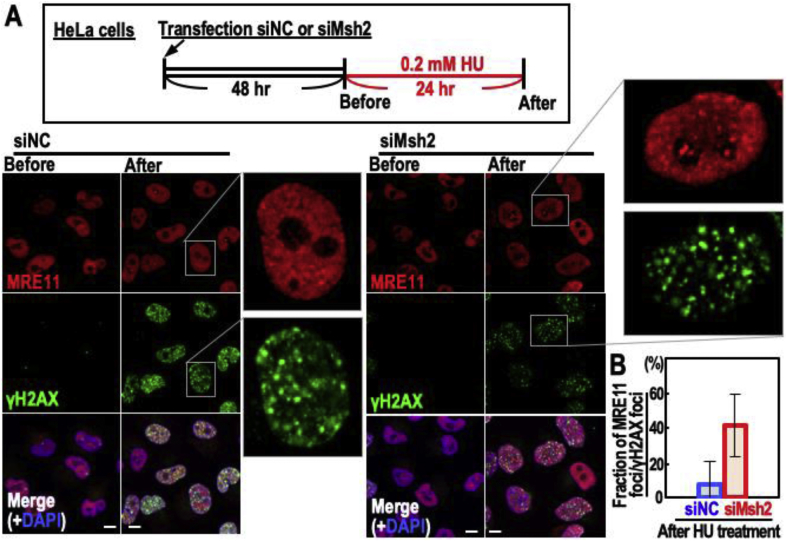
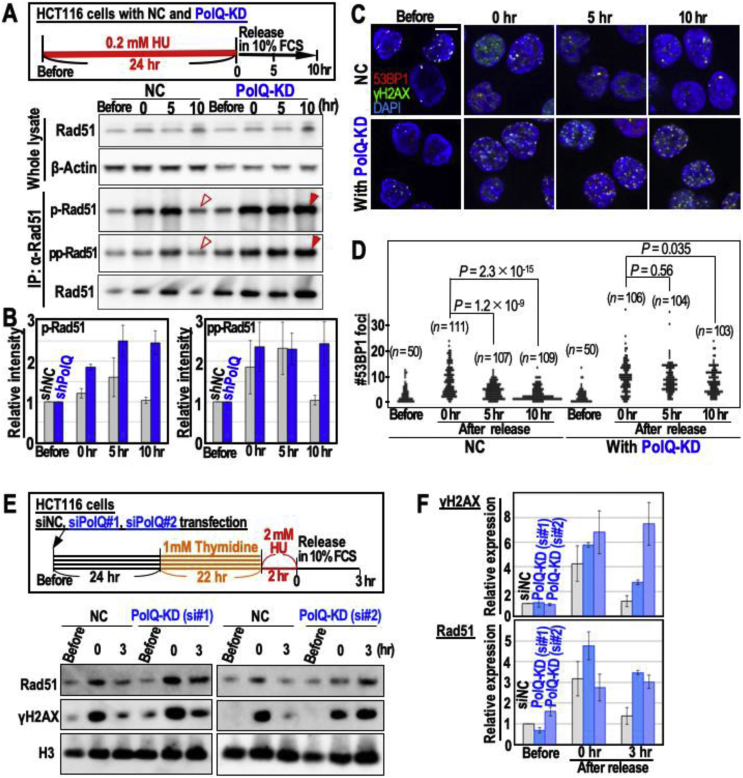
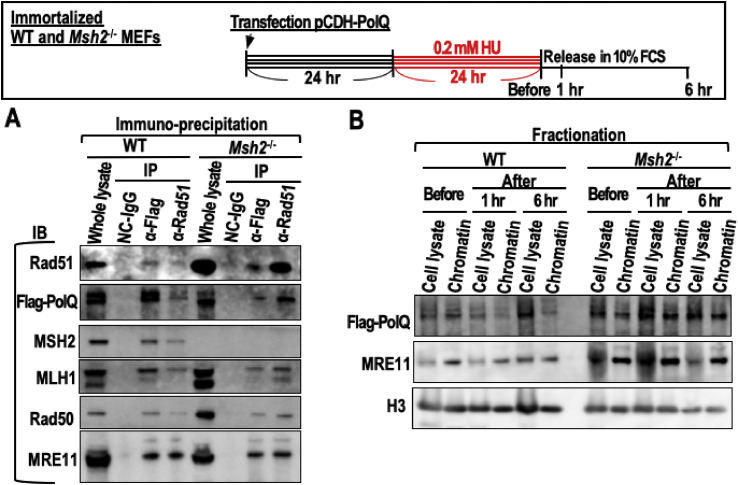
Most cancers develop with one of two types of genomic instability, namely, chromosomal instability (CIN) or microsatellite instability (MSI). Both are induced by replication stress-associated DNA double-strand breaks (DSBs). The type of genomic instability that arises is dependent on the choice of DNA repair pathway. Specifically, MSI is induced via a PolQ-dependent repair pathway called microhomology-mediated end joining (MMEJ) in a mismatch repair (MMR)-deficient background. However, it is unclear how the MMR status determines the choice of DSB repair pathway. Here, we show that replication stress-associated DSBs initially targeted by the homologous recombination (HR) system were subsequently hijacked by PolQ-dependent MMEJ in MMR-deficient cells, but persisted as HR intermediates in MMR-proficient cells. PolQ interacting with MMR factors was effectively loaded onto damaged chromatin in an MMR-deficient background, in which merged MRE11/γH2AX foci also effectively formed. Thus, the choice of DNA repair pathway according to the MMR status determines whether CIN or MSI is induced.
大多数癌症是由两种基因组不稳定类型之一发展而来的,即染色体不稳定(CIN)或微卫星不稳定(MSI)。两者均由复制应激相关的DNA双链断裂(DSB)诱导产生。出现的基因组不稳定类型取决于DNA修复途径的选择。具体而言,在错配修复(MMR)缺陷背景下,MSI是通过一种称为微同源性介导的末端连接(MMEJ)的依赖于PolQ的修复途径诱导产生的。然而,目前尚不清楚MMR状态如何决定DSB修复途径的选择。在这里,我们表明,在MMR缺陷细胞中,最初由同源重组(HR)系统靶向的复制应激相关DSB随后被依赖于PolQ的MMEJ劫持,但在MMR功能正常的细胞中则作为HR中间体持续存在。在MMR缺陷背景下,与MMR因子相互作用的PolQ有效地加载到受损染色质上,在该背景下也有效地形成了合并的MRE11/γH2AX病灶。因此,根据MMR状态选择DNA修复途径决定了是诱导CIN还是MSI。