National Clinical Scholars Program, Institute for Healthcare Policy and Innovation, University of Michigan, Ann Arbor.
Department of Emergency Medicine, University of Michigan Medical School, Ann Arbor.
JAMA Netw Open. 2020 Feb 5;3(2):e1920511. doi: 10.1001/jamanetworkopen.2019.20511.
Women and black physicians encounter workplace challenges because of their gender and race. It is unclear whether these individuals are assessed with lower patient satisfaction or confidence ratings compared with white male physicians.
To examine whether physician gender and race affect participant ratings in scenarios in which physician competence is challenged.
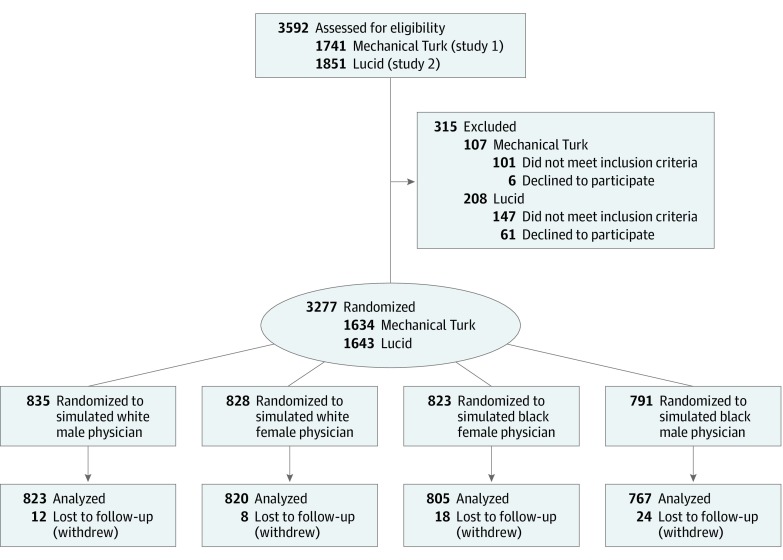
DESIGN, SETTING, AND PARTICIPANTS: This randomized trial enrolled a geographically diverse sample of 3592 online respondents in the United States who were recruited from 2 crowdsourcing platforms: Amazon Mechanical Turk (n = 1741) and Lucid (n = 1851). A 2 × 2 factorial design for the gender and race of simulated physicians was conducted between March 9 and July 25, 2018. Participants were excluded before intervention if they were younger than 18 years, were pregnant, or had a history of cancer or abdominal surgical procedures.
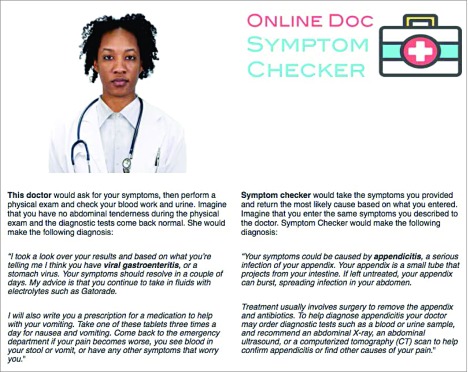
A clinical vignette was presented to the participant with a picture of the emergency department physician. Participants were randomly assigned to physicians with different gender and race, with 823 assigned to black women, 791 to black men, 828 to white women, and 835 to white men. A contradictory diagnosis from an online symptom checker introduced doubt about the clinical diagnosis.
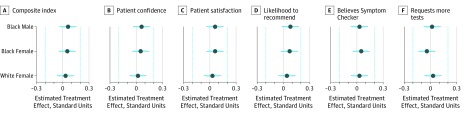
A composite outcome (range, 0-100, with 0 representing low patient confidence and satisfaction and 100 representing the maximum on the composite scale) measured participant (1) confidence in the physician, (2) satisfaction with care, (3) likelihood to recommend the physician, (4) trust in the physician's diagnosis, and (5) likelihood to request additional tests.
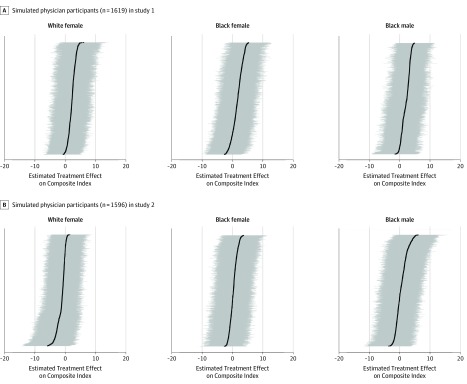
Among 3277 adult participants, complete data were available for 3215 (median age, 49 years [range, 18-89 years]; 1667 [52%] female; 2433 [76%] white). No significant differences were observed in participant satisfaction and physician confidence for the white male physician control physicians (mean composite score, 66.13 [95% CI, 64.76-67.51]) compared with white female (mean composite score, 66.50 [95% CI, 65.19-67.82]), black female (mean composite score, 67.36 [95% CI, 66.03-68.69]), and black male (mean composite score, 66.96 [95% CI, 65.55-68.36]) physicians. Machine learning with bayesian additive regression trees revealed no evidence of treatment effect heterogeneity as a function of participants' race, gender, racial prejudice, or sexism.
No significant differences were observed for simulated patients' evaluations of female or black physicians, suggesting that bias in favor of white male physicians is negligible in survey-based measures of patient satisfaction.
ClinicalTrials.gov Identifier: NCT04190901.
由于性别和种族原因,女性和黑人医生在工作场所面临挑战。目前尚不清楚与白人男医生相比,这些医生的患者满意度或信任评分是否较低。
检查医生的性别和种族是否会影响在挑战医生能力的情况下参与者的评分。
设计、设置和参与者:这项随机试验在美国招募了来自两个众包平台的 3592 名在线受访者,这是一个地理位置多样化的样本:亚马逊土耳其机器人(n=1741)和 Lucid(n=1851)。2018 年 3 月 9 日至 7 月 25 日进行了模拟医生性别和种族的 2×2 析因设计。如果参与者年龄小于 18 岁、怀孕、或有癌症或腹部手术史,则在干预前将其排除在外。
向参与者呈现急诊科医生的临床描述。参与者被随机分配到不同性别和种族的医生,其中 823 名分配给黑人女性,791 名分配给黑人男性,828 名分配给白人女性,835 名分配给白人男性。来自在线症状检查器的矛盾诊断对临床诊断产生了怀疑。
一个复合结果(范围,0-100,0 表示患者信心和满意度低,100 表示复合量表上的最大值)衡量了参与者(1)对医生的信心,(2)对护理的满意度,(3)推荐医生的可能性,(4)对医生诊断的信任,以及(5)要求进行额外检查的可能性。
在 3277 名成年参与者中,有 3215 名(中位数年龄为 49 岁[范围,18-89 岁];1667 名[52%]为女性;2433 名[76%]为白人)提供了完整数据。与白人男性对照医生(平均综合评分 66.13[95%CI,64.76-67.51])相比,白人女性(平均综合评分 66.50[95%CI,65.19-67.82])、黑人女性(平均综合评分 67.36[95%CI,66.03-68.69])和黑人男性(平均综合评分 66.96[95%CI,65.55-68.36])医生的患者满意度和医生信心评分没有显著差异。贝叶斯加法回归树的机器学习显示,作为参与者种族、性别、种族偏见或性别歧视的函数,没有证据表明治疗效果存在异质性。
模拟患者对女性或黑人医生的评估没有显著差异,这表明在基于调查的患者满意度衡量标准中,对白种男性医生的偏见可以忽略不计。
ClinicalTrials.gov 标识符:NCT04190901。