Department of Dermatology, Perelman School of Medicine at the University of Pennsylvania, Philadelphia.
Department of Biostatistics, Epidemiology and Informatics, Perelman School of Medicine at the University of Pennsylvania, Philadelphia.
JAMA Netw Open. 2020 Nov 2;3(11):e2024583. doi: 10.1001/jamanetworkopen.2020.24583.
The Press Ganey Outpatient Medical Practice Survey is used to measure the patient experience. An understanding of the patient- and physician-related determinants of the patient experience may help identify opportunities to improve health care delivery and physician ratings.
To evaluate the associations between the patient experience as measured by scores on the Press Ganey survey and patient-physician racial/ethnic and gender concordance.
DESIGN, SETTING, AND PARTICIPANTS: A cross-sectional analysis of Press Ganey surveys returned for outpatient visits within the University of Pennsylvania Health System between 2014 and 2017 was performed. Participants included adult patient and physician dyads for whom surveys were returned. Data analysis was performed from January to June 2019.
Patient-physician racial/ethnic and gender concordance.
The primary outcome was receipt of the maximum score for the "likelihood of your recommending this care provider to others" question in the Care Provider domain of the Press Ganey survey. Secondary outcomes included each of the remaining 9 questions in the Care Provider domain. Generalized estimating equations clustering on physicians with exchangeable intracluster correlations and cluster-robust standard errors were used to investigate associations between the outcomes and patient-physician racial/ethnic and gender concordance.
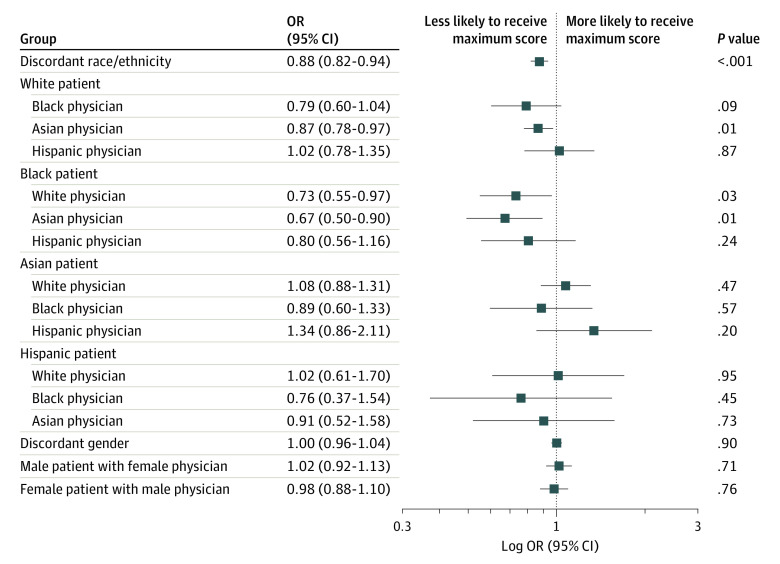
In total, 117 589 surveys were evaluated, corresponding to 92 238 unique patients (mean [SD] age, 57.7 [15.6] years; 37 002 men [40.1%]; 75 307 White patients [81.6%]) and 747 unique physicians (mean [SD] age 45.5 [10.6] years; 472 men [63.2%]; 533 White physicians [71.4%]). Compared with racially/ethnically concordant patient-physician dyads, discordance was associated with a lower likelihood of physicians receiving the maximum score (adjusted odds ratio [OR], 0.88; 95% CI, 0.82-0.94; P < .001). Black (adjusted OR, 0.73; 95% CI, 0.68-0.78; P < .001) and Asian (adjusted OR, 0.55; 95% CI, 0.50-0.60; P < .001) patient race were both associated with lower patient experience ratings. Patient-physician gender concordance was not associated with Press Ganey scores (adjusted OR, 1.00; 95% CI, 0.96-1.04; P = .90).
In this study, higher Press Ganey survey scores were associated with racial/ethnic concordance between patients and their physicians. Efforts to improve physician workforce diversity are imperative. Delivery of health care in a culturally mindful manner between racially/ethnically discordant patient-physician dyads is also essential. Furthermore, Press Ganey scores may differ by a physician's patient demographic mix; thus, care must be taken when publicly reporting or using Press Ganey scores to evaluate physicians on an individual level.
盖洛普门诊医疗实践调查用于衡量患者体验。了解患者和医生相关因素对患者体验的影响,可能有助于发现改善医疗服务提供和医生评分的机会。
评估患者体验(由盖洛普调查的评分衡量)与患者-医生种族/民族和性别一致性之间的关联。
设计、设置和参与者:对 2014 年至 2017 年间宾夕法尼亚大学卫生系统门诊就诊的盖洛普调查返回情况进行了横断面分析。参与者包括返回调查的成年患者和医生二人组。数据分析于 2019 年 1 月至 6 月进行。
患者-医生的种族/民族和性别一致性。
主要结局是在盖洛普调查的“提供者”域中,“您向他人推荐该护理提供者的可能性”问题获得最高分。次要结局包括“提供者”域中其余 9 个问题中的每个问题。使用广义估计方程对医生进行聚类,具有可交换的群内相关和群集稳健标准误差,以调查结果与患者-医生种族/民族和性别一致性之间的关联。
共评估了 117589 份调查,对应于 92238 名(平均[SD]年龄 57.7[15.6]岁;37002 名男性[40.1%];75307 名白人患者[81.6%])和 747 名独特的医生(平均[SD]年龄 45.5[10.6]岁;472 名男性[63.2%];533 名白人医生[71.4%])。与种族/民族一致的患者-医生二人组相比,不一致与医生获得最高分的可能性较低有关(调整后的优势比[OR],0.88;95%置信区间,0.82-0.94;P < 0.001)。黑人(调整后的 OR,0.73;95%置信区间,0.68-0.78;P < 0.001)和亚洲人(调整后的 OR,0.55;95%置信区间,0.50-0.60;P < 0.001)的患者种族均与较低的患者体验评分相关。患者-医生性别一致性与盖洛普评分无关(调整后的 OR,1.00;95%置信区间,0.96-1.04;P = 0.90)。
在这项研究中,较高的盖洛普调查评分与患者和医生之间的种族/民族一致性相关。必须努力提高医生劳动力的多样性。在种族/民族不一致的患者-医生二人组之间以文化意识的方式提供医疗保健也至关重要。此外,盖洛普评分可能因医生的患者人群组合而异;因此,在个人层面上公开报告或使用盖洛普评分来评估医生时,必须谨慎对待。
