Ministry of Health of Eritrea/Health Research and Resources Centre Division, Asmara, Eritrea.
Oxford University Clinical Research Unit, Oxford, UK.
BMC Public Health. 2020 Feb 22;20(1):267. doi: 10.1186/s12889-020-8281-0.
Although vaccination coverage in Eritrea has improved in recent years, some children are still missing out, and it's important to identify risk factors for lower coverage in order to target campaigns and interventions. The objective of this study was to assess: (1) the impact of maternal education on full immunization of children aged 12-23 months, and (2) whether the association was confounded or modified by other factors.
This study was a secondary data analysis of the Eritrean Population and Health Survey 2010 (EPHS 2010). In this analysis 1323 mothers of children aged 12-23 months were included. The outcome of the study was full immunization, defined as receiving all the WHO recommended basic vaccines: one dose of Bacillus Calmette-Gué rin (BCG), three doses of diphtheria-pertussis-tetanus(DPT), three doses of polio, and one dose of measles vaccine. The primary exposure was maternal education. Data on immunization coverage came from vaccination cards and from mothers' or caretakers' verbal reports. Bivariate and multivariable logistic regression analyses were performed.
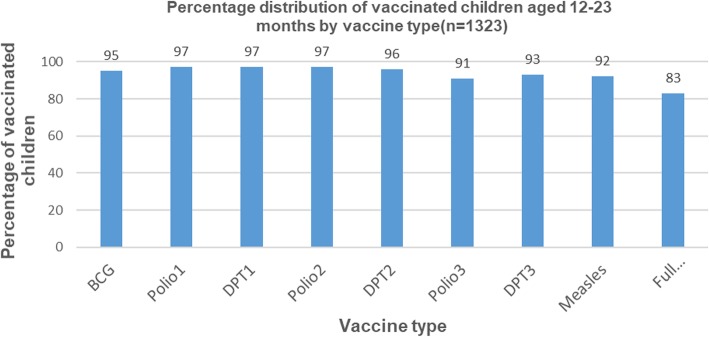
Full vaccination coverage among children aged 12-23 months was 83%. Most children received BCG (95%), DPT1 (97%), DPT2 (96%), DPT3 (93%), polio1 (97%), polio2 (97%), polio3 (91%) and measles (92%). In unadjusted analyses, children of mothers with primary (OR = 2.75, 95% CI 1.74-4.37), and middle or above (OR = 3.16, 95% CI 2.09-4.78) education were more likely to be fully immunised. However, after adjusting for wealth, region, ANC visit, and vaccination card ownership, only the effect for primary education remained significant (OR = 2.34, 95% CI 1.30-4.21).
The result of this study suggested that children of mothers who attained primary level were more likely to be fully vaccinated than children of mothers with no education. The association was influenced by wealth index of household, mothers ANC visit, region, and possession of vaccination card. The Expanded Program on Immunization of the Ministry of Health should target strategies to enhance full immunization among children of mothers with no education.
尽管近年来厄立特里亚的疫苗接种覆盖率有所提高,但仍有一些儿童未接种疫苗,因此确定低覆盖率的风险因素以针对疫苗接种运动和干预措施非常重要。本研究的目的是评估:(1)母亲教育程度对 12-23 月龄儿童完全免疫接种的影响;(2)这种关联是否受到其他因素的混杂或修饰。
本研究是对 2010 年厄立特里亚人口与健康调查(EPHS 2010)的二次数据分析。在本分析中,包括了 1323 名 12-23 月龄儿童的母亲。本研究的结局是完全免疫接种,定义为接受世界卫生组织推荐的所有基本疫苗:一剂卡介苗(BCG)、三剂白喉-百日咳-破伤风(DPT)、三剂脊髓灰质炎和一剂麻疹疫苗。主要暴露因素是母亲的教育程度。免疫接种覆盖率的数据来自疫苗接种卡和母亲或照顾者的口头报告。进行了单变量和多变量逻辑回归分析。
12-23 月龄儿童的完全疫苗接种覆盖率为 83%。大多数儿童接种了 BCG(95%)、DPT1(97%)、DPT2(96%)、DPT3(93%)、脊髓灰质炎 1 型(97%)、脊髓灰质炎 2 型(97%)、脊髓灰质炎 3 型(91%)和麻疹(92%)。在未调整分析中,母亲接受过小学(OR=2.75,95%CI 1.74-4.37)和中学或以上(OR=3.16,95%CI 2.09-4.78)教育的儿童更有可能完全免疫接种。然而,在调整了财富、地区、ANC 就诊和疫苗接种卡拥有情况后,只有小学教育的影响仍然显著(OR=2.34,95%CI 1.30-4.21)。
本研究结果表明,母亲接受过小学教育的儿童比没有接受过教育的母亲的儿童更有可能完全接种疫苗。这种关联受到家庭的财富指数、母亲的 ANC 就诊、地区和疫苗接种卡的影响。卫生部的扩大免疫规划应针对提高没有接受过教育的母亲的儿童完全免疫接种率的策略。