Keller Ronald, Mazurak Nazar, Fantasia Laura, Fusco Stefano, Malek Nisar P, Wehkamp Jan, Enck Paul, Klag Thomas
Division of Gastroenterology, Hepatology, Infectious Diseases, Department of Internal Medicine I, University Hospital Tübingen, Tübingen, Germany.
Division of Psychosomatic Medicine and Psychotherapy, Department of Internal Medicine VI, University Hospital Tübingen, Tübingen, Germany.
Intest Res. 2021 Jan;19(1):45-52. doi: 10.5217/ir.2019.00135. Epub 2020 Feb 27.
BACKGROUND/AIMS: The inflammatory bowel diseases (IBD), ulcerative colitis (UC), and Crohn's disease (CD) are chronic diseases mostly affecting young patients. As they are diseases accompanying patients for their entire life, and the quality of life (QUOL) interacts with disease activity, improving QUOL should be one of the main goals of therapy. This study aims to identify factors contributing to good or impaired QUOL.
Questionnaires addressing health-related QUOL and other psychological and social features were positioned on our institutions' webpage and on the webpage of the largest self-help group for IBD in Germany. Patients were subdivided according to their QUOL score with a cutoff of <60. We used the Short Inflammatory Bowel Disease Questionnaire, the Assessment of the Demand for Additional Psychological Treatment, and the Fear of Progression Questionnaire Short Form.
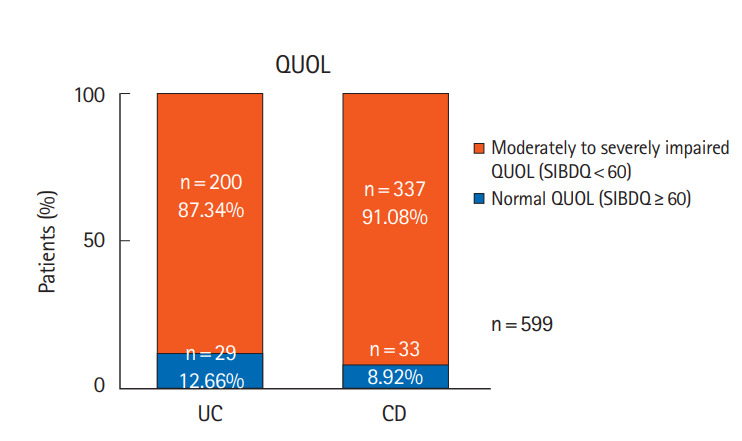
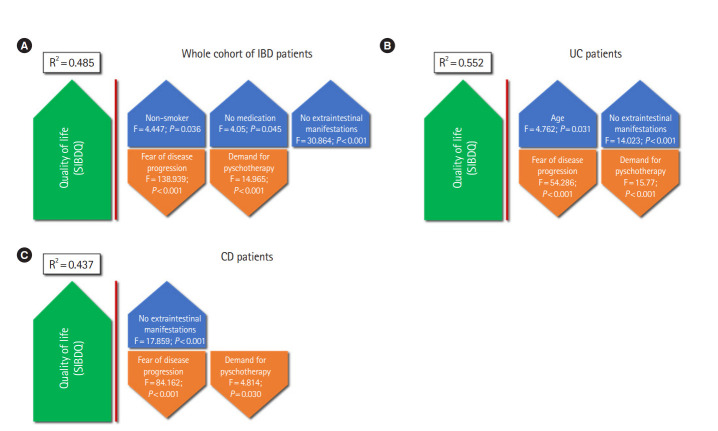
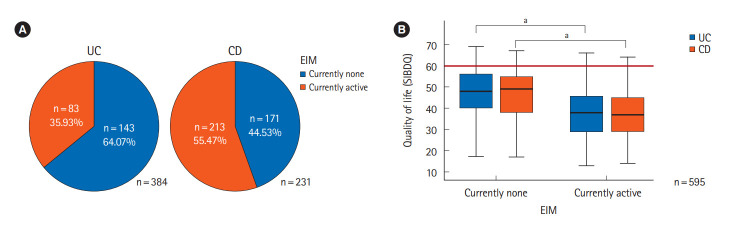
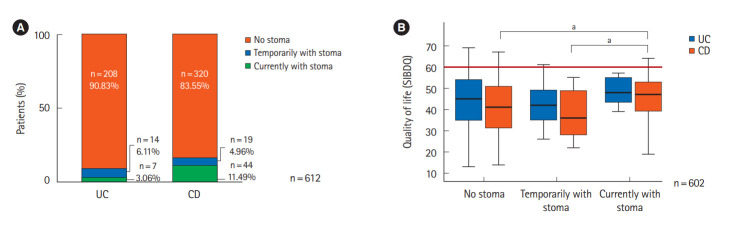
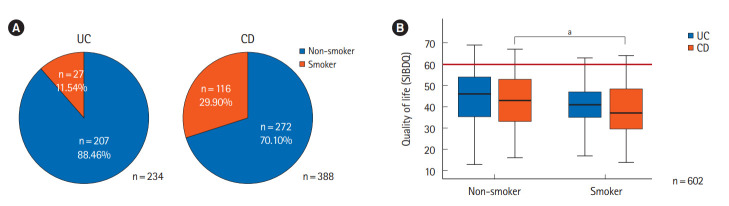
High numbers of patients in both subgroups showed an impaired QUOL (87.34% in UC, 91.08% in CD). Active extraintestinal manifestations, smoking, high fear of progression and high demand for psychotherapy were associated with reduced QUOL. In addition, polypharmacological interventions did not result in a good QUOL, but ostomies are linked to improved QUOL especially in CD patients.
Scores used in clinical day-to-day-practice mainly focusing on somatic factors do not sufficiently address important aspects concerning QUOL. Most importantly, extraintestinal manifestations show a hitherto underestimated impact on QUOL.
背景/目的:炎症性肠病(IBD)、溃疡性结肠炎(UC)和克罗恩病(CD)是主要影响年轻患者的慢性疾病。由于这些疾病会伴随患者一生,且生活质量(QUOL)与疾病活动相互影响,因此改善生活质量应是治疗的主要目标之一。本研究旨在确定影响生活质量良好或受损的因素。
关于健康相关生活质量以及其他心理和社会特征的问卷发布在我们机构的网页以及德国最大的IBD自助组织的网页上。患者根据其生活质量得分进行细分,临界值为<60。我们使用了简短炎症性肠病问卷、额外心理治疗需求评估问卷和恐惧进展问卷简表。
两个亚组中都有大量患者的生活质量受损(UC组为87.34%,CD组为91.08%)。肠道外活动表现、吸烟、对疾病进展的高度恐惧以及对心理治疗的高需求与生活质量降低相关。此外,多种药物干预并未带来良好的生活质量,但造口术与生活质量改善有关,尤其是在CD患者中。
临床日常实践中使用的主要关注躯体因素的评分未能充分涵盖生活质量的重要方面。最重要的是,肠道外表现对生活质量的影响迄今被低估。