Discipline of Anatomy and Histology, School of Medical Sciences, Faculty of Medicine and Health, The University of Sydney, Camperdown, Australia.
Redox Rep. 2020 Dec;25(1):11-16. doi: 10.1080/13510002.2020.1731261.
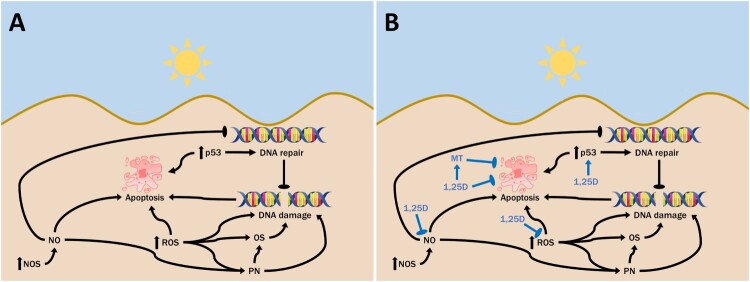
The active vitamin D compound, 1,25-dihydroxyvitamin D3 (1,25D) is produced in skin cells following exposure to ultraviolet radiation (UV) from the sun. However, there are many harmful effects of UV which include DNA damage caused by direct absorption of UV, as well as that caused indirectly via UV-induced reactive oxygen species (ROS). Interestingly, 1,25D and analogs have been shown to reduce both direct and indirect UV-induced DNA damage in skin cells. This was accompanied by reductions in ROS and in nitric oxide products with 1,25D following UV. Moreover, following acute UV exposure, 1,25D has been demonstrated to increase p53 levels in skin, which would presumably allow for repair of cells with damaged DNA, or apoptosis of cells with irreparably damaged DNA. Previous studies have also shown that p53 reduces intracellular ROS. Furthermore, 1,25D has been shown to induce metallothioneins, which are potent free radical scavengers. In addition to these protective effects, 1,25D has been demonstrated to inhibit stress-activated c-Jun N-terminal kinases following UV exposure, and to increase levels of the stress-induced protein heme oxygenase-1 in a model of oxidative stress. Herein, we discuss the protective effects of 1,25D and analogs in the context of UV, oxidative stress and skin cancer.
活性维生素 D 化合物 1,25-二羟维生素 D3(1,25D)在皮肤细胞暴露于太阳紫外线(UV)后产生。然而,UV 有许多有害影响,包括直接吸收 UV 引起的 DNA 损伤,以及间接通过 UV 诱导的活性氧(ROS)引起的损伤。有趣的是,1,25D 和类似物已被证明可减少皮肤细胞中直接和间接的 UV 诱导的 DNA 损伤。这伴随着 ROS 和一氧化氮产物的减少,而 1,25D 则跟随 UV。此外,在急性 UV 暴露后,1,25D 已被证明可增加皮肤中的 p53 水平,这可能允许对具有受损 DNA 的细胞进行修复,或对具有不可修复 DNA 损伤的细胞进行凋亡。先前的研究还表明,p53 可减少细胞内 ROS。此外,1,25D 已被证明可诱导金属硫蛋白,这是一种有效的自由基清除剂。除了这些保护作用外,1,25D 已被证明可抑制 UV 暴露后应激激活的 c-Jun N-末端激酶,并增加氧化应激模型中应激诱导蛋白血红素加氧酶-1 的水平。本文讨论了 1,25D 和类似物在 UV、氧化应激和皮肤癌方面的保护作用。