Garimella Lakshmi B V S, Dhiman Tarun K, Kumar Rahul, Singh Avinash K, Solanki Pratima R
Special Centre for Nanoscience and School of Physical Sciences, Jawaharlal Nehru University, New Delhi 110067, India.
ACS Omega. 2020 Feb 7;5(6):2552-2560. doi: 10.1021/acsomega.9b01987. eCollection 2020 Feb 18.
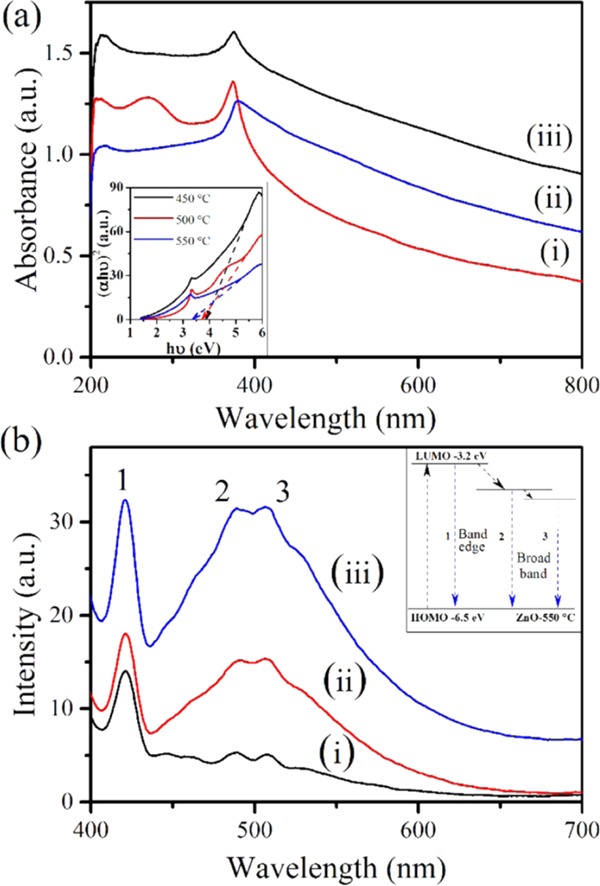
Pesticides are used in agriculture for crop production enhancement by controlling pests, but they have acute toxicological effects on other life forms. Thus, it becomes imperative to detect their concentration in food products in a fast and accurate manner. In this study, ZnO nanoparticles (ZnO nps) have been used as optical sensors for the detection of pesticide Aldicarb via a photoinduced electron transfer (PET) route. ZnO nps were synthesized directly by calcining zinc acetate at 450, 500, and 550 °C for 2 h. ZnO nps were characterized by X-ray diffraction (XRD), Raman spectroscopy, scanning electron microscopy (SEM), and UV-vis absorption and photoluminescence (PL) spectroscopies to study the phase, crystallinity, shape, morphology, absorbance, and fluorescence of the prepared ZnO nps. XRD and Raman studies confirmed the crystalline nature of ZnO nps. The average crystallite size obtained was 13-20 nm from the XRD study. The SEM study confirmed spherical-shaped ZnO nps with average sizes in the range of 70-150 nm. The maximum absorbance was obtained in the 200-500 nm regions with a prominent peak absorbance at 372 nm from UV-vis spectra. The corresponding band gap for ZnO nps was calculated using Tauc's plots and was found to be 3.8, 3.67, and 3.45 eV for the 450, 500, and 550 °C calcined samples, respectively. The fluorescence spectra showed an increase in the intensity along with the increase in the size of ZnO nps. The ZnO nps (samples calcined at 500 and 550 °C) exhibited a response toward Aldicarb, owing to their pure phase and higher PL intensity. Both the samples showed systematic detection of Aldicarb in the range of 250 pM to 2 nM (500 °C) and 250 pM to 5 nM (550 °C). Among the various quenching mechanisms, PET was found to be the dominant process for the detection of Aldicarb. This method can be used for the detection of Aldicarb in real (food) samples using a portable fluorimeter.
农药在农业中用于通过控制害虫来提高作物产量,但它们对其他生物具有急性毒理学影响。因此,快速准确地检测食品中它们的浓度变得势在必行。在本研究中,氧化锌纳米颗粒(ZnO nps)已被用作光学传感器,通过光诱导电子转移(PET)途径检测农药涕灭威。通过在450、500和550℃下煅烧醋酸锌2小时直接合成ZnO nps。通过X射线衍射(XRD)、拉曼光谱、扫描电子显微镜(SEM)以及紫外-可见吸收和光致发光(PL)光谱对ZnO nps进行表征,以研究制备的ZnO nps的相、结晶度、形状、形态、吸光度和荧光。XRD和拉曼研究证实了ZnO nps的晶体性质。从XRD研究获得的平均微晶尺寸为13 - 20nm。SEM研究证实了平均尺寸在70 - 150nm范围内的球形ZnO nps。从紫外-可见光谱在200 - 500nm区域获得最大吸光度,在372nm处有一个突出的峰值吸光度。使用陶氏图计算ZnO nps的相应带隙,发现对于在450、500和550℃煅烧的样品分别为3.8、3.67和3.45eV。荧光光谱显示随着ZnO nps尺寸的增加强度增加。ZnO nps(在500和550℃煅烧的样品)由于其纯相和更高的PL强度而对涕灭威表现出响应。两个样品都显示在250pM至2nM(500℃)和250pM至5nM(550℃)范围内对涕灭威进行系统检测。在各种猝灭机制中,发现PET是检测涕灭威的主要过程。该方法可用于使用便携式荧光计检测实际(食品)样品中的涕灭威。